 Jam
 Pickles
 Canned Vegetable
 Syrups
 Vinegar
 IQF Vegetables
 IQF Fruits
 Fruit Strip
 Iranian Foods
Wholesale Vinegar Supplier Guide: Sourcing Bulk & Industrial Vinegars for Export

This Wholesale Vinegar Supplier Guide is designed for importers, distributors, retailers and food manufacturers looking to source vinegar for wholesale distribution, food production or international export. Buying vinegar requires more than comparing prices between suppliers. Buyers need to evaluate vinegar type, acidity, raw materials, production method, packaging, certifications, documentation, minimum order quantities and the supplier’s ability to maintain consistent quality across repeated shipments.
For businesses searching for a reliable wholesale vinegar supplier, the right sourcing strategy starts by defining the exact product specification and intended application. Whether the requirement is retail-ready bottles, food-service packaging or industrial quantities, choosing a manufacturer with export experience can reduce quality and supply-chain risks.
What Should Buyers Look for in a Wholesale Vinegar Supplier?
A professional supplier should be able to provide clear information about the vinegar’s origin, ingredients, acidity, production method, shelf life, packaging and intended applications. This is particularly important when vinegar is being imported into another country, because food regulations and labeling requirements can differ between markets.
The supplier should also demonstrate that production is controlled consistently. A low quotation may not represent a lower total cost if the buyer later faces inconsistent acidity, packaging damage, labeling problems or delays in export documentation.
| Supplier Factor | What to Check | Why It Matters |
|---|---|---|
| Product specification | Vinegar type, acidity, ingredients | Confirms suitability for the application |
| Manufacturing | Production process and quality controls | Helps maintain batch consistency |
| Packaging | Bottle, drum, barrel or bulk format | Determines logistics and handling |
| Certifications | HACCP, ISO 22000 and applicable standards | Supports food-safety compliance |
| Export experience | Documentation and international logistics | Reduces import complications |
| MOQ | Minimum order quantity | Affects inventory and working capital |
| Private label | Label and packaging customization | Useful for retailers and brands |
| Shelf life | Unopened shelf life and storage conditions | Important for international distribution |
Understanding Different Types of Vinegar for Wholesale
Not every vinegar serves the same commercial purpose. Buyers should select the product based on the final application, target market and required packaging format rather than simply choosing the lowest-cost option.
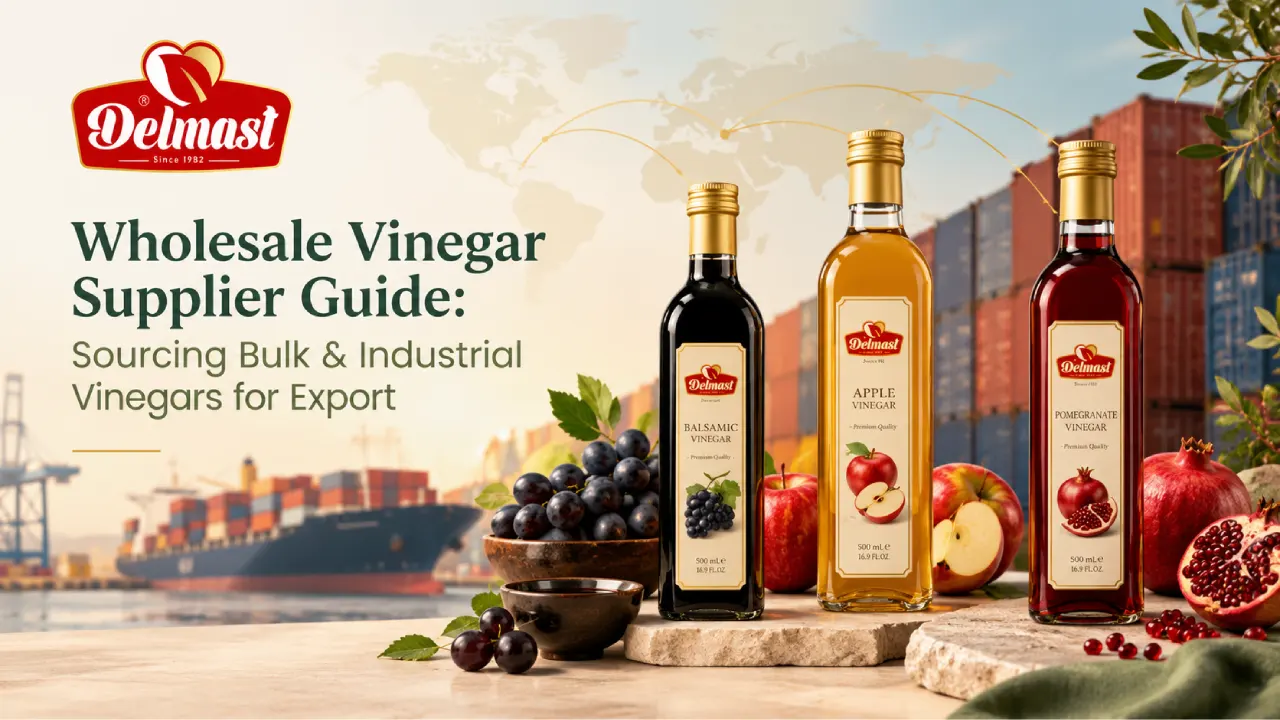
Common categories available from Delmast include apple vinegar, balsamic vinegar, date vinegar, fig vinegar and pomegranate vinegar. Codex classifies vinegars as food category 12.3 and includes products such as cider vinegar, wine vinegar, malt vinegar, spirit vinegar, grain vinegar, raisin vinegar and fruit wine vinegar as part of the broader international food classification system.
Delmast supplies these vinegar varieties for international B2B buyers in both bulk and private-label formats, making it possible for distributors, retailers and food businesses to source products under their own brand through a dedicated wholesale vinegar supplier.
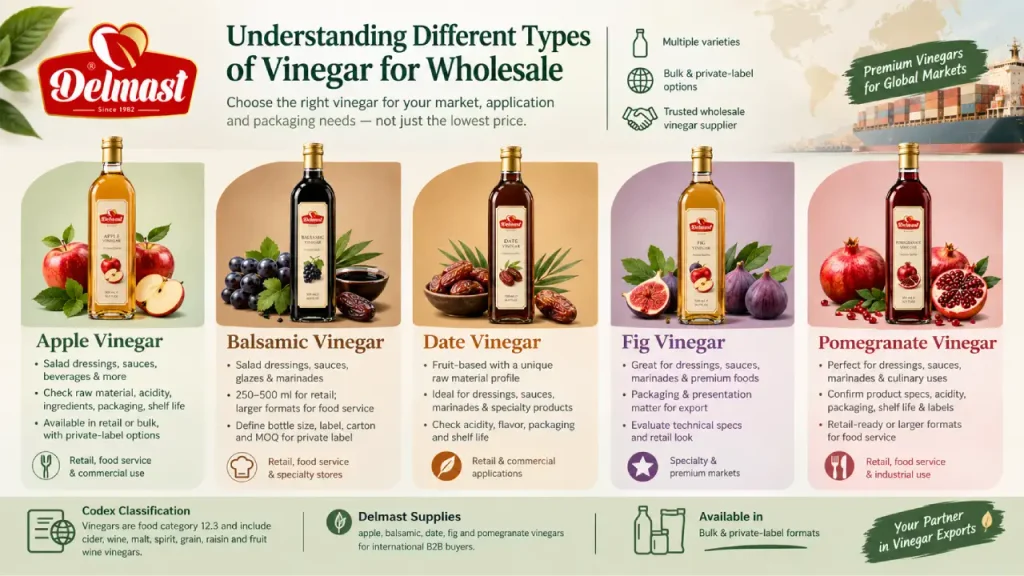
Apple Vinegar
Apple vinegar is widely used in retail food products, salad dressings, sauces, beverages and other food applications. For wholesale purchasing, buyers should confirm the raw material, production method, acidity, ingredient declaration, packaging and shelf life.
Apple vinegar can be supplied in consumer-ready bottles for supermarkets and distributors or in larger formats for food-service and commercial applications. Private-label packaging can also allow brands to introduce their own apple vinegar product without establishing an in-house manufacturing operation.
Balsamic Vinegar
Balsamic vinegar for wholesale can serve both retail and food-service markets. It is commonly used in salad dressings, sauces, glazes, marinades and restaurant applications, while premium packaging can help position the product for specialty food retailers.
Packaging can make a major difference in this segment. A supermarket brand may require 250–500 ml bottles, while a restaurant distributor or food manufacturer may need larger containers. For private-label projects, buyers should define bottle size, label specifications, carton configuration and minimum order quantity before production.
Date Vinegar
Date vinegar provides an alternative for buyers looking for a fruit-based vinegar with a distinctive raw-material profile. It can be used in dressings, sauces, marinades and other food applications, while its origin can also support specialty-food positioning in selected export markets.
For wholesale sourcing, buyers should evaluate acidity, flavor consistency, packaging options and shelf life. Date vinegar can be supplied in retail formats for distributors and retailers or in larger quantities for commercial customers, depending on the project requirements.
Fig Vinegar
Fig vinegar is another specialty fruit vinegar suitable for brands looking to expand beyond conventional vinegar products. Its distinctive fruit profile can be used in salad dressings, sauces, marinades and premium food products.
For export projects, packaging and presentation can be particularly important because fig vinegar may be positioned as a specialty product. Buyers should therefore evaluate both the technical specification and the intended retail presentation when selecting a supplier.
Pomegranate Vinegar
Pomegranate vinegar is suitable for food brands and distributors seeking a fruit-based vinegar with a distinctive flavor profile. It can be used in salad dressings, sauces, marinades and other culinary applications.
For wholesale and private-label orders, buyers should confirm the product specification, acidity, packaging format, shelf life and labeling requirements for the destination market. Retail-ready bottles can support supermarket distribution, while larger formats may be more appropriate for food-service or industrial customers.
Together, apple, balsamic, date, fig and pomegranate vinegar give buyers access to a diverse product portfolio covering conventional, premium and specialty applications. This range is particularly relevant to the growing specialty vinegar market, where product origin, flavor profile, packaging and brand positioning can influence purchasing decisions.
Bulk Vinegar vs. Retail-Ready Vinegar
One of the first sourcing decisions is whether the business needs bulk vinegar or finished retail products.
Bulk vinegar is generally appropriate for food manufacturers, large distributors, restaurants and companies that have their own bottling or repackaging operations. Retail-ready vinegar, on the other hand, is designed to go directly into distribution channels after import.
| Format | Typical Buyer | Main Advantage | Main Consideration |
|---|---|---|---|
| 250–500 ml bottle | Retailers | Ready for shelves | Higher packaging cost |
| 500 ml–1 L bottle | Food service | Convenient handling | Storage volume |
| Large container | Distributors | Better volume economics | Requires suitable logistics |
| 220 L bulk packaging | Industrial buyers | High-volume supply | Requires warehouse handling |
| Custom private label | Brands | Own-brand positioning | Artwork and MOQ requirements |
The right option depends on the buyer’s infrastructure, destination market and sales model. Buyers should consider not only the purchase price but also transportation, storage, handling and packaging costs when comparing formats.
How to Evaluate Bulk Vinegar Suppliers
Businesses comparing bulk vinegar suppliers should request a technical specification sheet before placing a large order. Product samples can also be useful when taste, aroma and appearance are important purchasing criteria.
At minimum, buyers should clarify:
- Vinegar type and raw material
- Acidity level
- Ingredient declaration
- Production method
- Packaging material and capacity
- Net and gross weight
- Shelf life
- Storage requirements
- Batch identification
- Available certifications
- Country of origin
- MOQ and production lead time
- Export documentation
A supplier that provides detailed specifications before receiving an order gives the buyer a clearer basis for comparison.
For larger orders, buyers should also confirm whether the supplier can maintain the same specification from one production batch to another. Consistency becomes particularly important when vinegar is used as an ingredient in another food product.
What Are Industrial Vinegar Suppliers?
Industrial vinegar suppliers serve customers that use vinegar as an ingredient in another commercial food product rather than selling the vinegar directly to consumers.
Typical applications include:
| Industry | Vinegar Application |
|---|---|
| Pickle manufacturing | Acidification and flavor |
| Sauces | Flavor and acidity |
| Salad dressing | Acidity and taste |
| Marinades | Flavor formulation |
| Canned foods | Processing and preservation applications |
| Food service | Cooking and preparation |
| Ready meals | Recipe formulation |
| Beverage development | Selected specialty vinegar applications |
For industrial purchasing, consistency can be more important than branding. The buyer may need the same acidity and sensory profile for every production batch because even relatively small variations can affect the final food product.
This is why industrial buyers should evaluate the manufacturer of vinegar rather than relying only on a trading company with limited control over production.
An industrial buyer should also consider production capacity. A supplier may be able to deliver a small initial order but struggle to maintain supply when the buyer’s distribution network expands. Discussing expected annual volume, order frequency and production lead times before signing a long-term agreement can help avoid supply interruptions.
Why Buying Directly From a Vinegar Manufacturer Can Be Valuable
Working directly with a manufacturer can simplify communication about specifications, packaging and production schedules. It can also make private-label projects easier because product development and packaging decisions can be discussed with the production team.
A direct manufacturer may be able to provide:
- Consistent production batches
- Product customization
- Multiple packaging formats
- Technical specifications
- Private-label support
- Export documentation
- Production scalability
However, buyers should verify these capabilities rather than assuming every manufacturer offers the same services.
Direct sourcing can also be useful when a buyer needs several vinegar varieties from one supplier. Instead of managing separate suppliers for different products, an importer may be able to consolidate products into a broader order and simplify purchasing, documentation and logistics.
Vinegar Quality and Food-Safety Requirements
Food safety should be treated as a core sourcing criterion for export vinegar.
Codex identifies vinegar as a fermented food category, while its general labeling standard requires prepackaged foods to provide applicable information such as the true name of the food, ingredients where applicable, net contents, manufacturer or responsible business information, lot identification and other required labeling details.
Importantly, vinegar should not simply be treated as diluted acetic acid. The U.S. FDA states that diluted acetic acid is not vinegar and that using it in a way that suggests a food was prepared with vinegar can create labeling and consumer-deception issues.
For this reason, buyers should ask suppliers for documentation that clearly identifies the product and its composition. The exact requirements will depend on the destination country, product category and importer.
Certifications Buyers May Request
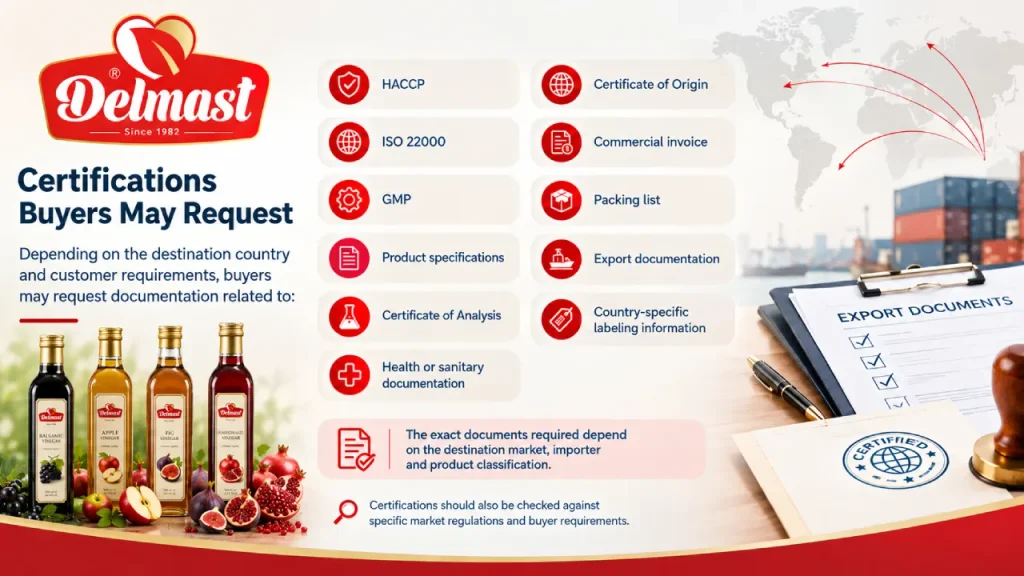
Depending on the destination country and customer requirements, buyers may request documentation related to:
- HACCP
- ISO 22000
- GMP
- Product specifications
- Certificate of Analysis
- Health or sanitary documentation
- Certificate of Origin
- Commercial invoice
- Packing list
- Export documentation
- Country-specific labeling information
The exact documents required depend on the destination market, importer and product classification.
Certifications should also be checked against the actual requirements of the purchasing market. A document that is useful for one customer may not satisfy the regulatory or commercial requirements of another market.
Packaging Considerations for Export Vinegar
Packaging is a commercial decision as well as a logistics decision. Glass bottles can create a premium retail appearance, while larger containers can improve cost efficiency for industrial customers.
Before ordering, compare packaging based on:
| Packaging Question | Why It Matters |
|---|---|
| Bottle material | Influences breakage and shipping weight |
| Bottle size | Determines retail positioning |
| Closure | Helps protect product integrity |
| Label material | Important for transport and humidity |
| Carton configuration | Affects palletization |
| Bulk container | Determines warehouse requirements |
| Pallet dimensions | Influences container utilization |
| Export labeling | Required for destination-market compliance |
For long-distance exports, packaging should be tested for transport conditions. A visually attractive bottle is not enough if cartons, closures or labels cannot withstand normal handling.
Packaging also affects the final landed cost. A smaller bottle may be more suitable for retail shelves but require more units, cartons and handling per pallet. Larger formats can reduce packaging requirements but may require additional warehouse equipment or handling procedures.
Private Label Vinegar Suppliers & Global Apple Cider Vinegar Distribution
Delmast works with international B2B buyers as one of their sourcing partners for private label vinegar suppliers, offering customized packaging and labeling solutions for retail, foodservice, and wholesale markets. Through its global supply network, Delmast supports the international distribution of apple cider vinegar for European & French markets, helping importers, distributors, and retailers source products tailored to their market requirements and private label specifications.
For a private-label project, the buyer should establish the product specification before the artwork is finalized. The label needs to reflect the actual product, ingredients, net contents, manufacturer information and other applicable requirements for the destination market.
The specialty vinegar market is also creating opportunities for differentiated products. Market research published in 2026 estimates the global specialty vinegar market at approximately $2.6 billion in 2026, with balsamic, wine and flavored varieties among the segments tracked. The same research identifies gourmet and natural-food demand as important market drivers.
This does not mean every specialty product will perform equally in every country. Buyers should validate demand within their specific market before committing to large inventory volumes.
Why Delmast Can Be Considered for Wholesale Vinegar Sourcing
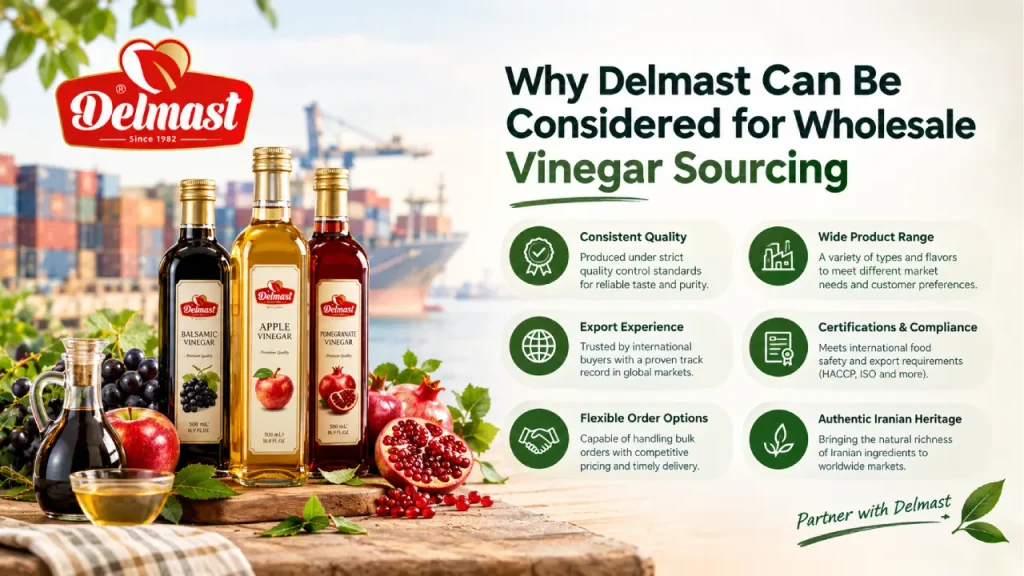
For businesses looking for a manufacturer rather than simply a trading intermediary, Delmast offers vinegar manufacturing and export-oriented supply solutions.
Delmast’s vinegar range includes date vinegar, pomegranate vinegar, fig vinegar, apple vinegar and balsamic vinegar, with packaging options designed for retail and bulk requirements. Its vinegar services also support private-label projects for businesses looking to develop their own branded products for international markets.
For example, Delmast offers balsamic vinegar in retail and larger commercial packaging formats, allowing buyers to select a format according to their distribution model and intended application.
| Delmast Capability | Benefit for Buyers |
|---|---|
| Vinegar manufacturing | Direct access to production |
| Multiple vinegar varieties | Broader product portfolio |
| Bulk packaging | Suitable for high-volume buyers |
| Retail packaging | Ready for distribution |
| Private label | Own-brand vinegar programs |
| Export orientation | Designed for international B2B supply |
| Food-safety systems | Supports controlled manufacturing |
| Custom packaging | Adaptation to market requirements |
Delmast also provides private-label solutions for vinegar, including customized branding and packaging. This can be useful for importers and distributors that want to build a dedicated vinegar brand instead of selling a manufacturer’s standard label.
For buyers planning to export vinegar under their own brand, working with a manufacturer that can coordinate product selection, production, packaging and export preparation can simplify the overall sourcing process.
How to Compare Vinegar Manufacturers Before Ordering
Price should be only one part of the sourcing decision. A better approach is to create a supplier comparison sheet and evaluate each quotation against measurable commercial requirements.
| Evaluation Point | Supplier A | Supplier B | Supplier C |
|---|---|---|---|
| Product specification | ✓ / ✕ | ✓ / ✕ | ✓ / ✕ |
| Required acidity | ✓ / ✕ | ✓ / ✕ | ✓ / ✕ |
| Sample available | ✓ / ✕ | ✓ / ✕ | ✓ / ✕ |
| Bulk packaging | ✓ / ✕ | ✓ / ✕ | ✓ / ✕ |
| Private label | ✓ / ✕ | ✓ / ✕ | ✓ / ✕ |
| Certifications | ✓ / ✕ | ✓ / ✕ | ✓ / ✕ |
| Export documents | ✓ / ✕ | ✓ / ✕ | ✓ / ✕ |
| MOQ | — | — | — |
| Lead time | — | — | — |
| Target price | — | — | — |
This approach makes it easier to identify whether a quotation is genuinely competitive or simply cheaper because it excludes important services.
Buyers should also compare the total landed cost rather than the factory price alone. Freight, insurance, customs duties, local transportation, warehousing and packaging can significantly affect the final cost of imported vinegar.
US Fruit Vinegar Market & Vinegar-Based Preservation Systems
Natural fruit and date vinegars are increasingly relevant to vinegar-based preservation systems in the US fruit vinegar market. Food manufacturers use these vinegars in pickles, sauces, and dressings to contribute acidity, flavor, and preservation properties. Delmast supplies date vinegar and other vinegar products for food processors seeking natural ingredients suitable for industrial applications and international food markets.
Final Checklist for Sourcing Vinegar for Export
A successful vinegar sourcing project should connect product quality with commercial requirements. Buyers should define the specification first, then compare manufacturers according to production capability, documentation, packaging and pricing.
For an export order, the process can be simplified into the following steps:
- Define the vinegar type and intended application.
- Set the required acidity and ingredient specification.
- Decide between retail, food-service and bulk packaging.
- Request samples and technical documentation.
- Verify certifications and food-safety procedures.
- Confirm MOQ, production capacity and lead time.
- Check destination-market labeling requirements.
- Compare freight-friendly packaging options.
- Confirm private-label requirements if applicable.
- Finalize commercial terms and export documentation.
For distributors, retailers and food manufacturers, choosing the right wholesale vinegar supplier is ultimately about building a repeatable supply chain. A supplier that can combine consistent manufacturing, flexible packaging, private-label capability and export support can provide greater value than a supplier selected only on the initial price.
The Wholesale Vinegar Supplier Guide approach is therefore straightforward: define the product, verify the manufacturer, confirm the documentation, select the appropriate packaging and establish clear quality requirements before placing the commercial order.
As international demand expands across conventional and specialty vinegar categories, buyers have more opportunities to build differentiated product portfolios. The most practical sourcing strategy is to match the vinegar specification to the final application, verify the manufacturer’s capabilities and establish clear quality requirements before the first commercial shipment.
Frequently Asked Questions
1. What should I look for in a wholesale vinegar supplier?
Look for consistent product specifications, suitable acidity, reliable production capacity, food-safety controls, export experience, flexible packaging and clear documentation. For private-label projects, confirm that the manufacturer can also support labeling, packaging and production requirements.
2. What is the difference between bulk vinegar and retail vinegar?
Bulk vinegar is intended for high-volume commercial or industrial use and is generally supplied in larger containers. Retail vinegar is packaged in consumer-sized bottles and is prepared for direct distribution through supermarkets, retailers or other sales channels.
3. Can vinegar manufacturers produce private-label products?
Yes. Some vinegar manufacturers provide private-label services in which the product is manufactured and packaged under the buyer’s own brand. The available bottle sizes, labels, packaging formats and minimum order quantities depend on the manufacturer and project.
4. Is balsamic vinegar available for wholesale purchasing?
Yes. Balsamic vinegar can be supplied in both retail and larger commercial formats. Buyers should compare the product specification, ingredients, packaging, acidity, shelf life and intended application before selecting a supplier.
5. Can Delmast supply vinegar for export and private-label projects?
Yes. Delmast manufactures several vinegar varieties, including balsamic, apple, fig, date and pomegranate vinegar, and offers bulk and retail packaging options. Its vinegar supply program also includes private-label services for businesses that want customized branding and packaging for international markets.