 Jam
 Pickles
 Canned Vegetable
 Syrups
 Vinegar
 IQF Vegetables
 IQF Fruits
 Fruit Strip
 Iranian Foods
B2B Private Label FAQ: Comprehensive MOQ, Shelf Life, Packaging & Shipping Guide

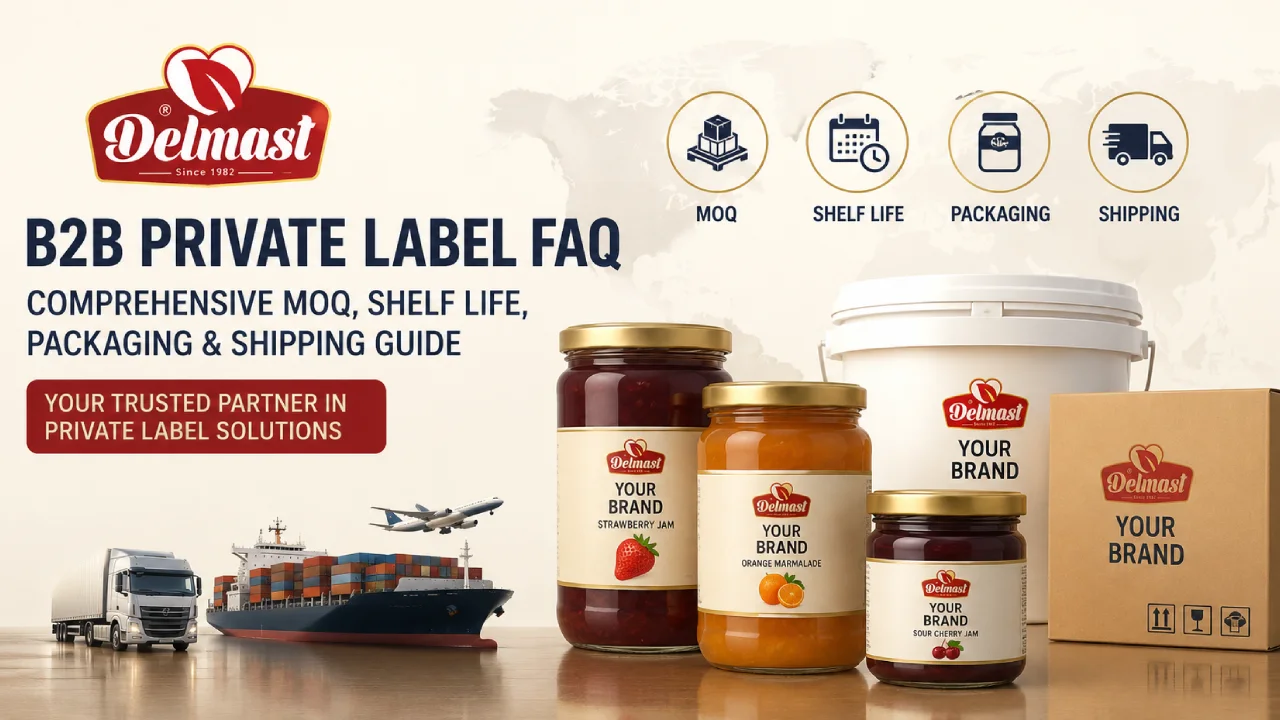
When partnering with an OEM Food Manufacturer or contract production partner, procurement officers, commercial brand owners, and international food distributors require total operational transparency before committing capital to bulk purchase orders. Navigating minimum order quantities (MOQs), extended shelf life guarantees, primary and secondary packaging durability, and international freight logistics is essential for minimizing commercial risks and maintaining supply chain stability.
This extended Private Label FAQ addresses the foundational and technical questions B2B buyers ask when sourcing contract manufacturing services, custom-branded product lines, and bulk shipments from Delmast.
What is the Minimum Order Quantity (MOQ) for Private Label Manufacturing?
In modern B2B Food Manufacturing, minimum order thresholds are determined by raw material sourcing schedules, production line calibration costs, and specialized packaging run limits.
- Standard Private Label MOQs: As noted in our Private Label FAQ guidelines, default production runs generally start at one full 20-foot container load (FCL), which equates to approximately 1,500 to 2,500 master cartons depending on unit dimensions (cans, glass jars, or pouches).
- Trial & New Market Launch Programs: To assist emerging brands with market testing, Delmast supports lower initial order volumes or multi-SKU consolidation within a single container load, significantly reducing upfront inventory holding costs.
Can We Combine Multiple SKUs Within a Single Shipment?
Yes. Purchasing directly from a primary processing facility enables buyers to consolidate diverse product categories—including Wholesale Canned Vegetables, fruit jams, concentrated syrups, and acidified pickles—into a single FCL shipment. This flexibility allows distributors to balance product portfolios without tying up excessive working capital in single-product stockpiles.
What is the Guaranteed Shelf Life for Delmast Bulk and Private Label Goods?
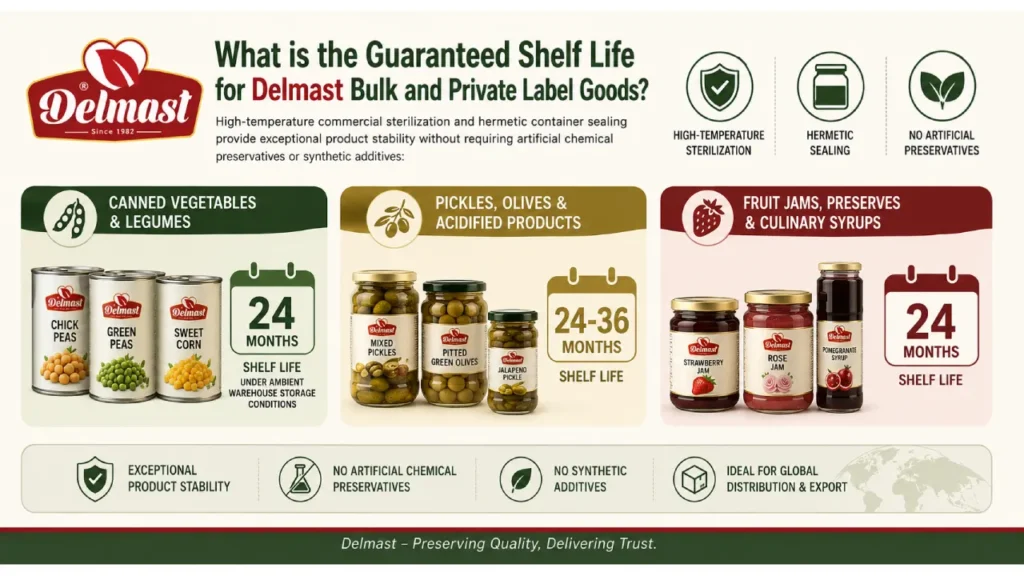
High-temperature commercial sterilization and hermetic container sealing provide exceptional product stability without requiring artificial chemical preservatives or synthetic additives:
- Canned Vegetables & Legumes: 24-month shelf life under ambient warehouse storage conditions.
- Pickles, Olives & Acidified Products: 24 to 36-month shelf life.
- Fruit Jams, Preserves & Culinary Syrups: 24-month shelf life.
How Does Delmast Guarantee Food Safety and Microbial Control Across Batches?
As an established Wholesale Pickle Manufacturer and canned food co-manufacturer, Delmast enforces strict HACCP and ISO 22000 quality management systems. Every manufacturing run undergoes:
- Retort Thermal Sterilization: Processing profiles engineered to achieve verified F0 sterilization values, effectively destroying heat-resistant pathogens like Clostridium botulinum.
- Hermetic Double-Seam Audits: Continuous micrometer measurements and destructive seam teardowns to guarantee long-term vacuum retention.
- CoA Verification: Every export shipment is accompanied by a batch-specific Certificate of Analysis (CoA) verifying pH levels, sodium concentration, drained weight compliance, and MRL safety limits.
What Primary and Secondary Packaging Formats Are Supported?
Packaging options addressed in this Private Label FAQ are tailored to retail shelves, commercial kitchens, and large-scale industrial processors:
- Retail Formats: Glass jars (various capacities), easy-open tinplate cans (EOE), and flexible retort pouches with high-definition custom artwork.
- Commercial & Food Service Formats: Industrial #10 cans, food-grade plastic drums, and large galon formats suited for commercial catering and manufacturing inputs.
Does Delmast Assist with Labeling Regulations and Barcode Integration?
Yes. OEM contracts include technical artwork validation. The production team provides guidance to ensure your label layout complies with destination port regulations—including multi-language ingredient listings, nutritional panel accuracy, allergen disclosures, and GS1 barcode formatting.
Which Incoterms Are Supported for International Shipments?
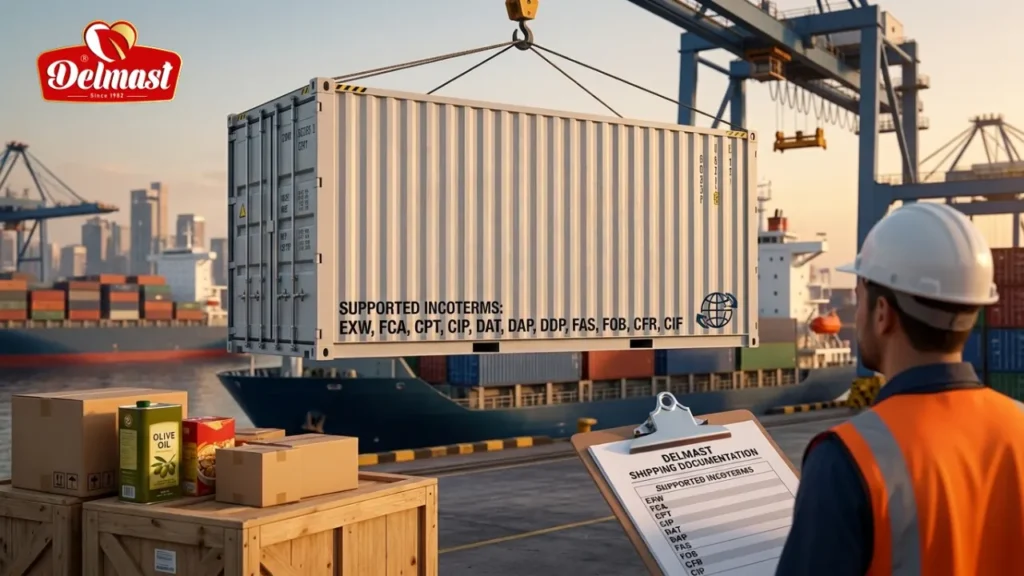
Export logistics accommodate standard commercial shipping terms based on the buyer’s supply chain preference, including FOB (Free On Board), CFR (Cost and Freight), and CIF (Cost, Insurance, and Freight).
How Is Cargo Protected Against Damage During Ocean Freight?
To prevent carton collapse, denting, or moisture degradation during long maritime transit, secondary export packaging adheres to strict industrial standards:
- High Edge Crush Test (ECT) corrugated master cartons capable of resisting high stacking pressures in humid container environments.
- Palletized cargo using heat-treated ISPM-15 compliant wooden or plastic pallets, reinforced with corner edge protectors and heavy-duty moisture-barrier stretch wrap.
Step-by-Step OEM & Contract Manufacturing Onboarding Workflow
To help procurement officers navigate the onboarding process efficiently, this section of the Private Label FAQ outlines the five structured stages of contract manufacturing:
- Product Spec & Recipe Alignment: Defining target taste profiles, ingredient ratios, drained weights, and packaging formats.
- Sample Approval & Lab Testing: Formulation of pre-production samples for client QC evaluation and lab testing.
- Artwork & Regulatory Finalization: Designing custom private label artwork and verifying destination market labeling laws.
- Mass Production & Quality Control: Scheduling raw ingredient sourcing, automated thermal processing, and batch CoA generation.
- Logistics & Export Clearance: Palletization, container loading, phytosanitary certification, and export customs documentation dispatch.
B2B Technical & Operational Reference Matrix
The reference matrix below summarizes the core operational parameters frequently requested in our Private Label FAQ documentation:
| Operational Parameter | Retail Private Label Lines | Commercial & Industrial Lines | Custom OEM Formulations |
| Packaging Types | Glass Jars (370g–1000g), EOE Cans | Industrial Cans, Food-Grade Drums | Custom Container Sourcing Available |
| Minimum Order (MOQ) | 1x20ft Container (Single SKU) | 1x20ft Container (Mixed SKUs) | Volume-dependent on packaging run |
| Standard Shelf Life | 24 to 36 Months | 24 to 36 Months | Verified via shelf-life stability tests |
| Quality Certifications | HACCP, ISO 22000, Halal | HACCP, ISO 22000, Halal | Market-specific certifications |
| Production Lead Time | 2–3 Weeks from Artwork Approval | 2 Weeks for Standard Formulations | Scheduled contract release cycles |
Procurement Risk Management: Pre-Shipment Audit Options
Another key topic in this Private Label FAQ is risk reduction. To maintain total confidence before final shipment dispatch, B2B buyers can request:
- Third-Party Inspection Access: Open-door policies for independent inspection agencies (e.g., SGS, Bureau Veritas) to conduct pre-shipment quality and loading audits.
- Retained Batch Sampling: Delmast retains production samples from every batch for the duration of the product’s shelf life to support post-market traceability.
Essential Key Takeaways for B2B Buyers
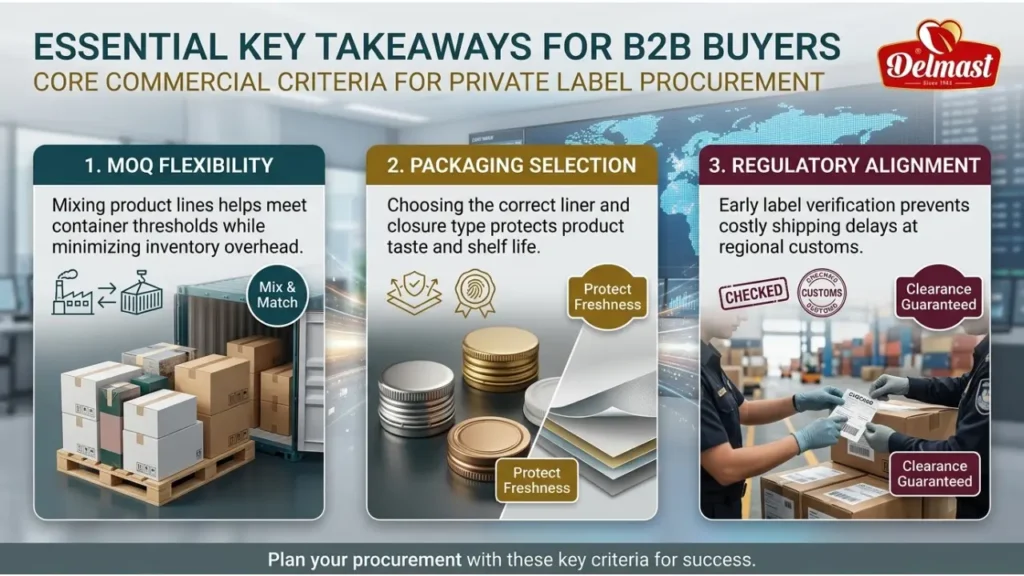
To conclude this Private Label FAQ, keep these core commercial criteria in mind when planning your procurement:
- MOQ Flexibility: Mixing product lines helps meet container thresholds while minimizing inventory overhead.
- Packaging Selection: Choosing the correct liner and closure type protects product taste and shelf life.
- Regulatory Alignment: Early label verification prevents costly shipping delays at regional customs.
Access the Complete Delmast Operational Knowledge Base
While this Private Label FAQ addresses critical commercial inquiries regarding MOQs, shelf stability, packaging compliance, and export logistics, specific order requirements depend on destination port laws and customized formulation parameters.
For additional technical specifications, export documentation rules, or specific ingredient inquiries, procurement teams are invited to review our full knowledge base on the official Delmast FAQ Page or contact our international sales department directly to request a formal quotation.
Ready to Scale Your Private Label Food Line?
Whether you are launching a new product line or looking to optimize your B2B supply chain, Delmast provides the manufacturing reliability, quality assurance, and export logistics you need.
- Get a Custom Quote: Submit your product specifications, estimated volumes, and target packaging through our streamlined Request for Quotation form.
- Request Samples: Evaluate our quality firsthand before committing to a production run.
👉 Submit a Request for Quotation (RFQ) Today
(Or contact our international procurement team directly at Info@delmast.com)
One thought on “B2B Private Label FAQ: Comprehensive MOQ, Shelf Life, Packaging & Shipping Guide”