 Jam
 Pickles
 Canned Vegetable
 Syrups
 Vinegar
 IQF Vegetables
 IQF Fruits
 Fruit Strip
 Iranian Foods
Sourcing Commercial Apricot Jam and Carrot Jam: A Guide for Global Brands & Retailers

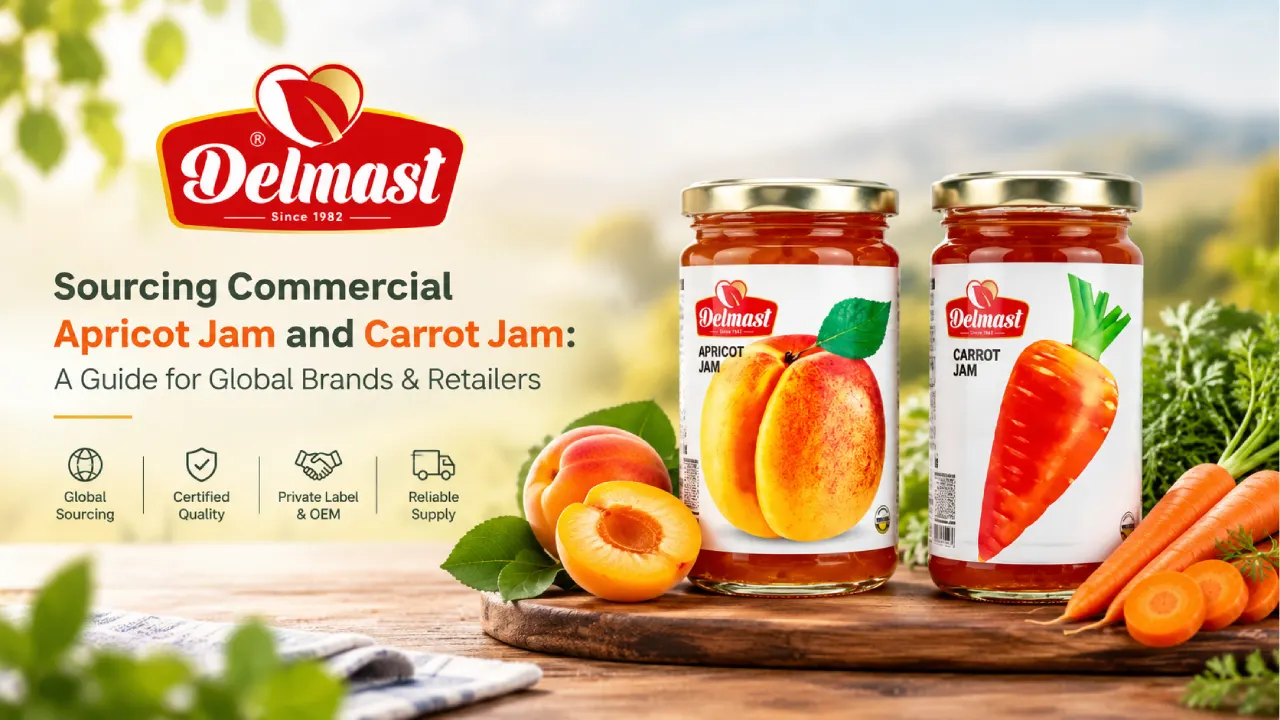
Sourcing jam for an international market involves much more than finding a manufacturer that can produce a sweet fruit spread. Global brands and retailers need to evaluate product consistency, raw material quality, packaging options, food safety, shelf life, logistics and the manufacturer’s ability to support large-volume orders.
Apricot jam and carrot jam can both serve different market segments, from breakfast products and bakery ingredients to hotel, foodservice and retail applications. For buyers looking for Wholesale Apricot Jam, understanding how to assess a supplier can make the difference between a reliable long-term partnership and repeated supply problems.
Why Apricot and Carrot Jam Are Attractive for Global Markets
Apricot jam has a familiar fruit profile and works across several categories. It can be sold as a retail breakfast spread, used as a bakery ingredient or incorporated into desserts and pastry fillings. Its color, flavor and texture also make it suitable for premium and mainstream product lines.
Carrot jam has a different market position. It can appeal to brands looking for less conventional fruit-and-vegetable preserves or products inspired by regional recipes. Depending on the formulation, carrot jam can be positioned as a specialty preserve or incorporated into foodservice and bakery applications.
For international buyers, the important point is that the product should be developed around its intended market rather than simply purchased as a standard formula.
| Product | Common Applications | Key Buyer Considerations |
|---|---|---|
| Apricot Jam | Breakfast, bakery, desserts, retail | Fruit content, texture, color, sweetness |
| Carrot Jam | Specialty retail, breakfast, bakery | Flavor profile, texture, recipe consistency |
| Bulk Jam | Industrial food production | Packaging format, shelf life, volume |
| Private Label Jam | Supermarkets, brands, distributors | Custom recipe, branding, packaging |
What to Check When Sourcing Commercial Jam
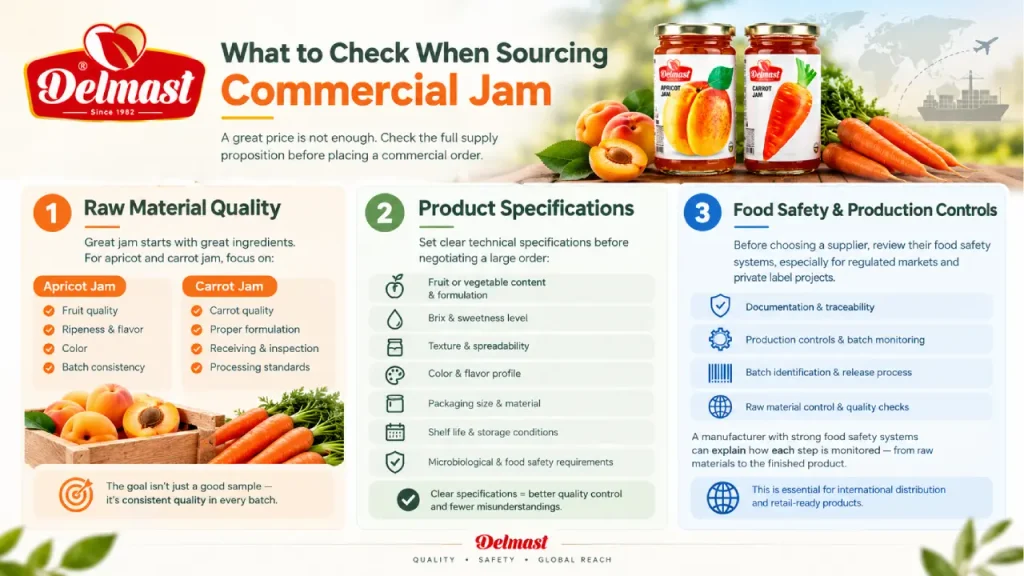
A supplier may offer an attractive price, but price alone does not tell you whether the product will work for your market. Buyers should evaluate the complete supply proposition before placing a commercial order.
1. Raw Material Quality
The quality of the finished jam begins with the raw material. For apricot jam, buyers should pay attention to fruit quality, ripeness, flavor, color and consistency between production batches.
For carrot jam, the characteristics of the carrots and the formulation process are equally important. A reliable manufacturer should have procedures for receiving, inspecting and processing raw materials.
The objective is not simply to obtain a product that tastes good during sampling. The supplier should be capable of maintaining the same specifications throughout commercial production.
2. Product Specifications
Before negotiating a large order, define the technical specifications clearly. These may include:
- Fruit or vegetable content and formulation
- Brix and sweetness level
- Texture and spreadability
- Color and flavor profile
- Packaging size and material
- Shelf life and storage conditions
- Microbiological and food safety requirements
These specifications provide a practical reference for quality control and help prevent misunderstandings between the buyer and manufacturer.
3. Food Safety and Production Controls
International buyers should investigate the manufacturer’s food safety procedures before finalizing a supplier. Documentation, traceability, production controls and batch identification are particularly important when products will enter regulated retail markets.
A manufacturer with established food safety systems should be able to explain how raw materials are controlled, how production batches are monitored and how finished products are released.
This becomes even more important when the product will be distributed across multiple countries or sold under a retailer’s own brand.
Comparing Global Apricot Jam Brands & Buying Wholesale Apricot Jam Online
When comparing global apricot jam brands, buyers should look beyond flavor and price to evaluate ingredient quality, production capacity, packaging options, shelf life, and export reliability. Businesses looking to apricot jam buy online can explore suppliers that offer both retail-ready products and bulk quantities for commercial use. For example, buyers searching for apricot jam online India may have different sourcing requirements depending on whether they serve local retailers, foodservice businesses, or international markets. Choosing the right manufacturer is particularly important when sourcing jam for large scale retailing, where consistent quality and reliable deliveries directly affect customer satisfaction.
Delmast is an experienced food manufacturer offering jam production and private-label solutions for brands, distributors, and retailers. By working with a manufacturer like Delmast, businesses can explore customized packaging and scalable production options that support their wholesale sourcing needs and long-term growth.
Choosing Between Standard and Private Label Jam
Not every buyer needs a completely customized product. Some distributors may prefer an established recipe that can be purchased in commercial quantities. Others need a product developed specifically for their brand.
This is where the sourcing process should begin with a clear definition of the business model.
| Buyer Type | Suitable Supply Model | Main Requirement |
|---|---|---|
| Importer | Standard or customized | Reliable export supply |
| Food Distributor | Standard product | Consistent specifications |
| Supermarket | Private label | Custom packaging and branding |
| Restaurant Chain | Customized or bulk | Consistent taste and volume |
| Food Manufacturer | Bulk | Technical specifications |
| Retail Brand | Private label | Recipe + packaging + branding |
Working with experienced private-label jam makers can allow a brand to control elements such as recipe, sweetness, packaging format, label design and positioning while outsourcing the manufacturing process.
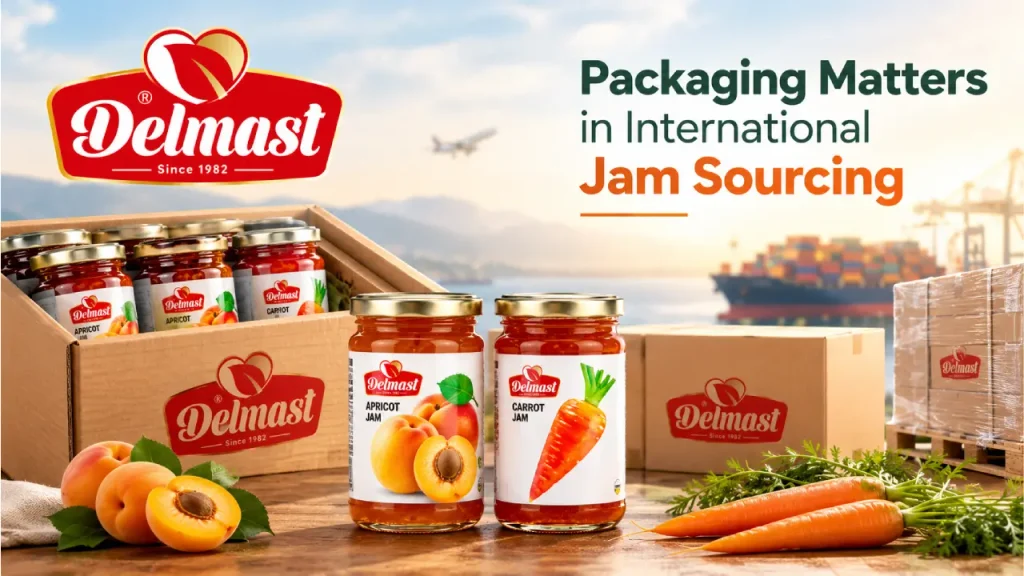
Packaging Matters in International Jam Sourcing
Packaging needs to be considered according to the destination market and distribution channel. A small retail jar may be appropriate for supermarkets, while foodservice customers may require larger containers.
For export orders, packaging should also withstand handling, transportation, storage and palletization. Labels need to accommodate the regulatory and commercial requirements of the target market.
A sourcing specification should therefore define:
| Packaging Factor | Questions for Buyers |
|---|---|
| Jar Size | What retail or foodservice volume is required? |
| Closure | Is the selected closure suitable for the product and transport? |
| Label | Does it meet destination-market requirements? |
| Carton | Can the master carton withstand export handling? |
| Pallet | How many units/cartons fit on each pallet? |
| Shipping | Is the packaging suitable for the planned logistics route? |
A supplier that can coordinate product manufacturing and export packaging can simplify the procurement process considerably.
MOQ, Pricing and Commercial Volumes
Minimum order quantity is another important factor when comparing suppliers. A low unit price may not be useful if the required MOQ is significantly higher than the buyer’s sales volume.
When evaluating a quotation, consider the total commercial cost rather than the jar price alone. Freight, packaging, labeling, pallet configuration, customs requirements and payment terms can all affect the final landed cost.
For this reason, buyers should request quotations based on clearly defined quantities and specifications.
A useful comparison can include:
- Unit price at different order quantities
- MOQ
- Packaging and labeling costs
- Production lead time
- Payment terms
- Shipping terms
- Sample and approval process
This approach makes supplier comparisons more meaningful and reduces the risk of choosing a manufacturer based solely on an attractive initial quotation.
Finding a Manufacturer for Large Retail Programs
Retail programs require a different level of supplier reliability than occasional small orders. When a product becomes part of a supermarket or retail chain’s permanent assortment, supply interruptions can quickly affect inventory and sales.
A suitable manufacturer for jam for large scale retailing should therefore demonstrate production capacity, quality consistency and the ability to manage repeat orders.
The buyer should also ask how the manufacturer handles:
- Forecast-based production
- Repeat purchase orders
- Batch traceability
- Quality complaints
- Packaging changes
- Seasonal raw material availability
- Export documentation
The goal is to establish whether the supplier can support the product after the first shipment, not simply complete the first order.
Why Manufacturer Experience Matters
A supplier’s product portfolio can provide useful evidence about its manufacturing capabilities. Buyers may encounter companies specializing exclusively in jam, while others operate as a broader food manufacturer.
It is also important to distinguish between a jam producer and a marmalade manufacturing company. Although the products may share some production principles, different recipes and raw materials can require different processing approaches.
For international sourcing, the most useful supplier is one that can clearly explain its production process, specifications, quality controls and packaging capabilities.
Delmast as a Private Label Jam Manufacturer
Delmast is a food manufacturer producing jams and other processed food products for international markets. In addition to manufacturing its own product range, Delmast provides private-label production for brands, importers, distributors and retailers.
This model allows buyers to work with a manufacturer while developing products around their own commercial requirements. Depending on the project, private-label cooperation can involve product specifications, packaging formats, branding and export preparation.
For a retailer or food brand considering apricot or carrot jam, this type of partnership can be useful when the objective is to build a branded product rather than simply purchase an off-the-shelf item.
How to Compare Potential Jam Suppliers
A practical supplier evaluation should combine product quality with commercial and operational factors. Instead of choosing a manufacturer based on one quotation, buyers can use a structured evaluation process.
| Evaluation Area | What to Verify |
|---|---|
| Product | Recipe, taste, texture and specifications |
| Quality | Testing, batch controls and traceability |
| Capacity | Ability to handle required volumes |
| Packaging | Jar, label, carton and pallet options |
| Private Label | Custom branding and product development |
| Logistics | Export documentation and shipping support |
| Communication | Response time and technical support |
| Commercial Terms | MOQ, price, payment and lead time |
This process also makes it easier to identify differences between suppliers that may appear similar at first.
Questions to Ask Before Placing an Order
Before approving a commercial supplier, buyers should request samples and documentation rather than relying only on product descriptions.
Two particularly important areas are product consistency and scalability. A sample represents one production run; a commercial partnership may involve dozens of batches over time.
Ask the supplier:
- Can you provide product samples and technical specifications?
- What is the MOQ for each packaging format?
- Can the recipe be customized?
- What private-label services are available?
- What certifications and food safety systems are in place?
- What is the typical production lead time?
- How is batch traceability managed?
- Can you support repeat export orders?
Clear answers to these questions help buyers establish whether the manufacturer is prepared for a long-term commercial relationship.
Choosing the Right Jam Supplier for Your Market
Sourcing apricot and carrot jam for global retail markets requires a broader evaluation than comparing prices between suppliers. Product specifications, raw material quality, food safety, packaging, MOQ, production capacity and export experience all influence the success of a commercial jam program.
For buyers searching for Wholesale Apricot Jam, the right supplier should be able to deliver consistent quality while adapting its production and packaging capabilities to the requirements of the target market.
For brands seeking greater control over their product identity, private-label manufacturing can provide an alternative to building an in-house production operation. Delmast combines jam manufacturing with private-label capabilities, giving international buyers an option for developing branded jam products while working with an established food manufacturer.