

 Jam
 Pickles
 Canned Vegetable
 Syrups
 Vinegar
 IQF Vegetables
 IQF Fruits
 Fruit Strip
 Iranian Foods
Wholesale IQF Celery Supplier: Sourcing Bulk Diced & Chopped Frozen Celery for Food Processing

A reliable Wholesale IQF Celery Supplier provides food manufacturers with frozen celery in consistent cuts, export-ready packaging, and specifications suited to industrial production. Individually quick-frozen (IQF) celery allows manufacturers to portion ingredients efficiently, reduce preparation labor, and maintain a more predictable supply throughout the year. For importers, canned-food producers, soup manufacturers, and commercial kitchens, the right supplier must deliver consistent product quality, documented food safety controls, and dependable cold-chain logistics.
Delmast supports international food sourcing with export-oriented manufacturing, private-label capabilities, and experience supplying food products to international markets. When sourcing bulk frozen celery, buyers should evaluate cut dimensions, blanching requirements, moisture levels, microbiological specifications, packaging, and shipping conditions before confirming an order.
Why Partner with a Certified Wholesale IQF Celery Supplier?
Choosing a qualified Wholesale IQF Celery Supplier is about more than purchasing frozen vegetables at a competitive price. Industrial buyers need raw materials that perform consistently in production lines, comply with destination-market requirements, and arrive in usable condition. A reliable iqf celery manufacturer should maintain consistent processing standards and provide products that meet specific industrial requirements.
A dependable supplier should provide clear product specifications, batch traceability, packaging details, and agreed quality-control procedures. Buyers should also confirm minimum order quantities, production lead times, sample availability, and export documentation before entering a long-term supply agreement.
Farm-Fresh Sourcing and Immediate IQF Processing
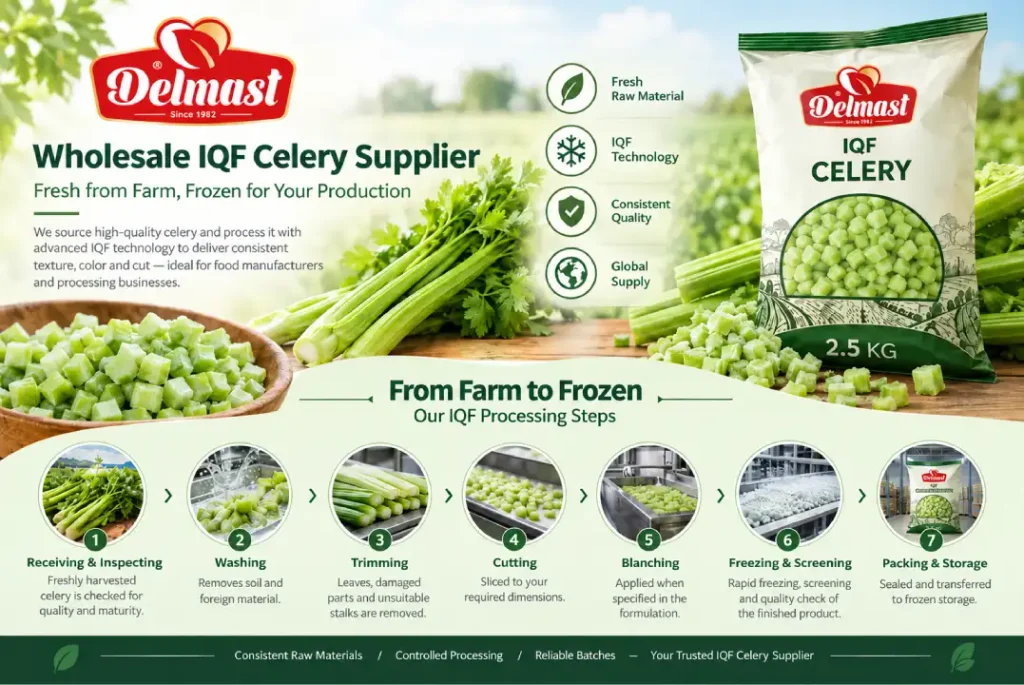
Celery quality begins with the raw material. Freshly harvested celery should have suitable color, aroma, firmness, and maturity for the intended application. Delays between harvesting and processing can affect its texture and appearance, making raw-material handling an important consideration for frozen vegetable buyers.
An established IQF production process typically involves:
- Receiving and inspecting harvested celery.
- Washing to remove soil and other foreign material.
- Trimming leaves, damaged sections, and unsuitable stalks.
- Cutting the celery to the buyer’s required dimensions.
- Applying blanching when specified in the product formulation.
- Freezing, screening, and checking the finished product.
- Packing and transferring the product into frozen storage.
For a Wholesale IQF Celery Supplier, consistent raw-material selection and controlled processing help reduce variation between production batches. The exact process should be confirmed with the manufacturer, particularly when color retention, texture, and cut uniformity are critical to the finished food.
Individual Quick Freezing (IQF) Technology vs. Traditional Cold Storage
IQF technology freezes individual vegetable pieces rapidly, helping them remain separate rather than forming a single frozen block. This makes dosing and handling easier for automated filling systems, industrial mixers, and commercial kitchens.
| Feature | IQF celery | Conventionally block-frozen celery |
|---|---|---|
| Piece separation | Individual pieces generally remain separate | Pieces may freeze together |
| Portioning | Easier to weigh and dispense | May require breaking apart |
| Production efficiency | Suitable for automated ingredient handling | Can require additional handling |
| Product consistency | Depends on cut and process controls | Depends on the freezing method and format |
| Nutrient retention | Influenced by raw material, blanching, and storage | Influenced by raw material, processing, and storage |
Rapid freezing helps preserve product structure, but it does not guarantee that celery will retain exactly the same texture as fresh produce after thawing and cooking. Nutrient retention also depends on blanching, storage duration, and temperature management. Buyers should select specifications according to the intended application rather than assuming that every frozen celery product performs identically.
Product Specifications: Diced, Chopped, and Sliced Frozen Celery
Industrial buyers should define the required cut, preparation method, and quality parameters before requesting a quotation. A Wholesale IQF Celery Supplier should be able to discuss the available formats and confirm which specifications can be produced consistently at the required volume.
Standard Cut Sizes for Industrial Use
Frozen celery can be prepared in different formats depending on the finished product. Small dice works well in uniform soup formulations, while larger cuts may suit chunky sauces and ready meals. Slices can be appropriate for applications where the vegetable remains visually identifiable.
| Product format | Typical specification | Suitable applications |
|---|---|---|
| Small dice | 6 × 6 mm | Smooth or finely textured soups, sauces, seasoning bases |
| Medium dice | 10 × 10 mm | Canned soups, stews, ready meals |
| Chopped celery | Irregular, controlled pieces | Stocks, broths, prepared foods |
| Sliced celery | Cross-cut slices | Vegetable mixes, selected prepared meals |
| Custom cuts | Agreed dimensions | Specialized food manufacturing |
These dimensions are indicative industrial options, not a guarantee of standard availability. Buyers should confirm tolerances, piece-length distribution, broken-piece limits, and the proportion of fines before placing an order.
For example, a frozen diced celery manufacturer supplying an automated soup line may need to meet tighter dimensional tolerances than a supplier serving a blended sauce producer. The correct format depends on the filling equipment, cooking process, and final product requirements.
Quality Assurance, Moisture Control, and Certifications
Quality specifications should be agreed in writing before production. A purchase specification may cover:
- Color, aroma, and general appearance.
- Cut dimensions and acceptable size variation.
- Foreign-material limits and product cleanliness.
- Moisture, drainage, and surface ice requirements.
- Microbiological criteria appropriate to the product and destination market.
- Storage temperature, shelf life, and batch identification.
- Sampling procedures and acceptance criteria.
Blanching can help control enzyme activity and support color stability, but it also changes texture and can affect soluble nutrient retention. Therefore, blanched iqf celery should be selected according to the buyer’s cooking process and product formulation.
Food safety certification is another important part of supplier qualification. Buyers seeking ISO 22000 certified frozen vegetables should request current certificates, verify their scope and validity, and confirm that they cover the relevant facility and product category. HACCP-based controls and Halal certification may also be required, depending on the destination market and customer specifications.
Certification claims should always be supported by current documentation rather than assumed from a supplier’s general export experience.
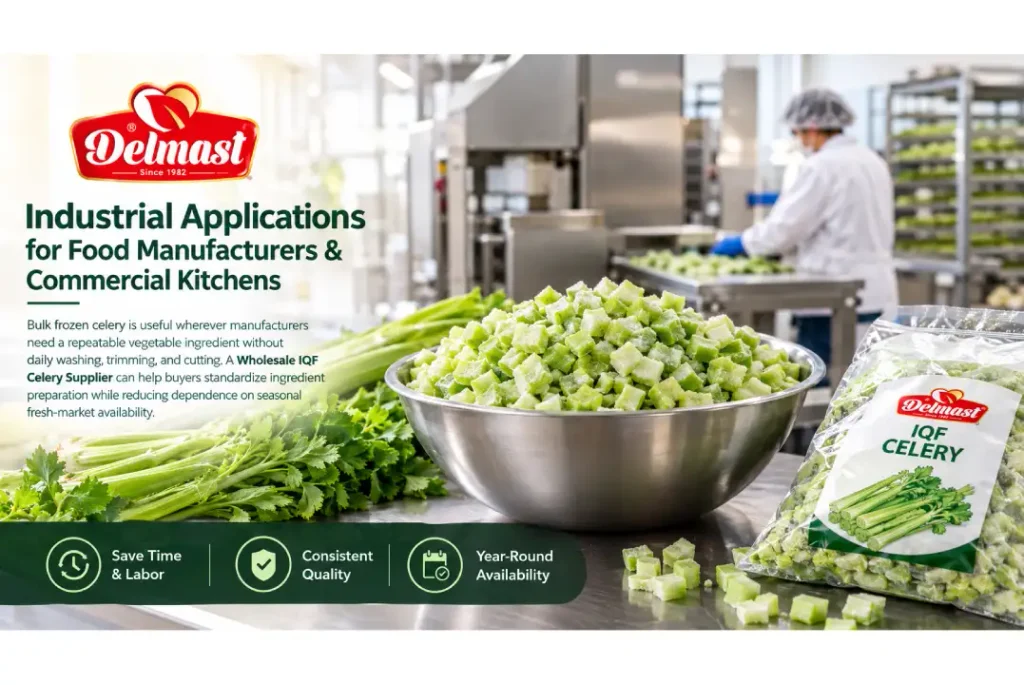
Industrial Applications for Food Manufacturers & Commercial Kitchens
Bulk frozen celery is useful wherever manufacturers need a repeatable vegetable ingredient without daily washing, trimming, and cutting. A Wholesale IQF Celery Supplier can help buyers standardize ingredient preparation while reducing dependence on seasonal fresh-market availability.
Prepared Soups, Broths, and Ready Meals
Celery contributes a recognizable vegetable flavor to soups, broths, stews, and prepared meals. Frozen formats can be incorporated into production recipes according to the required piece size and cooking sequence.
Typical applications include:
- Canned vegetable and chicken soups.
- Frozen ready meals and stew formulations.
- Commercial stocks and broth concentrates.
- Selected processed meat products, including formulations for which celery is an approved ingredient.
- Foodservice soup bases prepared in large batches.
Manufacturers sourcing frozen celery for canned soups should assess how the pieces respond to blanching, retorting, or other thermal processing. Cut size, initial texture, and cooking time can influence the final appearance and consistency. Recipe trials are advisable before approving a large commercial shipment.
Commercial Sauces, Mirepoix Mixes, and Seasoning Bases
Celery is frequently combined with onions and carrots to create a vegetable base for soups, sauces, stocks, and prepared dishes. Purchasing pre-cut frozen ingredients can simplify preparation and make production schedules easier to manage.
A mirepoix vegetable supplier may offer individual ingredients or mixed vegetables, but buyers should confirm the composition of any premixed product. Celery purchased separately gives manufacturers more control over the ratio of vegetables in each recipe.
For industrial sauce production, smaller cuts can disperse more easily, while larger pieces may be appropriate for chunky products. Buyers should consider the cooking sequence, desired flavor intensity, and final texture when selecting specifications.
Pet Food and Dehydration Manufacturing
Frozen celery may also be considered for selected pet-food formulations and further-processing operations. However, its suitability depends on the nutritional formulation, moisture content, processing method, and applicable food or feed regulations.
For dehydration manufacturers, frozen celery can serve as an ingredient when the process and purchasing specifications are designed around frozen raw material. Buyers should evaluate thawing losses, drying yield, energy consumption, and the final product’s quality requirements.
Before using frozen celery in either application, manufacturers should confirm that the product’s specifications and intended use meet the relevant regulatory and technical requirements.
Global Sourcing: A Reliable Alternative to Chinese IQF Celery Suppliers
Importers searching for an iqf celery supplier china often compare Chinese manufacturers with producers in other agricultural and processing regions. China may be a suitable sourcing market for some buyers, but the lowest quoted price does not necessarily represent the lowest total procurement cost.
A broader supplier evaluation should compare product consistency, freight costs, delivery schedules, documentation, payment terms, and the ability to maintain supply across multiple orders.
| Sourcing factor | What buyers should compare |
|---|---|
| Ex-works or FOB price | Product price, processing specifications, and included services |
| Freight and insurance | Route, shipment size, and reefer availability |
| Quality consistency | Cut-size tolerances, inspection records, and batch variation |
| Production capacity | Seasonal availability and repeat-order capacity |
| Compliance | Applicable certificates and destination-market documentation |
| Communication | Response times, specification approval, and complaint handling |
For importers, working with a bulk iqf vegetable supplier that can clearly document product specifications and coordinate export requirements may reduce procurement uncertainty. Alternative sourcing regions can also provide useful diversification when buyers want to avoid relying on a single country or production facility.
Delmast brings an established export-oriented food supply background, serving international markets with products tailored to buyer requirements. Buyers considering frozen celery should request current product availability, country of origin, production details, and supporting documentation before comparing offers. Any comparison should be based on verified specifications and delivered cost rather than assumptions about the origin of the product.
Bulk Export Packaging and Cold-Chain Logistics
Packaging and temperature control directly affect the condition of frozen celery during international transportation. A Wholesale IQF Celery Supplier should confirm the packaging format, pallet configuration, storage temperature, and shipping responsibilities before the order is finalized.
Packaging Options
Common industrial packaging formats include lined cartons designed to protect frozen vegetables from contamination and moisture exposure. Depending on production capabilities and the buyer’s requirements, suppliers may offer different net weights and customized export packaging.
| Packaging option | Typical buyer | Key consideration |
|---|---|---|
| 10 kg cartons | Importers and medium-sized processors | Convenient handling and inventory control |
| 20 kg cartons | High-volume industrial users | Lower packaging units per tonne |
| Food-grade polyethylene liner | Industrial and foodservice buyers | Product protection and hygienic handling |
| Palletized shipments | Distributors and large manufacturers | Stable loading and efficient warehouse handling |
Buyers requesting 10kg bulk poly-lined cartons should specify the liner material, carton strength, net weight, labeling, and pallet requirements. Blue polyethylene liners may be requested as a visual identification preference, but food-contact suitability and applicable compliance documentation should take priority over color.
Private-label packaging can also be discussed where available, including buyer-specific labeling and export carton identification. Artwork approval, language requirements, and minimum order quantities should be confirmed before production.
Strict -18°C Cold Chain Shipping and Reefer Containers
Frozen celery should generally be stored and transported at -18°C or colder, in accordance with the agreed product specification and applicable requirements. Maintaining a consistent cold chain helps prevent thawing, refreezing, and deterioration during distribution.
A reefer container celery export plan should address:
- Pre-cooling and temperature verification before loading.
- Inspection of the reefer container and its operating condition.
- Correct loading practices that allow the refrigeration system to circulate air.
- Temperature monitoring and shipment documentation.
- Coordination between the exporter, freight forwarder, carrier, and importer.
- Prompt transfer to suitable frozen storage after arrival.
The required container size and shipment quantity depend on the carton dimensions, pallet configuration, loading restrictions, and carrier limits. Buyers should request a confirmed loading plan rather than estimating container capacity from net product weight alone.
Sourcing Bulk IQF Celery from Delmast (Request a Quote)
Selecting the right Wholesale IQF Celery Supplier starts with a clear product specification and a transparent quotation. Delmast has operated in international food manufacturing and export since 1998, supplying products to customers across more than 25 countries. Its export-oriented approach and private-label capabilities support buyers seeking structured commercial sourcing arrangements.
For frozen celery enquiries, buyers should first confirm product availability and the relevant manufacturing details. This is particularly important when specifications include custom cuts, blanching, defined microbiological limits, or destination-specific certifications.
To help evaluate your request, include the following information:
- Product format: diced, chopped, sliced, or a custom cut.
- Cut dimensions: for example, 6 × 6 mm or 10 × 10 mm.
- Processing requirements: blanched or unblanched, as applicable.
- Order quantity: trial shipment, pallet quantity, or full-container volume.
- Packaging: 10 kg or 20 kg cartons, liner requirements, and private-label needs.
- Destination: country, delivery port, and applicable import requirements.
- Documentation: required food safety certificates and product specifications.
A quotation should identify the available product format, minimum order quantity, packaging configuration, production lead time, shipment terms, and relevant documentation. Buyers should also confirm whether samples are available for technical evaluation before approving a commercial order.
If your purchasing program includes several frozen vegetables, explore the Delmast frozen vegetables range to review relevant product options and discuss consolidated sourcing requirements.
Request a quote from Delmast with your target specifications, annual volume, and destination market. These details make it easier to assess the suitability of the product, establish realistic delivery expectations, and compare the total cost of supply.
Whether you are qualifying a new manufacturer or diversifying an existing supply chain, the right Wholesale IQF Celery Supplier should be able to support your production requirements with clear specifications, documented quality controls, and dependable export coordination.