

 Jam
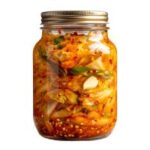 Pickles
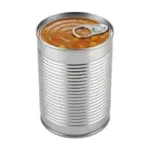 Canned Vegetable
 Syrups
 Vinegar
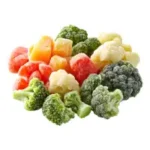 IQF Vegetables
 IQF Fruits
 Fruit Strip
 Iranian Foods
ISO 22000 Food Manufacturer: What Makes a Reliable Supplier?

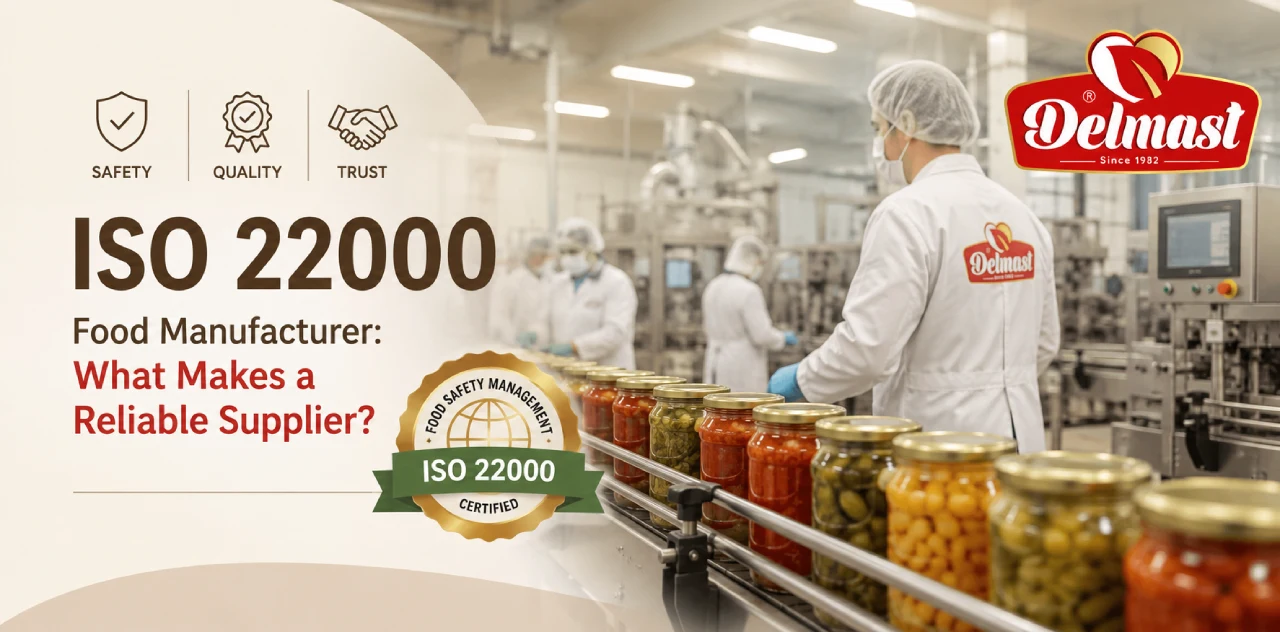
Choosing the right food manufacturer is not just about price or product range. For importers, distributors, and food brands, a reliable supplier must consistently deliver safe, high-quality products while meeting regulatory and export requirements.
This is why many international buyers look for an ISO 22000 food manufacturer. But certification alone does not tell the whole story. A dependable supplier should also have strong quality control, effective traceability, hygienic production, reliable capacity, and proven experience in international food supply.
So, what should you look for when choosing an ISO 22000 certified food manufacturer?
Why ISO 22000 Matters When Choosing a Food Manufacturer?
Food safety risks can enter the supply chain at almost any stage, from raw material sourcing and processing to packaging, storage, and distribution. For international buyers, controlling these risks becomes even more important because products often cross multiple borders before reaching the final consumer.
ISO 22000 is an international standard for a food safety management system (FSMS). It is designed for organizations across the food chain and incorporates principles of HACCP together with prerequisite programs, system management, and interactive communication.
For a buyer, this means an ISO 22000 food manufacturer should have a systematic framework for managing food safety rather than relying only on final-product inspection.
Certification can also provide additional confidence when evaluating potential suppliers. ISO explains that certification is one way an organization can demonstrate to customers and stakeholders that its food safety management system meets the requirements of the standard.
Still, certification is only part of the picture. The next question is whether the manufacturer can turn those systems into consistent day-to-day production.
What Does ISO 22000 Certification Tell You About a Food Manufacturer?
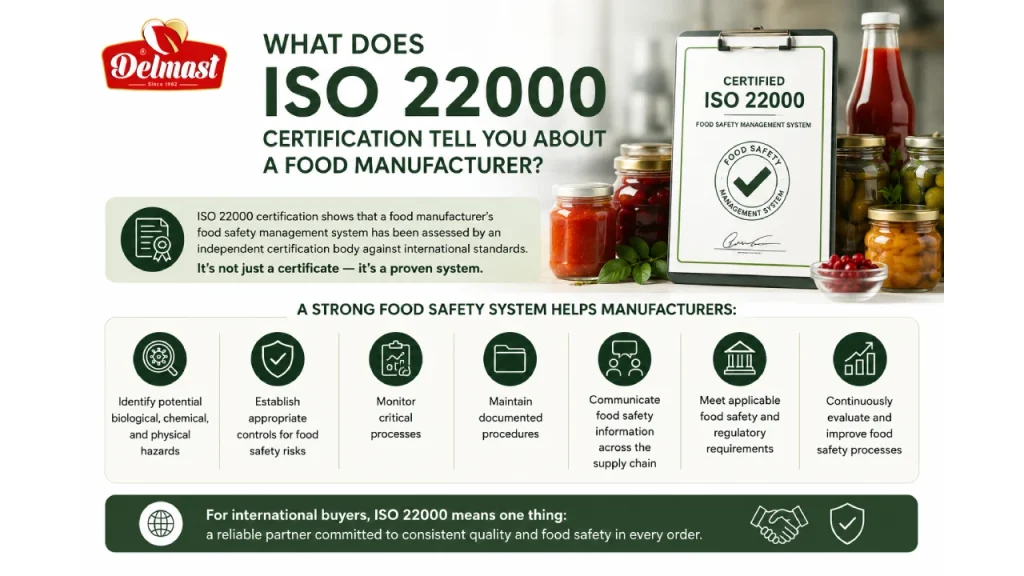
When businesses find a private label food manufacturer, ISO 22000 certification can serve as an important factor in evaluating the manufacturer’s food safety management system. An ISO 22000 certification indicates that the system has been assessed against the requirements of the standard by a certification body. ISO itself does not perform certification; organizations seeking certification work with an external certification body.
For buyers, the value lies in the systems behind the certificate.
A well-managed food safety management system should help a manufacturer:
- Identify potential biological, chemical, and physical hazards
- Establish appropriate controls for food safety risks
- Monitor critical processes
- Maintain documented procedures
- Communicate relevant food safety information throughout the supply chain
- Meet applicable food safety and regulatory requirements
- Continuously evaluate and improve its food safety processes
This is particularly relevant for international food buyers who need a supplier capable of meeting consistent standards across repeated orders.
International Quality Assurance & Export Compliance Standards
Food safety, product consistency and export compliance are essential when selecting a reliable food manufacturer. Working with an ISO 22000 food manufacturer helps businesses assess food safety management practices, quality control procedures and documentation requirements for international markets.
| Quality Standard | Details |
|---|---|
| Food Safety Management | ISO 22000 Certified Production Lines & Full HACCP Hazard Control |
| Religious & Regional Compliance | Halal Certification for GCC, Malaysia, Indonesia, Pakistan & Global Markets |
| Laboratory Quality Control | Brix, pH, Microbiological, Heavy Metal & Pesticide Residue Batch Testing |
| Export Documentation | Certificate of Origin, Phytosanitary Certificate, Health Certificate & SGS/Intertek Inspection |
7 Key Factors That Make an ISO 22000 Food Manufacturer Reliable
An ISO 22000 certified food manufacturer may meet an important food safety requirement, but buyers should look beyond the certificate when evaluating a long-term supplier.
Here are seven factors worth examining.
1. A Strong Food Safety Management System
The first thing to evaluate is how food safety is actually managed within the factory.
ISO 22000 is built around a systematic food safety management approach. It combines elements such as prerequisite programs, HACCP principles, management systems, and communication across the food chain.
A reliable manufacturer should therefore have clearly defined procedures covering raw materials, processing, sanitation, packaging, storage, and other relevant production activities.
For buyers, this provides a more meaningful indication of reliability than simply asking whether a supplier has a food safety certificate.
2. Consistent Quality Control
Food safety and product quality are closely connected, but they are not exactly the same thing.
A dependable food manufacturer and exporter should have quality control procedures throughout the production process rather than checking products only after manufacturing is complete.
This can include inspection and testing of raw materials, monitoring production parameters, evaluating finished products, and maintaining documented quality procedures.
Consistency is especially important for B2B buyers. If a distributor orders the same product several times, the taste, texture, appearance, packaging, and specifications should remain within the agreed requirements.
Delmast, for example, states that its production system includes quality assurance and quality control processes, with in-house testing covering raw materials, processing, and packaging. The company also describes regular audits and documented SOPs as part of its quality approach.
3. Strict Hygiene and Sanitation Practices
A modern production facility should have hygiene and sanitation procedures that are applied consistently, not simply documented for certification purposes.
Areas such as production equipment, workspaces, employee hygiene, cleaning procedures, and sanitation controls all contribute to food safety.
For an international buyer, visiting a facility is useful when possible. If an on-site visit is not practical, manufacturers should still be able to provide relevant documentation and clearly explain how their hygiene and sanitation systems operate.
A manufacturer that treats food safety as part of everyday production is more likely to provide reliable long-term supply.
4. Full Product Traceability
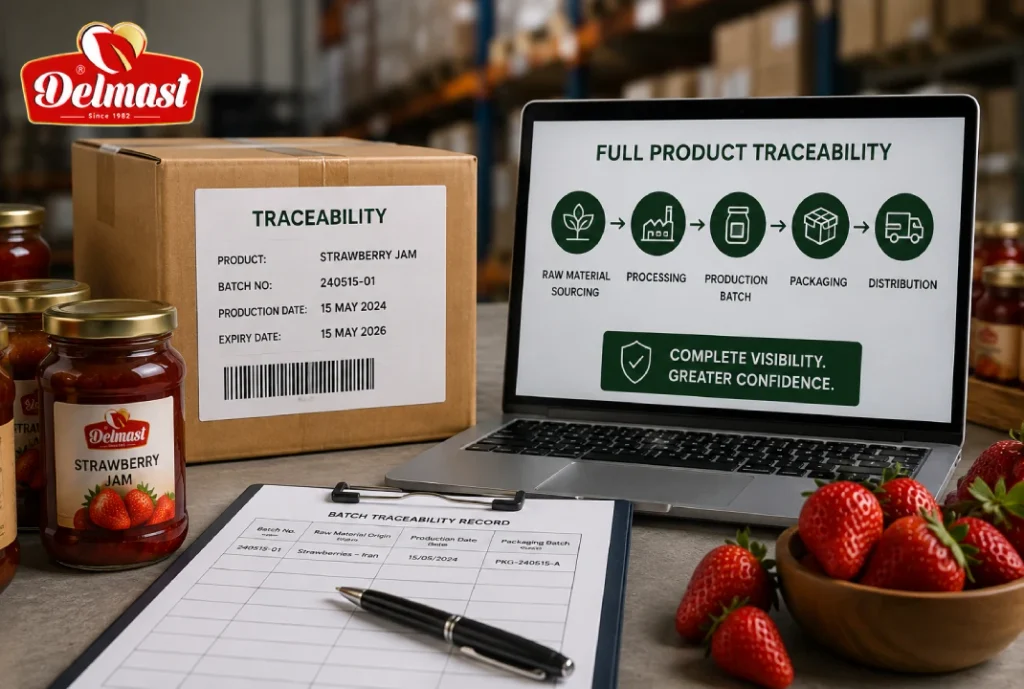
Traceability is another important consideration when choosing an ISO 22000 food supplier.
A manufacturer should be able to identify where relevant raw materials came from, how products were processed, and which production or packaging batches were involved.
Effective traceability helps manufacturers respond more efficiently when a quality or food safety issue occurs. It also gives buyers greater visibility into the supply chain.
For importers and distributors, batch-level documentation can be particularly valuable because products may remain in storage or move through several distribution channels before reaching consumers.
When evaluating a supplier, ask how its traceability system works and what information can be provided for each production batch.
5. Effective Hazard Identification and Risk Control
A reliable manufacturer needs more than a final-product testing program. Food safety hazards need to be considered throughout the production process.
ISO 22000 focuses on identifying, preventing, and controlling food safety hazards through a structured food safety management system.
This is one reason why buyers should ask potential suppliers how they manage risks rather than simply asking whether they test finished products.
Questions worth asking include:
- How are food safety hazards identified?
- Which controls are used during production?
- How are critical processes monitored?
- What happens when a control limit is not met?
- How are corrective actions documented?
The answers can reveal much about the maturity of a manufacturer’s food safety system.
6. Compliance With International Food Safety Requirements
For a domestic buyer, local compliance may be the primary concern. For an importer, the situation is more complicated.
An international food manufacturer may need to consider destination-market requirements, labeling rules, documentation, packaging specifications, certifications, and customer-specific requirements.
This makes international food manufacturing experience particularly valuable.
A supplier that regularly works with international buyers is more likely to understand the documentation and operational requirements involved in cross-border food trade.
Delmast describes its production as export-ready and states that it supports international customers with documentation, labeling compliance, and export logistics.
7. Reliable Production and Supply Capacity
Food safety certification does not automatically tell you whether a supplier can handle your order volume.
Before choosing a manufacturer, consider:
- Production capacity
- Minimum order quantities
- Packaging options
- Lead times
- Raw material availability
- Ability to scale production
- Private label capabilities
- Export logistics
- Communication and order support
A supplier may produce excellent food but still be unsuitable for your business if it cannot maintain supply when demand increases.
For growing food brands and distributors, scalable food manufacturing can therefore be just as important as certification.
ISO 22000 vs. Other Food Safety Certifications: What Should Buyers Look For?
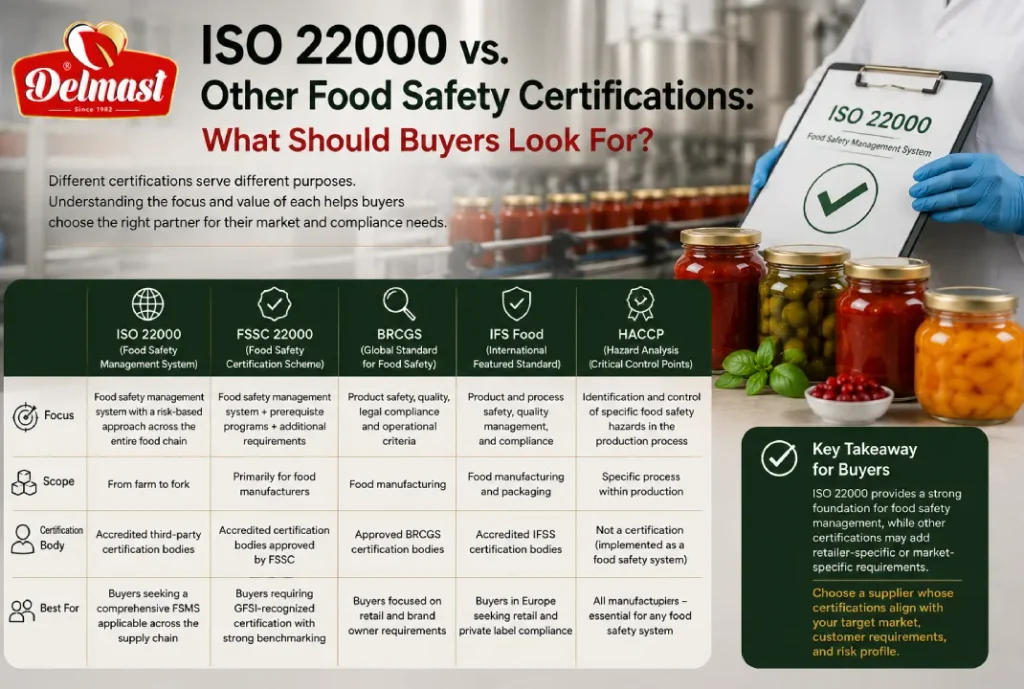
One common mistake is to treat ISO 22000 as if it were the only certification that matters.
It is better to view food safety certification as one part of a broader supplier evaluation.
ISO 22000 focuses specifically on the requirements of a food safety management system. It can be integrated with other management systems and is designed for organizations throughout the food chain.
Depending on the market and product, buyers may also encounter certifications or standards related to areas such as HACCP, IFS, Halal, Kosher, quality management, or specific regulatory requirements.
The right combination depends on the product, destination market, and customer’s requirements.
For this reason, instead of asking, “Which certificate is best?”, a better question is:
Does this manufacturer have the food safety, quality, compliance, and production systems required for my specific market?
That approach gives buyers a much more practical basis for supplier selection.
How to Evaluate an ISO 22000 Food Manufacturer Before Partnering
Before signing a long-term agreement with a reliable food manufacturer, create a simple supplier evaluation checklist.
Start by verifying the manufacturer’s certification and asking for relevant certification details. Then evaluate its production facility, quality control procedures, product specifications, packaging capabilities, traceability system, and export experience.
It is also useful to request product samples before placing a large order.
Pay attention to how the supplier communicates during the evaluation process. A manufacturer that responds clearly, provides complete documentation, explains specifications accurately, and understands your market requirements is generally easier to work with over the long term.
For private-label projects, ask additional questions about recipe development, packaging formats, labeling, minimum order quantities, and production scalability.
For example, Delmast offers private label manufacturing with custom recipes, brand-specific packaging, flexible MOQs, scalable production, and export compliance support.
You can explore its private label manufacturing services when evaluating custom production options.
Why ISO 22000 Matters for International Food Buyers and Importers
For international buyers, supplier selection involves more than finding a manufacturer with competitive pricing.
Products need to arrive safely, meet agreed specifications, comply with destination-market requirements, and remain consistent from one shipment to the next.
This is why ISO 22000 for international food suppliers can be particularly relevant.
A structured food safety management system can help manufacturers establish consistent processes and manage food safety risks throughout the supply chain. ISO also identifies market access, regulatory compliance, improved customer confidence, and operational efficiency among the benefits associated with ISO 22000.
However, international buyers should combine certification checks with practical questions about export operations.
Ask the supplier:
- Which countries do you currently export to?
- Can you provide the required export documentation?
- Do you support destination-market labeling requirements?
- What packaging formats are available?
- Can you handle bulk or private-label orders?
- What are your typical production lead times?
- How is product traceability maintained?
A manufacturer that can answer these questions clearly is better positioned to become a long-term B2B partner.
For additional information about Delmast’s export capabilities, buyers can review its export packaging and freight logistics information.
Questions to Ask an ISO 22000 Food Manufacturer Before Placing an Order
Before choosing a supplier, consider asking the following questions:
1. Is your ISO 22000 certification current?
Ask for certification details and verify the scope and validity through the relevant certification body.
2. What other food safety certifications do you hold?
Depending on the destination market, additional certifications may be relevant.
3. How do you control food safety hazards?
The manufacturer should be able to explain its food safety management approach.
4. How do you maintain product traceability?
Ask how batches and raw materials are tracked throughout production.
5. What quality control and testing do you perform?
Look for evidence of systematic quality control rather than relying only on final inspection.
6. What production volumes can you handle?
Make sure the manufacturer’s capacity matches both your current requirements and potential future growth.
7. Can you support private label production?
If you are building your own brand, clarify packaging, recipe, labeling, MOQ, and production requirements in advance.
8. Do you have experience exporting to my market?
Previous experience with international buyers can simplify documentation and compliance.
Why Delmast Is a Reliable ISO 22000 Food Manufacturer and Exporter
Choosing a food manufacturer ultimately comes down to whether the supplier can combine food safety, quality, consistency, production capability, and export support.
Delmast describes itself as a global food manufacturer serving distributors, wholesalers, and food brands across international markets. Its production approach includes HACCP, ISO 22000, and IFS guidelines, alongside hygienic production infrastructure and regular microbial, chemical, and physical product testing.
The company also highlights in-house quality testing, documented SOPs, regular audits, industrial-scale production, private label capabilities, and export support.
For buyers looking for products such as jams, pickles, canned vegetables, syrups, and other food products, this combination of food safety systems and export-oriented production can make supplier evaluation more straightforward.
You can learn more about Delmast’s food manufacturing capabilities or explore its canned vegetable manufacturing and export options.
The Bottom Line for Food Buyers
An ISO 22000 food manufacturer can provide an important level of confidence when you are evaluating potential suppliers, but the certificate should be the starting point rather than the final decision.
A reliable supplier combines a structured food safety management system with consistent quality control, strong hygiene practices, traceability, effective hazard management, export experience, and dependable production capacity.
For international buyers, the best supplier is not necessarily the one with the longest list of certificates. It is the manufacturer that can consistently turn those standards into safe, compliant, high-quality products and dependable deliveries.
That is the standard buyers should use when choosing a long-term food manufacturing partner.
Frequently Asked Questions About ISO 22000 Food Manufacturers
What is an ISO 22000 food manufacturer?
An ISO 22000 food manufacturer is a food-producing company that operates a food safety management system meeting the requirements of ISO 22000 and, where applicable, has obtained certification from an external certification body.
Is ISO 22000 enough to ensure food safety?
ISO 22000 is an important food safety management standard, but buyers should not use certification as the only supplier-selection criterion. Production hygiene, quality control, traceability, regulatory compliance, testing, and manufacturing capability should also be evaluated.
Why should importers choose an ISO 22000 certified manufacturer?
An ISO 22000 certified manufacturer has demonstrated that its food safety management system meets the requirements of the standard through the applicable certification process. This can give international buyers additional confidence when evaluating suppliers.
How can I verify an ISO 22000 food manufacturer’s certification?
Ask the manufacturer for its certification information, including the certification body’s details, certificate scope, and validity. Certification is performed by external certification bodies rather than ISO itself.
What should I look for besides ISO 22000 certification?
Look at quality control, food hygiene, product traceability, testing procedures, production capacity, export experience, packaging capabilities, regulatory compliance, communication, and the manufacturer’s ability to maintain consistent supply.