 Jam
 Pickles
 Canned Vegetable
 Syrups
 Vinegar
 IQF Vegetables
 IQF Fruits
 Fruit Strip
 Iranian Foods
Custom Packaging Trends in Food Industry: What B2B Buyers Need to Know

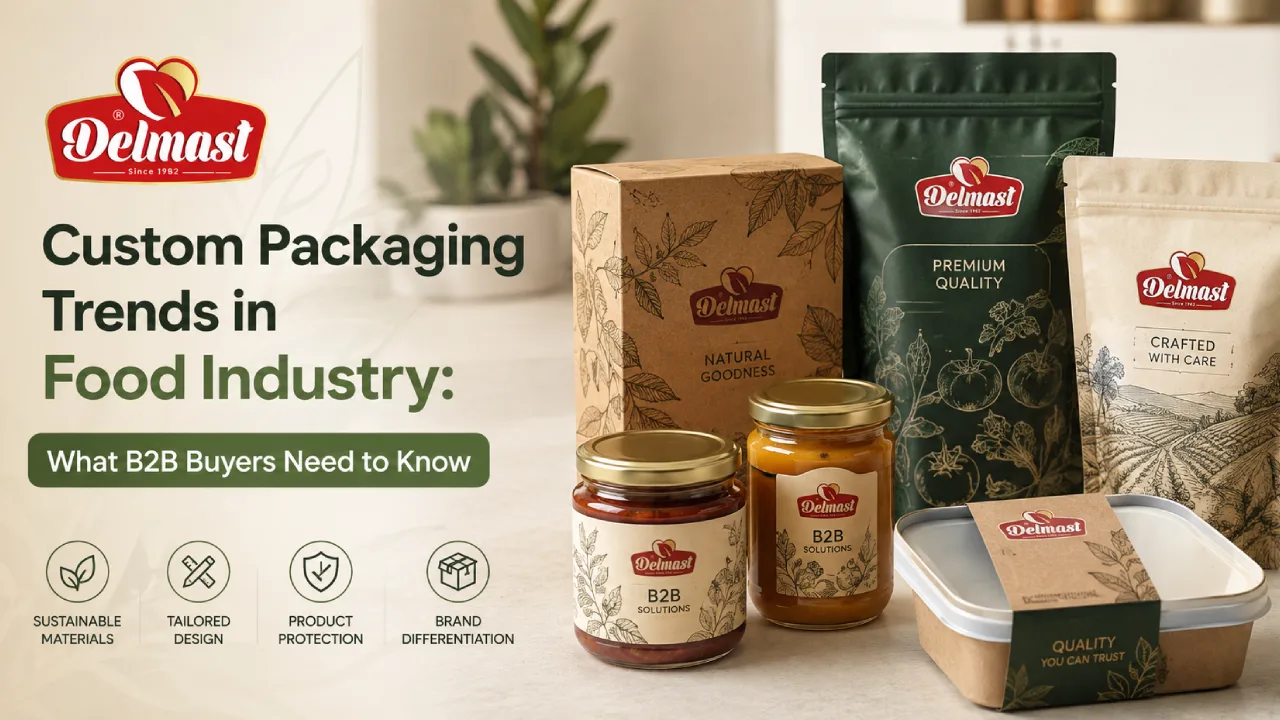
The food packaging industry is changing quickly. Today, packaging is no longer just about protecting a product; it also plays a role in branding, sustainability, logistics, shelf life, and export readiness. For manufacturers and distributors, understanding the latest Custom packaging trends can make a significant difference when choosing the right packaging strategy.
From sustainable materials and smart designs to packaging made specifically for IQF Vegetables, sauces, pickles, Vinegar, and IQF Fruits, businesses are looking for packaging that matches both product requirements and market expectations.
What Is Custom Food Packaging?
Custom Food Packaging refers to packaging that is designed around the specific needs of a food product, brand, target market, and distribution channel. Unlike standard packaging formats, custom packaging can be modified in terms of material, dimensions, printing, closure, labeling, and functionality.
For B2B buyers, this approach can offer several advantages:
- Better product protection during transportation
- Stronger brand recognition
- More efficient use of storage space
- Improved shelf presentation
- Packaging adapted to export requirements
- Greater flexibility in product sizes and formats
- Better compatibility with production and filling lines
The growing demand for customized packaging is one of the reasons Custom packaging trends have become an important topic for food manufacturers and exporters.
Why Custom Packaging Is Becoming More Important
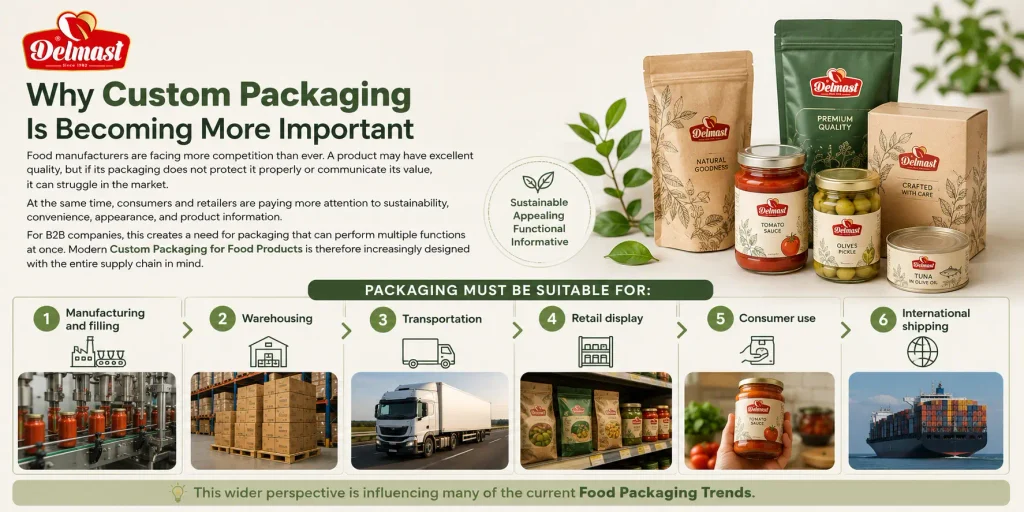
Food manufacturers are facing more competition than ever. A product may have excellent quality, but if its packaging does not protect it properly or communicate its value, it can struggle in the market.
At the same time, consumers and retailers are paying more attention to sustainability, convenience, appearance, and product information.
For B2B companies, this creates a need for packaging that can perform multiple functions at once. Modern Custom Packaging for Food Products is therefore increasingly designed with the entire supply chain in mind.
Packaging must be suitable for:
- Manufacturing and filling
- Warehousing
- Transportation
- Retail display
- Consumer use
- International shipping
This wider perspective is influencing many of the current Food Packaging Trends.
Sustainable Packaging Materials
Sustainability is one of the strongest Custom packaging trends in the food industry. Food manufacturers are looking for ways to reduce packaging waste while maintaining product safety and durability.
Common approaches include:
- Using recyclable materials
- Reducing unnecessary packaging layers
- Lightweighting containers
- Choosing renewable or recycled materials
- Designing packaging for easier recycling
However, sustainability cannot come at the expense of food safety. Packaging for products with high moisture, acidity, oil content, or long shelf lives needs to provide an appropriate barrier against oxygen, moisture, light, and contamination.
For a B2B buyer, the right material depends heavily on the product itself.
Packaging Designed Around the Product
Another important trend is moving away from one-size-fits-all packaging.
A jar designed for Balsamic Vinegar, for example, has different requirements from packaging used for frozen IQF Vegetables. Similarly, IQF Fruits require packaging that can withstand freezing and transportation conditions.
Packaging design should consider factors such as:
| Product | Important Packaging Considerations | Typical Priority |
|---|---|---|
| IQF Vegetables | Freezer resistance, sealing, durability | Product protection |
| IQF Fruits | Moisture resistance, freezing conditions | Shelf life |
| Vinegar | Acid resistance, leakage prevention | Safety & durability |
| Balsamic Vinegar | Bottle protection, premium appearance | Branding & protection |
| Pickled Foods | Glass compatibility, sealing | Shelf life & safety |
This product-specific approach is becoming central to modern Food Packaging Solutions.
Flexible Packaging Continues to Grow
Flexible packaging remains popular because it can be lightweight, practical, and relatively efficient for transportation and storage.
Pouches, flexible bags, films, and multilayer structures can be customized for different food categories. Depending on the application, flexible formats may also help companies reduce material consumption compared with heavier packaging formats.
For frozen products such as IQF Vegetables and IQF Fruits, flexible packaging can provide practical advantages in both retail and foodservice applications.
For B2B manufacturers, the main consideration should not simply be whether flexible packaging is trendy. The material structure must be compatible with freezing temperatures, sealing equipment, product weight, and transportation conditions.
Minimalist and Brand-Focused Designs
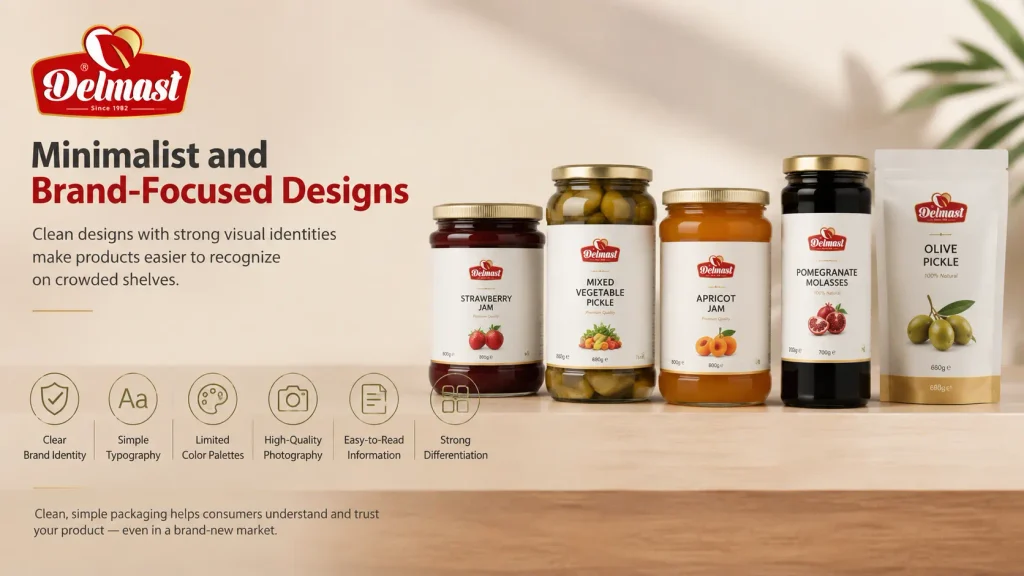
Packaging design is also becoming simpler.
Instead of filling every available space with information and graphics, many brands are choosing cleaner designs with stronger visual identities. This can make products easier to recognize on crowded shelves.
Minimalist packaging often focuses on:
- Clear brand identity
- Simple typography
- Limited color palettes
- High-quality product photography
- Easy-to-read product information
- Strong differentiation between product varieties
For companies selling food internationally, this can be particularly useful. Packaging needs to communicate the product quickly, even when consumers are unfamiliar with the brand.
Packaging for Export Markets
Global food trade has made export-oriented packaging another major area of development.
Food Packaging for Export needs to address more than appearance. Products may travel long distances, pass through multiple distribution centers, and face different temperatures and handling conditions.
Export packaging should therefore consider:
- Transportation distance
- Climate and humidity
- Product shelf life
- Pallet configuration
- Container loading
- Labeling requirements
- Product protection
- Destination-market regulations
Companies can also benefit from specialized Export Packaging strategies that consider freight, logistics, and product protection together.
Convenience Is Driving New Packaging Formats
Convenience continues to influence Food Packaging Trends. Consumers increasingly prefer packaging that is easy to open, store, portion, and use.
Depending on the product, this can include resealable pouches, smaller portion sizes, easy-open lids, and packaging that allows controlled dispensing.
For B2B food producers, convenience also means considering how packaging works throughout the supply chain. A package that is convenient for consumers but difficult to stack, transport, or fill may not be an efficient commercial solution.
The best Custom Packaging for Food Products balances consumer convenience with manufacturing and logistics requirements.
Premium Packaging for Premium Foods
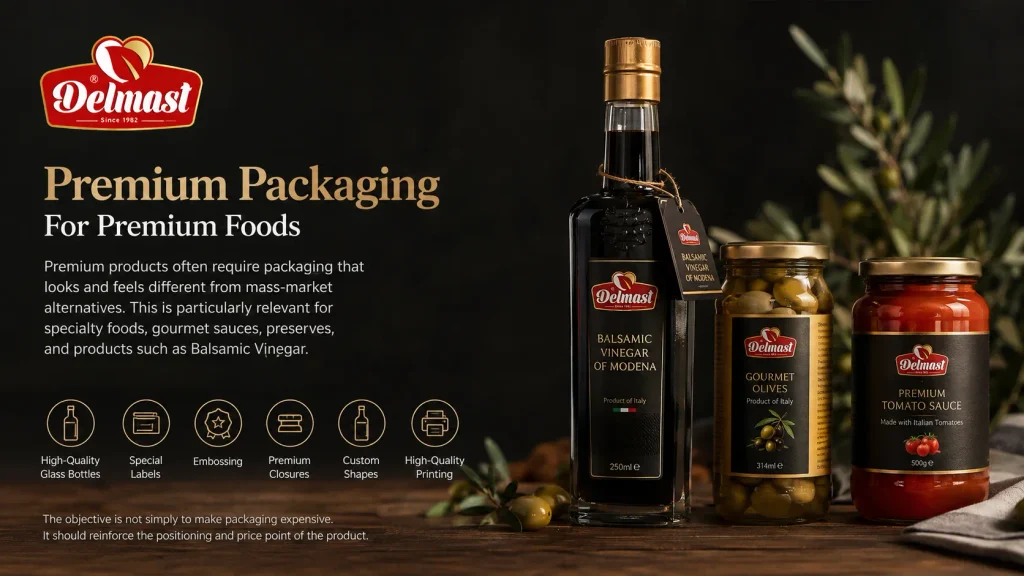
Another noticeable trend is the use of packaging to communicate product quality.
Premium products often require packaging that looks and feels different from mass-market alternatives. This is particularly relevant for specialty foods, gourmet sauces, preserves, and products such as Balsamic Vinegar.
A premium packaging strategy may include:
- High-quality glass bottles
- Special labels
- Embossing
- Premium closures
- Custom shapes
- High-quality printing
The objective is not simply to make packaging expensive. It should reinforce the positioning and price point of the product.
Smarter B2B Food Packaging
Technology is also influencing packaging. While smart packaging is still developing across many food categories, manufacturers are increasingly interested in features that improve traceability, inventory management, and consumer engagement.
QR codes, digital product information, batch identification, and traceability systems can connect physical packaging with digital information.
For B2B Food Packaging, these technologies can be especially useful because manufacturers, distributors, retailers, and exporters may all need access to product information at different points in the supply chain.
How to Choose the Right Custom Packaging
Following Custom packaging trends does not mean adopting every new packaging idea. The right solution should be selected based on the actual product and business requirements.
Before choosing packaging, consider:
- What is the product’s shelf life?
- Does it need refrigeration or freezing?
- How far will it be transported?
- Is it intended for retail or foodservice?
- What packaging machinery will be used?
- What are the target export markets?
- What material provides adequate product protection?
- What packaging quantity is required?
- How important are sustainability and recyclability?
A professional Food Packaging Supplier can help evaluate these factors and recommend a structure that fits the product and supply chain.
The Future of Custom Packaging Trends
The future of food packaging will likely combine customization, sustainability, functionality, and stronger branding. Businesses will increasingly expect packaging to do more than simply contain food.
For manufacturers and exporters, the most valuable Custom packaging trends will be those that solve practical problems: protecting products during transportation, extending shelf life, reducing waste, improving efficiency, and helping brands stand out.
Whether the product is frozen IQF Vegetables, IQF Fruits, Vinegar, sauces, pickled foods, or premium specialty products, packaging should be developed around its specific requirements.
Ultimately, successful Custom Food Packaging is not about following trends blindly. It is about finding the right balance between product protection, cost, sustainability, branding, logistics, and market requirements. Working with an experienced Food Packaging Supplier can help food manufacturers turn these trends into practical Food Packaging Solutions that work from production line to final market.