

 Jam
 Pickles
 Canned Vegetable
 Syrups
 Vinegar
 IQF Vegetables
 IQF Fruits
 Fruit Strip
 Iranian Foods
IQF Vegetable Suppliers for UK & Global Importers: B2B Distribution & Cold-Chain Guide

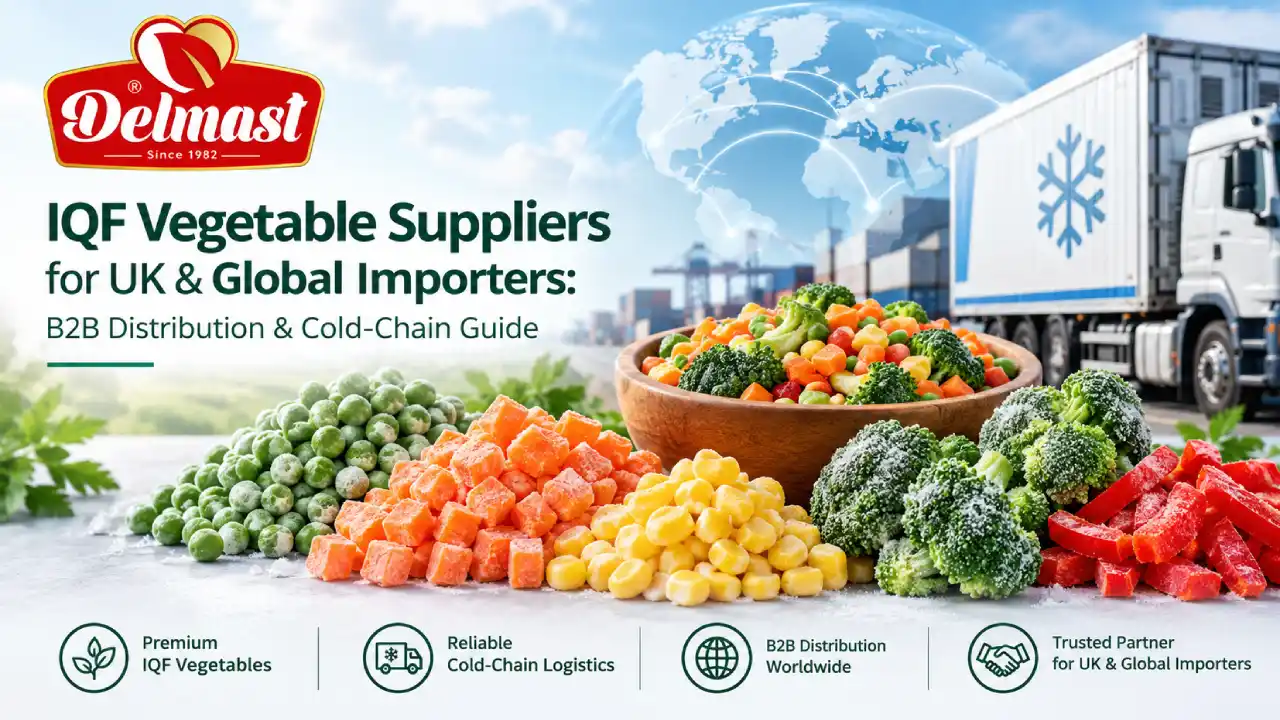
Choosing reliable IQF Vegetable Suppliers UK is essential for importers, wholesalers, food manufacturers and retail brands that need consistent frozen vegetable quality and dependable international delivery. Delmast is both a food manufacturer and a private-label producer, helping businesses source frozen vegetables and develop products under their own brand. As an experienced iqf vegetable supplier, Delmast supports B2B buyers looking for suitable products, packaging options and export-oriented supply solutions.
IQF (Individually Quick Frozen) technology freezes individual vegetable pieces rapidly, helping preserve their color, texture and nutritional characteristics. For international buyers, the right supplier must combine manufacturing capabilities with food safety controls, suitable packaging and reliable cold-chain logistics.
UK & European IQF Vegetable Distribution Specifications
| Specification | Details |
|---|---|
| Core IQF Export Lines | IQF Celery, Broccoli, Cauliflower, Chopped Spinach & Mixed Vegetables |
| Bulk Packaging | 10kg & 20kg Corrugated Cartons with Food-Grade Blue Poly Liner / 25kg Kraft Bags |
| Cold-Chain & Container | 40ft High-Cube Reefer Containers Maintained at -18°C to -22°C |
| Compliance & Standards | ISO 22000, HACCP, Pesticide Residue Lab Tested & Full UK/EU Import Documentation |
Sourcing from International IQF Vegetable Suppliers for the UK & European Market
The UK and European markets require consistent product quality, traceability and compliance with applicable food import regulations. For distributors and food manufacturers, working with IQF Vegetable Suppliers UK that understand international sourcing requirements can help simplify procurement and maintain a stable supply of frozen produce.
Importers can source directly from manufacturers or work with trading companies. Direct sourcing often makes it easier to discuss production specifications, packaging requirements, quality standards and private-label opportunities with the company responsible for manufacturing. Buyers looking for a frozen diced celery manufacturer can also discuss product specifications and bulk packaging options directly with suppliers.
Delmast serves as both a manufacturer and a private-label partner. This allows buyers to discuss frozen vegetable sourcing alongside branding and packaging requirements for retail, foodservice and industrial applications. The available options depend on the product, production capacity and order specifications.
What should importers look for in a supplier?
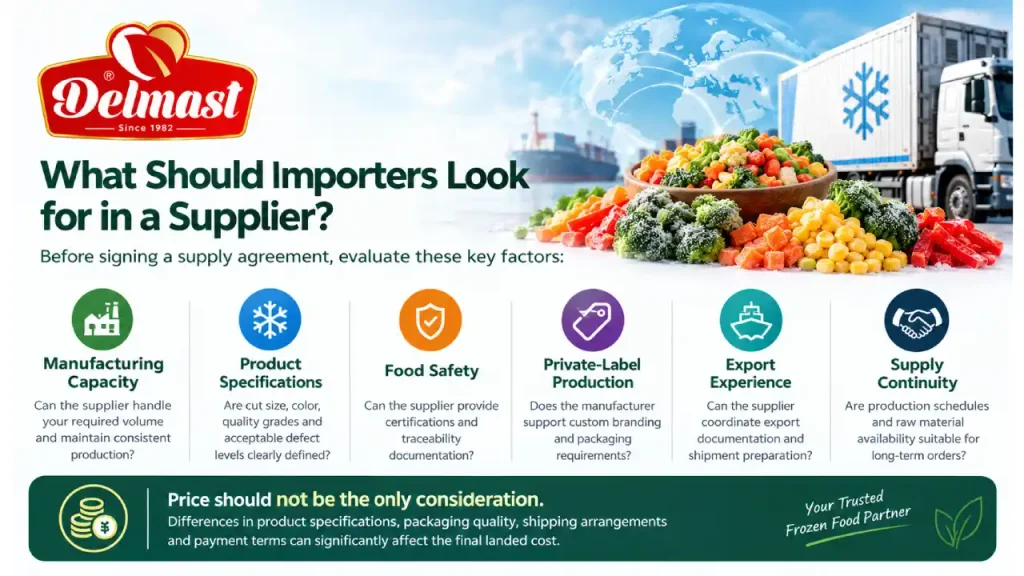
Before signing a supply agreement, buyers should evaluate the following factors:
- Manufacturing capacity: Can the supplier handle the required order volume and maintain consistent production?
- Product specifications: Are cut size, color, quality grades and acceptable defect levels clearly defined?
- Food safety: Can the supplier provide relevant certification and traceability documentation?
- Private-label production: Does the manufacturer support custom branding and packaging requirements?
- Export experience: Can the supplier coordinate export documentation and shipment preparation?
- Supply continuity: Are production schedules and raw material availability suitable for long-term orders?
Price should not be the only consideration. Differences in product specifications, packaging quality, shipping arrangements and payment terms can significantly affect the final landed cost.
Direct manufacturer vs. trading company
Both sourcing models can work, but they offer different advantages.
| Factor | Direct manufacturer | Trading company |
|---|---|---|
| Product specifications | Direct communication with the production team | Depends on the information available |
| Private-label options | Can coordinate directly with manufacturing | Depends on partner factories |
| Custom requirements | Discussed with the producer | Subject to supplier capabilities |
| Product range | Limited to available production lines | May cover multiple manufacturers |
| Production planning | Can be coordinated with factory schedules | Depends on supplier relationships |
| Quality communication | Direct access to manufacturing information | May involve intermediaries |
For businesses building long-term supply relationships, IQF Vegetable Suppliers UK should be assessed on their ability to meet technical requirements, maintain product consistency and communicate clearly throughout the purchasing process.
Key Requirements for an IQF Vegetable Distributor & Importer (ISO 22000 & Cold Chain)
Food safety and temperature control are critical when importing frozen vegetables. Distributors need to ensure that products remain safe, traceable and properly frozen from manufacturing through final delivery.
ISO 22000 and food safety documentation
ISO 22000 is an international food safety management system standard that helps organizations identify hazards, establish controls and maintain documented food safety procedures.
When evaluating IQF Vegetable Suppliers UK, importers should verify the scope and validity of relevant certifications rather than relying only on statements in marketing materials.
Important documents and checks may include:
- Food safety management certificates.
- HACCP-based hazard analysis and control procedures.
- Batch identification and traceability records.
- Product specifications and certificates of analysis, where applicable.
- Microbiological test results and quality inspection records.
- Ingredient, allergen and labeling information when relevant.
Importers must also confirm the applicable UK import rules for the product and country of origin. Requirements can vary depending on commodity classification, official controls and the exporting country.
Maintaining the cold chain
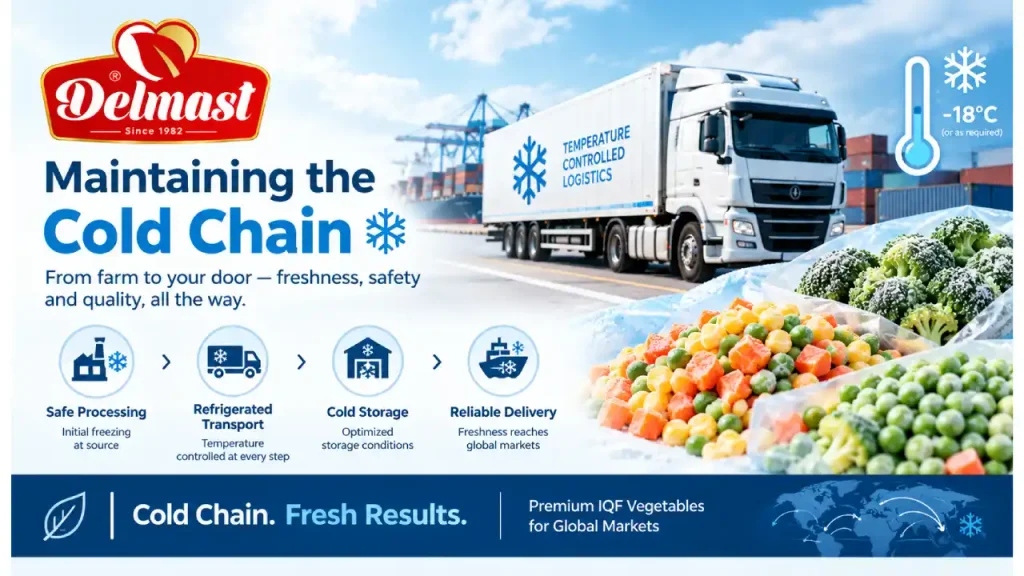
IQF vegetables must remain frozen during storage and transportation. Temperature fluctuations can affect product quality, cause excess ice formation and lead to pieces sticking together.
Many frozen vegetable products are transported at approximately −18°C or colder, subject to product specifications and applicable requirements. The exact temperature should be agreed upon with the manufacturer and logistics provider.
A reliable cold-chain plan should include:
- Checking reefer container condition before loading.
- Confirming that the container is set to the required temperature.
- Maintaining suitable storage conditions before dispatch.
- Preventing unnecessary exposure to ambient temperatures.
- Monitoring temperature records throughout transit.
- Arranging prompt collection and refrigerated storage at the destination.
Cold-chain management should cover the entire journey, including factory storage, port handling, ocean freight, customs clearance and final delivery.
Essential import documentation
Incomplete paperwork can delay customs clearance and increase storage costs. Buyers should agree on documentation requirements before shipment.
| Document | Purpose |
|---|---|
| Commercial invoice | Details the transaction and declared value |
| Packing list | Identifies package counts and shipment weights |
| Bill of lading | Records key transportation details |
| Certificate of origin, if required | Supports verification of product origin |
| Health or official certificates, where applicable | Supports compliance with relevant import controls |
| Product specification sheet | Defines product characteristics and quality requirements |
| Temperature records | Helps verify cold-chain conditions |
| Traceability records | Connects products to production batches |
The required documents depend on the destination market, product and country of origin. Importers should verify the current requirements with the relevant authorities and customs professionals.
High-Demand Bulk Frozen Produce: Broccoli, Cauliflower, Spinach, Celery & Leeks
Food manufacturers, retailers, restaurants and distributors purchase frozen vegetables for different applications. Some need retail-ready packs, while others require bulk packaging for automated production lines, catering operations or prepared food manufacturing.
When comparing IQF Vegetable Suppliers UK, buyers should confirm that the supplier can provide the required vegetable varieties, product formats, packaging and order volumes.
Delmast’s IQF vegetable portfolio includes sweet corn, green peas, carrots, mixed vegetables, cauliflower, broccoli, spinach and celery. Buyers can contact the manufacturer to discuss current availability and export specifications.
IQF broccoli and cauliflower
Broccoli is commonly used in frozen vegetable mixes, ready meals, soups and foodservice dishes. Its commercial suitability depends on factors such as floret size, color, texture and the percentage of broken or undersized pieces.
Explore Delmast’s IQF broccoli page to review the product offering for wholesale and industrial sourcing.
Cauliflower is another versatile vegetable used in frozen meals, soups, prepared dishes and retail packs. Importers should specify the required cut size and quality standards before requesting a quotation.
Delmast also offers IQF cauliflower for buyers assessing frozen vegetable options for their product portfolios.
Spinach and celery
IQF spinach is suitable for soups, sauces, fillings, prepared meals and foodservice recipes. Buyers should confirm whether they require chopped spinach, leaf formats or another available presentation.
Celery is widely used in stocks, soups, sauces and frozen vegetable blends. Consistent cut size can help food manufacturers maintain standardized recipes and improve portion control.
For both products, buyers should check the required specifications, moisture characteristics, packaging format and suitability for the intended application.
Leeks, peppers and beets
Importers may also need additional vegetables to expand their product range or meet specific customer requirements.
An iqf leek manufacturer should be able to discuss available cut formats, such as sliced or diced leeks, along with minimum order quantities and packaging options. Leeks are commonly used in soups, sauces and prepared meals.
An iqf pepper supplier may offer different pepper varieties and cuts for stir-fries, pizza toppings, sauces and frozen vegetable mixes. Buyers should confirm color, cut dimensions and product availability.
Businesses sourcing iqf beets should specify whether they require sliced, diced or other formats. Availability should be confirmed directly with the manufacturer before the product is included in a purchasing plan.
Not every manufacturer offers all these vegetables. Buyers should verify the available range rather than assume that every product can be supplied.
Comparing frozen vegetable specifications
| Product | Common applications | Key purchasing considerations |
|---|---|---|
| Broccoli | Ready meals, soups, vegetable mixes | Floret size, color, defects |
| Cauliflower | Frozen meals, retail packs, foodservice | Cut size, consistency |
| Spinach | Sauces, soups, fillings | Leaf or chopped format, moisture |
| Celery | Stocks, soups, processed foods | Cut size, cleanliness |
| Leeks | Soups, sauces, prepared meals | Slice thickness, product format |
| Peppers | Stir-fries, sauces, pizza toppings | Variety, color, cut dimensions |
| Beets | Foodservice, prepared meals | Cut format, availability |
Private-label and bulk packaging
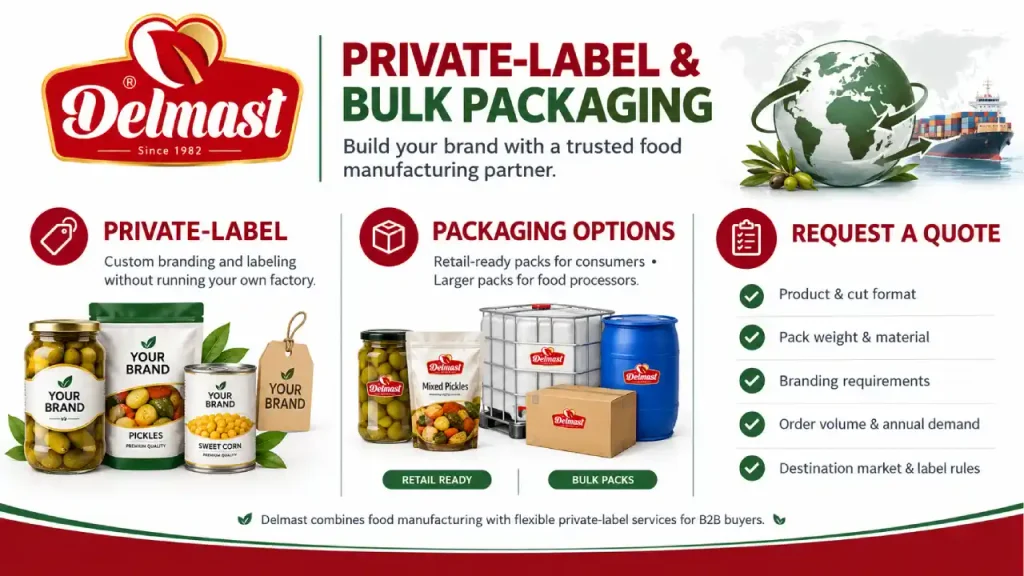
Private-label manufacturing allows retailers and distributors to sell products under their own brand without operating a food production facility. Instead, they work with a manufacturer to establish suitable product specifications, packaging and labeling.
Delmast combines food manufacturing with private-label services, allowing B2B buyers to discuss branding and packaging alongside their sourcing requirements. This can be useful for businesses entering new markets or expanding their existing frozen food range.
Packaging should match the distribution channel. Retail products may require consumer-ready bags and branded labels, while food processors often need larger packs that are convenient for industrial handling.
When requesting a quotation, specify:
- Product and cut format.
- Required pack weight and packaging material.
- Retail branding or private-label requirements.
- Order volume and estimated annual demand.
- Destination market and labeling requirements.
Container Loading, Palletization & Reefer Logistics to UK and Global Ports
International frozen vegetable shipments require careful coordination between the manufacturer, freight forwarder, shipping line, customs broker and importer. Even when products leave the factory in good condition, poor loading practices or temperature control can affect their quality before delivery.
For IQF Vegetable Suppliers UK, dependable logistics planning is an important part of the overall sourcing process.
Selecting the right reefer container
Refrigerated containers, known as reefers, maintain controlled temperatures during transportation. The appropriate container depends on shipment volume, cargo weight, packaging dimensions and the shipping route.
A 40-foot reefer may suit larger orders, while smaller shipments may require different arrangements. The decision should be based on actual cargo requirements, carrier availability and permitted payload limits.
Before booking, confirm:
- Required temperature settings.
- Container capacity and payload limits.
- Estimated transit time and transshipment points.
- Reefer availability at the loading port.
- Destination port handling and cold-storage arrangements.
- Shipping schedules and contingency plans for delays.
Palletization and container loading
Proper palletization helps protect cartons, improve warehouse handling and support efficient unloading. The loading plan must also allow appropriate airflow inside the reefer container.
A standard loading checklist includes:
- Inspect packaging: Confirm that cartons and bags are intact and suitable for frozen transport.
- Prepare pallets: Follow the agreed pallet dimensions and stacking configuration.
- Check product temperature: Verify that the cargo meets the agreed loading specifications.
- Load correctly: Avoid blocking air circulation channels and exceeding weight limits.
- Record shipment details: Document pallet counts, batch numbers and relevant temperature information.
- Secure the cargo: Minimize movement during transit using suitable loading methods.
Importers should agree on pallet dimensions and carton configurations in advance, especially when their destination warehouses have specific receiving requirements.
Shipping to the UK and international markets
Successful delivery depends on coordinating production schedules, port cut-off times, customs documentation and final transportation. Delays can increase demurrage, detention and refrigerated storage costs.
For UK-bound shipments, buyers should verify the appropriate port, import procedures and inland transport arrangements before dispatch. European and other international destinations may have different documentation and food control requirements.
Delmast can coordinate product and packaging discussions as part of its manufacturing and private-label services. The purchase agreement should clearly define Incoterms, freight responsibilities, insurance, export documentation and temperature monitoring arrangements.
How to request a B2B quotation from Delmast
To receive a relevant quotation, importers should provide clear information about their purchasing requirements. This helps the manufacturer assess product availability, packaging needs and shipment arrangements.
Include the following details in your inquiry:
- Required vegetables and product specifications.
- Order quantity and expected annual demand.
- Packaging format and private-label requirements.
- Destination country and preferred port.
- Required certifications and import documents.
- Target delivery date and preferred shipping terms.
Delmast supports businesses seeking a manufacturing partner for frozen vegetables and private-label food products. By discussing specifications, packaging and logistics at the beginning of the process, importers can establish clearer expectations and build a supply arrangement suited to their target markets.
Ultimately, choosing the right IQF Vegetable Suppliers UK requires more than comparing unit prices. Verified food safety procedures, consistent product quality, dependable cold-chain management, suitable packaging and clear communication all contribute to a reliable long-term B2B partnership.