

 Jam
 Pickles
 Canned Vegetable
 Syrups
 Vinegar
 IQF Vegetables
 IQF Fruits
 Fruit Strip
 Iranian Foods
Certified IQF Fruit Supplier: Sourcing Bulk Industrial Frozen Fruits for Food Manufacturers & HORECA

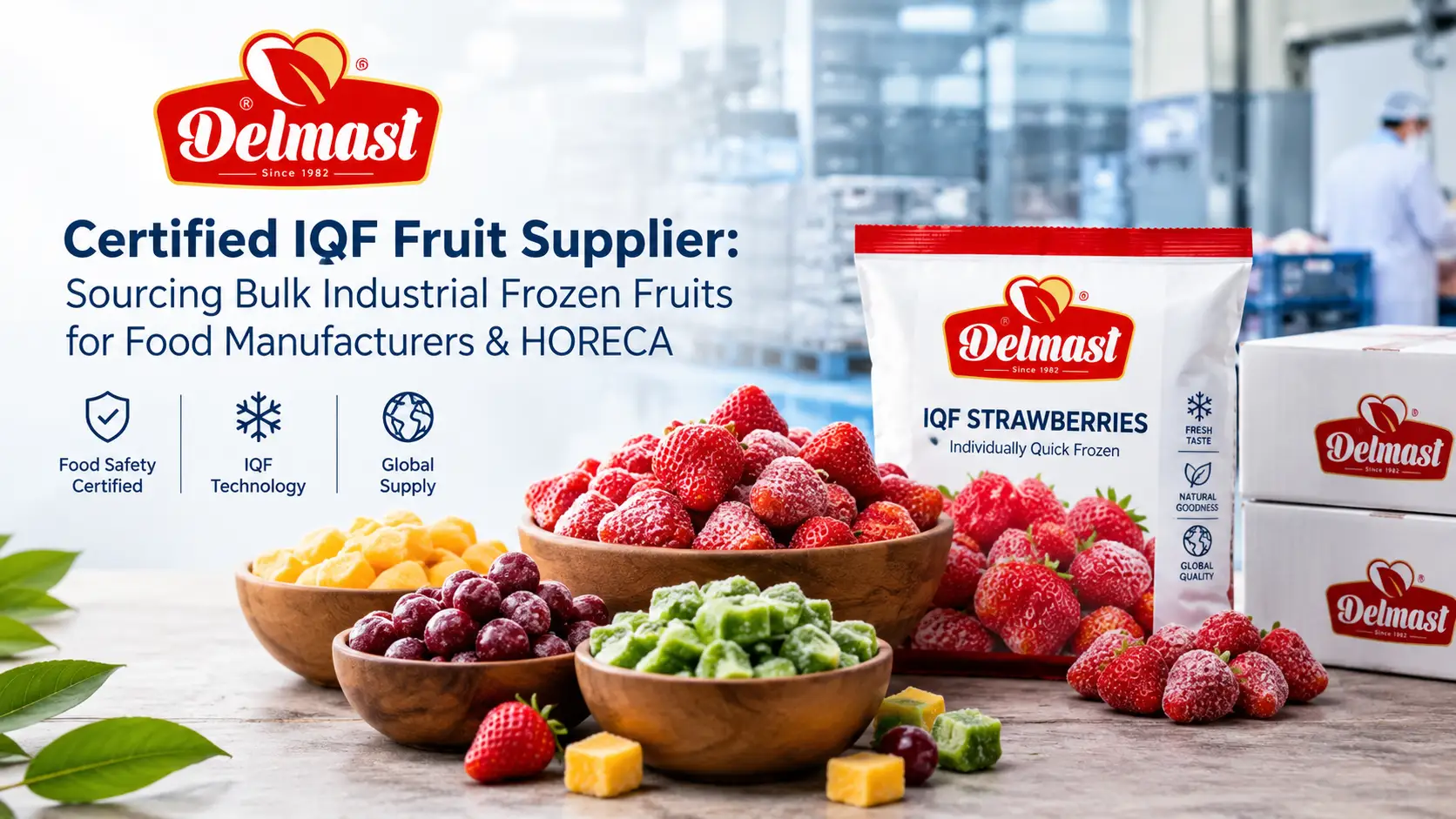
Choosing a certified IQF fruit supplier involves more than comparing prices per kilogram. Food manufacturers need consistent fruit sizes, reliable freezing standards, documented food safety controls, and packaging that fits their production lines. Delmast supplies IQF fruit for industrial processing and commercial foodservice, with options for bulk purchasing and export. Buyers can review available products through the certified IQF fruit supplier portfolio and assess specifications before placing an order. This approach helps procurement teams match fruit quality with production requirements, storage capacity, and target markets.
Global IQF Fruits Market & Industrial Applications (Jam, Dairy & Bakery)
The iqf fruits market serves manufacturers that need frozen fruit ingredients throughout the year without depending entirely on seasonal fresh-fruit availability. IQF, or Individual Quick Freezing, freezes individual fruit pieces rapidly so they remain separate instead of forming a solid block.
For food businesses, this makes purchasing, portioning, and handling easier. Jam producers, bakeries, dairy manufacturers, beverage processors, and HORECA distributors can select fruit formats according to their recipes and operational needs.
Working with established iqf fruit manufacturers also gives procurement teams a clearer route to discussing grading, packaging, order volumes, and export documentation.
Why Industrial Jam, Smoothie, and Yogurt Makers Rely on Individual Quick Freezing
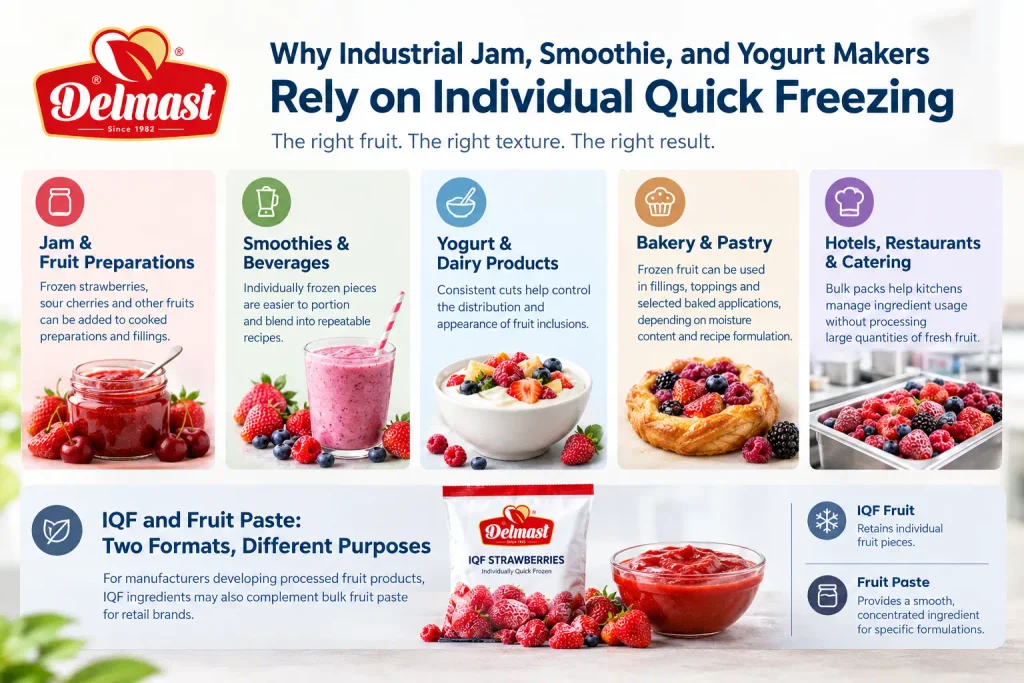
Different applications require different fruit characteristics. Jam manufacturers may prioritize flavor, color, and processing yield, while smoothie producers need fruit that blends consistently. Yogurt manufacturers often require recognizable fruit pieces that distribute evenly throughout the product.
IQF fruit supports these requirements through practical advantages:
- Jam and fruit preparations: Frozen strawberries, sour cherries, and other fruits can be incorporated into cooked preparations and fillings.
- Smoothies and beverages: Individually frozen pieces are easier to portion and blend into repeatable recipes.
- Yogurt and dairy products: Consistent cuts help control the distribution and appearance of fruit inclusions.
- Bakery and pastry: Frozen fruit can be used in fillings, toppings, and selected baked applications, depending on moisture content and recipe formulation.
- Hotels, restaurants, and catering: Bulk packs help kitchens manage ingredient usage without processing large quantities of fresh fruit.
For manufacturers developing processed fruit products, IQF ingredients may also complement bulk fruit paste for retail brands. The two formats serve different purposes: IQF retains individual fruit pieces, while fruit paste provides a more uniform ingredient for formulations that require a smooth or concentrated texture.
Preserving Natural Brix, Cellular Integrity, and Color Without Added Sugar
Rapid freezing helps limit the formation of large ice crystals that can damage fruit tissue. However, IQF processing does not guarantee that fruit will retain every characteristic of its fresh counterpart. Variety, ripeness, preparation, freezing conditions, and thawing practices all influence the final result.
Brix measures the soluble solids concentration of fruit juice and is commonly used to assess sweetness. It is particularly relevant when manufacturers need predictable flavor profiles for jams, dairy preparations, and beverages.
Freezing itself does not require added sugar. Buyers should nevertheless confirm whether the product contains added ingredients and request a specification sheet covering relevant parameters, including Brix where applicable, cut size, color, and permitted defects.
For fruit for industrial applications, these details are more useful than a general claim of premium quality because they help production teams assess whether a product will perform consistently in a specific recipe.
Core Export Portfolio: Sour Cherries, Strawberries, Pomegranate Arils & Orchard Fruits
A commercial IQF portfolio should cover the fruit formats buyers actually use, rather than offering a single standard cut for every application. Delmast’s product range includes fruit options for food processing and bulk export, allowing buyers to evaluate products against their intended use.
Bulk Pitted IQF Sour Cherries & Calibrated IQF Strawberries (Whole & Diced)
Sour cherries are used in bakery fillings, desserts, fruit preparations, sauces, and other processed foods. For bulk buyers, pitting quality, remaining stem or pit fragments, color, and piece integrity are important points to verify.
Delmast’s IQF Sour Cherries are relevant to manufacturers sourcing iqf sour cherries for commercial recipes. Buyers should confirm whether the required specification covers whole pitted fruit, size grading, acceptable breakage, and packaging weight.
Strawberries are another widely used ingredient across yogurt, ice cream, bakery, jam, and beverage production. Depending on the application, buyers may require whole berries, diced fruit, or calibrated sizes.
Explore IQF Strawberries for product-specific information. Whole berries can suit applications where appearance matters, while diced formats may simplify portion control and mixing. When evaluating an IQF fruit supplier, request details about size tolerances, ripeness, color, and the proportion of broken pieces.
IQF Pomegranate Arils, Diced Apples, Pears, Kiwi & Seedless Grapes
Pomegranate arils provide a distinct appearance and flavor for desserts, prepared foods, beverages, and selected foodservice applications. Their delicate structure makes handling, sorting, and packaging particularly relevant. Delmast offers IQF Pomegranate Arils for buyers evaluating frozen pomegranate ingredients.
Orchard fruits extend the available options for industrial recipes:
- Apples: Diced apples can be used in bakery fillings, fruit preparations, and processed desserts. An iqf apple supplier should provide details about cut dimensions, browning control, and the intended application.
- Pears: Frozen pears can support desserts, fillings, and fruit blends. Buyers comparing an iqf pear manufacturer should check firmness after thawing, cut consistency, and product handling requirements.
- Kiwi: Sliced or diced kiwi may suit fruit blends and selected dessert applications. An iqf kiwi manufacturer should clarify the available formats and how the product performs after thawing.
- Grapes: Frozen grapes can be used in selected beverage, dessert, and fruit-blend applications. An iqf grape supplier should specify whether the fruit is seedless, the grading criteria, and the intended end use.
Not every fruit behaves identically during freezing or thawing. Before committing to recurring bulk volumes, manufacturers should evaluate representative samples under their actual processing conditions.
Which Companies Offer the Best Quality IQF Fruit for Food Manufacturers?
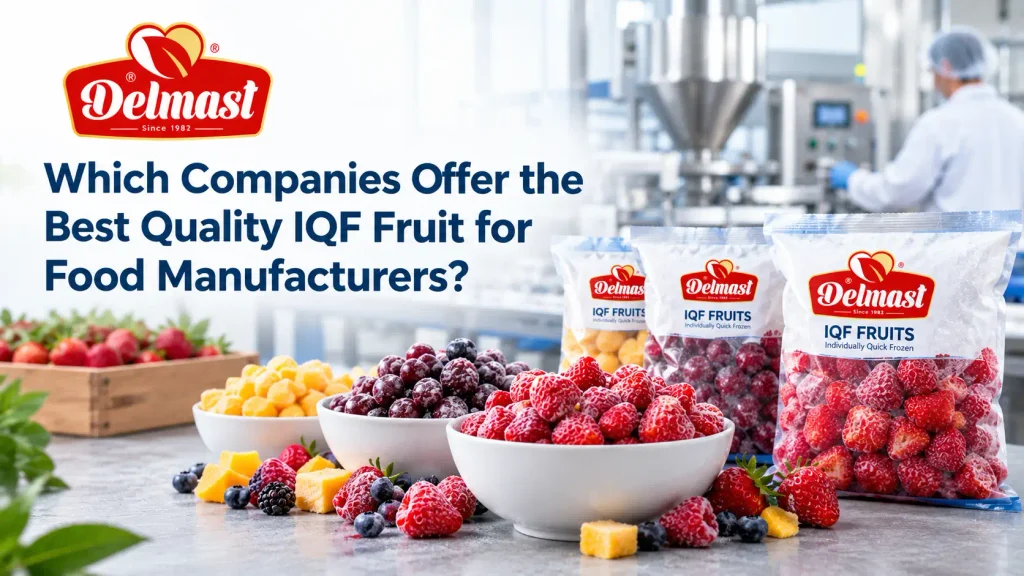
The best supplier is one that can demonstrate product consistency, food safety controls, traceability, and dependable export handling. A manufacturer’s name or a low quotation alone cannot establish whether a frozen fruit product meets a buyer’s requirements.
When assessing which companies offer the best quality IQF fruit for food manufacturers, procurement teams should examine the following criteria:
- Food safety certification: Verify the scope and validity of relevant certifications, such as ISO 22000 and HACCP-based food safety systems. Certification should be supported by documentation rather than an unsupported marketing claim.
- Sorting and foreign-material control: Ask whether the production line uses optical or laser sorting where appropriate, alongside industrial metal detection and documented inspection procedures.
- Freezing performance: Confirm the freezing process, product core temperature, and whether individual pieces remain free-flowing. A reported air temperature of -38°C describes a process condition, not necessarily the final product temperature.
- Cold-chain management: Frozen fruit is commonly stored and transported at -18°C or colder, according to the product specification and applicable requirements. Ask for temperature monitoring and shipment records.
- Traceability and documentation: Request batch identification, product specifications, ingredient declarations, shelf-life information, and relevant export documents.
- Commercial reliability: Confirm minimum order quantities (MOQs), lead times, sample availability, packaging options, and the supplier’s ability to maintain specifications across repeat orders.
Delmast provides a starting point for buyers seeking an export-oriented supplier of frozen fruit. Before finalizing a contract, buyers should verify the applicable certifications, product-specific specifications, and shipment arrangements for their destination market.
B2B Technical Specifications & Bulk Export Packaging Table
The following table outlines common commercial considerations when sourcing IQF fruit. Exact specifications, pack formats, and certification coverage should be confirmed with the supplier for each product and order.
| Specification | Details |
|---|---|
| IQF berry and stone fruit lines | Whole or diced IQF Strawberries, pitted IQF Sour Cherries, and apricot halves, subject to availability |
| Orchard and specialty fruits | IQF Pomegranate Arils, diced apples, pears, sliced kiwi, and grapes |
| Freezing and sorting | Flash-freezing process; optical sorting and metal detection where available; free-flowing product specification |
| Bulk export packaging | 10 kg and 15 kg poly-lined cartons or 25 kg kraft bags, subject to product and packaging availability |
| Retail and private label | Potential OEM pouch formats from 400 g to 2.5 kg, subject to order requirements |
| Food safety and cold chain | Verify applicable ISO 22000 and HACCP documentation, Halal status where required, and storage at -18°C or colder |
| Shelf life | Confirm the declared shelf life for each product and packaging format; a 24-month period should not be assumed without product-specific documentation |
Packaging selection should account for more than the price of the carton. Industrial buyers need to consider pallet configuration, container loading, warehouse handling, moisture protection, and how quickly the product will be consumed after opening.
For private-label projects, confirm the required artwork, label language, ingredient declaration, net weight, and destination-market regulations before production. These checks help avoid delays when the shipment reaches the importing country.
How to Choose the Right IQF Fruit Supplier for Your Business
Before requesting a quotation, prepare a clear purchasing specification. Include the fruit variety, cut size, acceptable defect levels, intended application, annual volume, packaging preference, delivery destination, and required certifications.
Ask shortlisted suppliers to provide a technical data sheet, a commercial quotation, and samples where available. Testing the fruit in the intended recipe can reveal issues with texture, moisture release, color, or portioning that a specification sheet alone may not identify.
For recurring purchases, evaluate the supplier on consistency across batches rather than on the first delivery alone. A practical agreement should define product tolerances, inspection procedures, storage conditions, delivery schedules, and how nonconforming batches will be handled.
Delmast serves commercial buyers exploring IQF fruit for food manufacturing and export applications. By comparing product specifications and confirming order requirements in advance, businesses can make a more informed sourcing decision and build a supply arrangement suited to their production needs.