

 Jam
 Pickles
 Canned Vegetable
 Syrups
 Vinegar
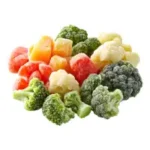 IQF Vegetables
 IQF Fruits
 Fruit Strip
 Iranian Foods
How to Choose the Right IQF Vegetable Supplier for Your Business

Choosing the right IQF vegetable supplier is an important decision for food manufacturers, wholesalers, distributors, restaurants, and importers. The supplier you work with can affect everything from product quality and food safety to delivery times and the cost of your final product.
For bulk buyers, the decision should not be based on price alone. A reliable supplier needs to provide consistent IQF vegetables, suitable packaging, dependable production capacity, and the documentation required for international trade. Working with a certified IQF vegetable supplier also helps buyers verify food safety standards and ensure compliance with relevant export requirements.
Before placing a large order, it is worth checking how the supplier handles freezing, quality control, certifications, packaging, exports, and long-term supply.
What Is an IQF Vegetable Supplier?
An IQF vegetable supplier provides vegetables that have been processed and frozen using Individual Quick Freezing technology. Unlike vegetables frozen together in large blocks, IQF vegetables are frozen individually, making them easier to portion, store, transport, and use.
IQF vegetables are commonly purchased by businesses rather than individual consumers. Typical buyers include:
- Food manufacturers
- Frozen food companies
- Restaurants and foodservice businesses
- Wholesalers and distributors
- Importers
- Catering companies
- Ready-meal manufacturers
- Food processors
An IQF supplier may also be the actual manufacturer. This distinction matters because buying directly from an IQF vegetable manufacturer can give commercial buyers more control over specifications, packaging, production, and repeat orders. Working with an experienced IQF fruit supplier for food manufacturers can offer similar advantages, helping buyers coordinate product requirements, packaging formats, and supply volumes directly with the source.
Why Choosing the Right IQF Vegetable Supplier Matters
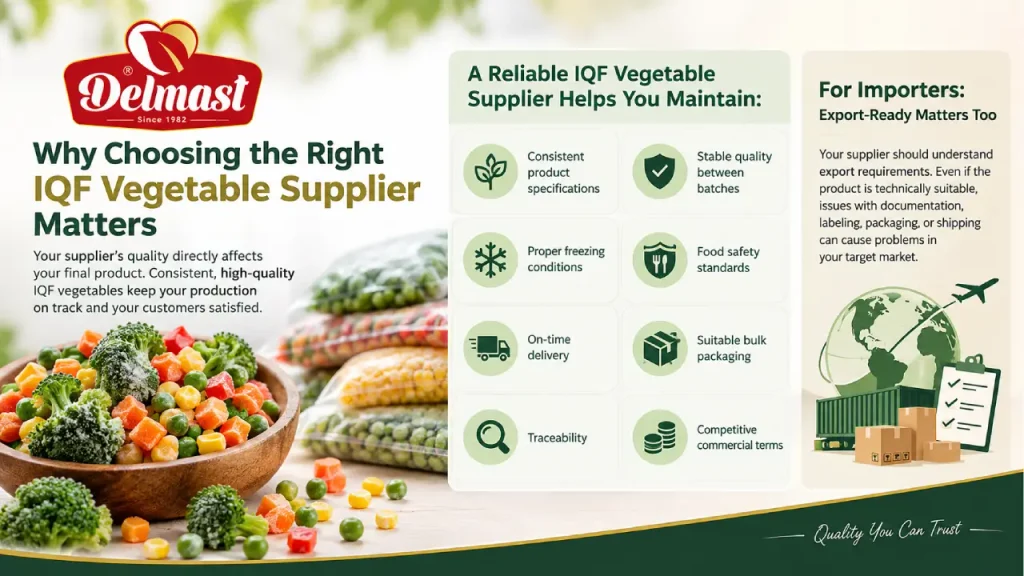
The quality of your supplier directly affects the quality of your finished product. If vegetables arrive with inconsistent sizes, poor color, excessive ice, or unsuitable texture, these problems can continue through your production process.
Supply problems can also create delays when you depend on frozen vegetables as a regular ingredient. When comparing IQF vegetable suppliers UK and Europe, buyers should assess product consistency, food safety standards, and the supplier’s ability to meet regional import and distribution requirements.
A reliable IQF vegetable supplier should help you maintain:
- Consistent product specifications
- Stable quality between batches
- Appropriate freezing conditions
- Food safety standards
- Reliable delivery schedules
- Suitable bulk packaging
- Traceability
- Competitive commercial terms
For importers, there is another consideration: the supplier needs to understand export requirements. A product can be technically suitable but still cause problems if its documentation, labeling, packaging, or shipping arrangements are not appropriate for the destination market.
7 Factors to Consider When Choosing an IQF Vegetable Supplier
There are several factors worth checking before choosing an IQF supplier. Looking at these areas together gives you a much clearer picture than comparing quotations alone.
1. Product Quality
Product quality should be the first thing you evaluate.
Ask the supplier for detailed product specifications and, where possible, request samples before placing a commercial order.
Check factors such as:
- Vegetable color
- Size and cut
- Uniformity
- Texture
- Taste and odor
- Foreign material control
- Broken pieces
- Defect tolerance
- Moisture
- Storage temperature
- Shelf life
The sample should also be tested in the way your business will actually use the product. A vegetable that looks good when frozen may behave differently after thawing or cooking.
2. Freezing Process
The freezing process is one of the defining characteristics of IQF vegetables.
Individual Quick Freezing is designed to freeze individual pieces rapidly. A properly controlled process can help maintain the vegetable’s appearance, texture, and usability.
When speaking with an IQF vegetable manufacturer, ask about:
- Preparation before freezing
- Washing and sorting
- Cutting and sizing
- Freezing technology
- Temperature control
- Cold storage
- Handling after freezing
- Cold-chain management
You do not necessarily need a technical explanation of every machine used in the factory. What matters is whether the manufacturer has a controlled process and can consistently meet the agreed product specification.
3. Food Safety Certifications
Food safety is especially important when buying frozen vegetables for commercial production.
Before ordering, ask which certifications and food safety systems the supplier maintains. Also check whether the certification applies to the relevant manufacturing facility and products.
Important areas to review include:
- ISO 22000 certification
- HACCP-based food safety controls
- GMP practices
- Traceability
- Hygiene procedures
- Product testing
- Batch identification
- Recall procedures
For buyers looking specifically for certified production, you can learn more through the ISO 22000 certified food manufacturer page.
Certifications are useful, but they should not be the only consideration. Product samples, specifications, factory controls, and supply history are equally important when evaluating an IQF vegetable supplier.
4. Packaging Options
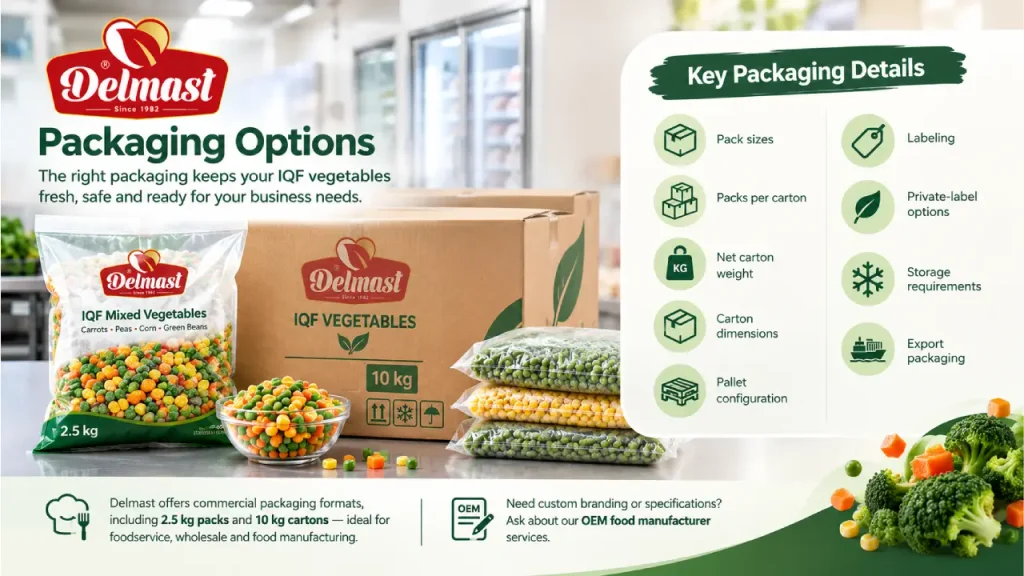
Packaging needs to match the way your business purchases, stores, and uses frozen vegetables.
A restaurant, distributor, and industrial food manufacturer may have completely different packaging requirements.
Before ordering, ask about:
- Pack sizes
- Number of packs per carton
- Net carton weight
- Carton dimensions
- Pallet configuration
- Labeling
- Private-label options
- Storage requirements
- Export packaging
Delmast supplies IQF vegetables in commercial packaging formats, including 2.5 kg packs and 10 kg cartons. This type of packaging can be practical for foodservice, wholesale, and food manufacturing applications.
If you need customized branding or specifications, it is also useful to check whether the company provides OEM food manufacturer services.
5. Production Capacity
A supplier may have a good product but still be unsuitable for your business if it cannot handle your required volume.
This is particularly important for importers and distributors placing recurring orders.
Ask about:
- Production capacity
- Minimum order quantity
- Available inventory
- Seasonal production
- Lead times
- Storage capacity
- Repeat-order capability
- Ability to increase volumes
A supplier should give you a realistic idea of how much it can produce and how long an order will take.
6. Export Experience
Export experience is important when sourcing IQF vegetables internationally.
Frozen products require proper temperature control, suitable packaging, and coordinated logistics. Export documentation must also be prepared correctly.
When evaluating an IQF vegetable supplier, ask:
- Which countries do you export to?
- How long have you been exporting?
- Which export documents can you provide?
- What are your standard Incoterms?
- Which ports do you normally use?
- How do you manage cold-chain transportation?
- Can you meet destination-market labeling requirements?
You can also review Delmast’s export markets to understand its international food export activities.
7. Consistency of Supply
A supplier should be able to provide consistent quality and availability rather than simply delivering one successful shipment.
This is especially important for companies that use IQF vegetables as regular ingredients.
Ask how the supplier manages:
- Seasonal raw material availability
- Production planning
- Inventory
- Repeat orders
- Sudden increases in demand
- Supply interruptions
- Product specifications between batches
A long-term supply relationship is much easier when expectations are established from the beginning.
What Certifications Should an IQF Vegetable Supplier Have?
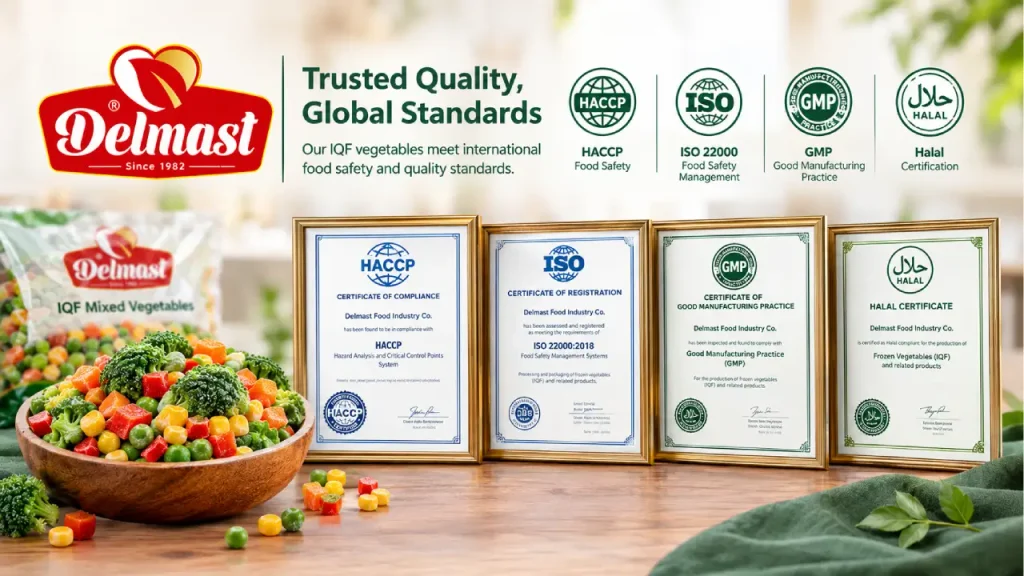
There is no single certification that automatically makes an IQF vegetable supplier suitable for every buyer or market. Requirements can vary depending on the destination country, product, and intended application.
However, buyers should look for evidence of a structured food safety system.
Important credentials and controls may include:
- ISO 22000
- HACCP
- GMP
- Traceability systems
- Food safety procedures
- Product specifications
- Batch control
- Appropriate export documentation
ISO 22000 is particularly relevant because it provides a framework for managing food safety risks throughout the food chain.
At the same time, buyers should request copies or details of applicable certifications rather than relying on a supplier simply stating that it is “certified.”
How to Evaluate IQF Vegetable Quality
Evaluating IQF vegetable quality should involve more than looking at a product photograph or reading a catalogue description.
If you are considering a new supplier, request a sample and compare it with your requirements.
During the evaluation, check:
- Appearance: Is the color natural and consistent?
- Size: Are individual pieces reasonably uniform?
- Cut: Does the cut match your production requirements?
- Separation: Do the pieces remain individually frozen?
- Ice: Is there excessive ice buildup?
- Texture: Does the vegetable maintain an acceptable texture after cooking?
- Odor: Is there any unusual smell?
- Foreign material: Is the product properly cleaned and sorted?
- Packaging: Is the pack intact and suitable for frozen storage?
It is also useful to compare samples from different batches. This can tell you more about consistency than testing a single shipment.
Packaging and Bulk Supply Options for IQF Vegetables
Commercial buyers usually need larger quantities than retail customers. For this reason, packaging is an important part of an IQF supply agreement.
Delmast offers IQF vegetables in 2.5 kg packaging with 10 kg cartons, providing a commercial format suitable for bulk purchasing.
Before confirming an order, clarify:
- Pack weight
- Carton weight
- Number of packs per carton
- Pallet arrangement
- Product labeling
- Carton labeling
- Minimum order quantity
- Storage temperature
- Shipping conditions
For distributors and importers, carton and pallet specifications are particularly important because they affect warehouse space and transportation efficiency.
Businesses looking for customized branding can also discuss private-label requirements directly with the manufacturer.
Which IQF Vegetables Can You Source from a Supplier?
The product range available from an IQF supplier depends on its production facilities and sourcing capabilities.
A supplier with several vegetable products can make purchasing easier because you may be able to consolidate multiple products into the same commercial relationship.
Delmast’s IQF range includes:
- IQF celery – suitable for soups, sauces, prepared meals, and food processing
- IQF carrot – used in prepared foods, soups, sauces, and vegetable mixes
- IQF green peas – commonly used in frozen meals and foodservice
- IQF sweet corn – suitable for prepared meals, salads, and processed foods
- IQF cauliflower – used in foodservice and processed food applications
- IQF broccoli – suitable for vegetable mixes and prepared meals
- IQF spinach – commonly used in sauces, fillings, cooked foods, and ready meals
You can explore the complete IQF vegetables range to see the available product categories.
When comparing products, make sure the supplier can meet your required cut, size, packaging, and quality specifications rather than choosing only based on the vegetable name.
How to Check an IQF Supplier’s Export Capability
Export capability should be checked before you place a large international order.
An experienced exporter should be able to explain the commercial and logistical side of the shipment clearly.
Check whether the supplier can provide:
- Commercial invoices
- Packing lists
- Product specifications
- Certificates required for the destination
- Shipping documentation
- Traceability information
- Appropriate product labeling
- Export packaging
- Cold-chain arrangements
It is also useful to ask about previous export destinations. Experience with international buyers can help reduce misunderstandings about documentation, packaging, shipping, and delivery requirements.
Do not hesitate to ask for a clear timeline from production to shipment. This can help you plan warehouse space and inventory before the goods arrive.
Questions to Ask an IQF Vegetable Manufacturer Before Ordering
Before signing a supply agreement, prepare a list of questions and make sure the supplier can answer them clearly.
Product questions
- What IQF vegetables do you manufacture?
- What cuts and sizes are available?
- Can you provide product specifications?
- Can I request a sample?
- What is the expected shelf life?
- How is product quality controlled?
Packaging questions
- What pack sizes are available?
- Do you offer 2.5 kg packs?
- Are 10 kg cartons available?
- Can you provide private-label packaging?
- How are cartons arranged on pallets?
Commercial questions
- What is your MOQ?
- What is your standard lead time?
- What are your payment terms?
- Which Incoterms do you offer?
- Can you handle recurring orders?
Export questions
- Which countries do you currently export to?
- Can you provide export documentation?
- How is the cold chain maintained?
- Which shipping ports do you normally use?
- Can you meet the labeling requirements of my market?
Getting these answers before ordering makes the purchasing process much more straightforward.
Why Partner with Delmast as Your IQF Vegetable Supplier & Global IQF Supplier?
Delmast combines food manufacturing and international export experience, making it a suitable option for businesses looking for an IQF vegetable supplier with direct manufacturing capabilities.
Active since 1998, Delmast supplies a range of IQF vegetables, including:
- Celery
- Carrot
- Green peas
- Sweet corn
- Cauliflower
- Broccoli
- Spinach
IQF products are available in 2.5 kg packs and 10 kg cartons, supporting bulk purchasing and distribution. Delmast also offers OEM food manufacturing and customized production options based on product and packaging requirements.
When evaluating Delmast, buyers can consider key factors such as:
- Product quality and consistency
- Food safety
- Packaging options
- Production capacity
- Export experience
- Product range
With manufacturing and export experience, Delmast can work with importers, distributors, and food manufacturers looking for a long-term IQF supply partner.
Looking for an IQF Vegetable Supplier?
Contact Delmast to discuss product specifications, packaging options, minimum order quantities, and export requirements for your market.
Frequently Asked Questions About IQF Vegetable Suppliers
What is an IQF vegetable supplier?
An IQF vegetable supplier provides individually quick frozen vegetables to commercial customers. The supplier may manufacture the products itself or source them from an IQF manufacturer.
How do I choose a reliable IQF vegetable supplier?
Compare suppliers based on product quality, freezing process, food safety certifications, packaging, production capacity, export experience, and consistency of supply. Always request product specifications and samples before placing a large order.
What certifications should an IQF vegetable supplier have?
The appropriate certifications depend on the destination market and product. Buyers commonly look for ISO 22000, HACCP-based controls, GMP practices, traceability, and documented food safety procedures.
Can IQF vegetables be supplied in bulk?
Yes. IQF vegetables are widely supplied in commercial quantities for food manufacturers, distributors, wholesalers, and foodservice businesses. Packaging depends on the supplier and buyer’s requirements. Delmast offers formats including 2.5 kg packs and 10 kg cartons.
What is the difference between an IQF manufacturer and supplier?
An IQF manufacturer produces and processes the vegetables, including freezing and packaging. A supplier may manufacture the products directly or purchase them from another manufacturer. Buying directly from an IQF vegetable manufacturer can provide greater control over specifications, packaging, and production arrangements.
What should I check before ordering IQF vegetables?
Before placing an order, check the product specification, sample quality, certifications, packaging, MOQ, lead time, production capacity, export documentation, payment terms, and shipping conditions.
Can an IQF supplier provide private-label products?
Some manufacturers offer private-label and OEM services. If branding is important for your business, ask about packaging customization, minimum order quantities, label requirements, and production specifications before ordering.