

 Jam
 Pickles
 Canned Vegetable
 Syrups
 Vinegar
 IQF Vegetables
 IQF Fruits
 Fruit Strip
 Iranian Foods
canned sweet corn manufacturer: How to Choose a Reliable Manufacturer and Supplier

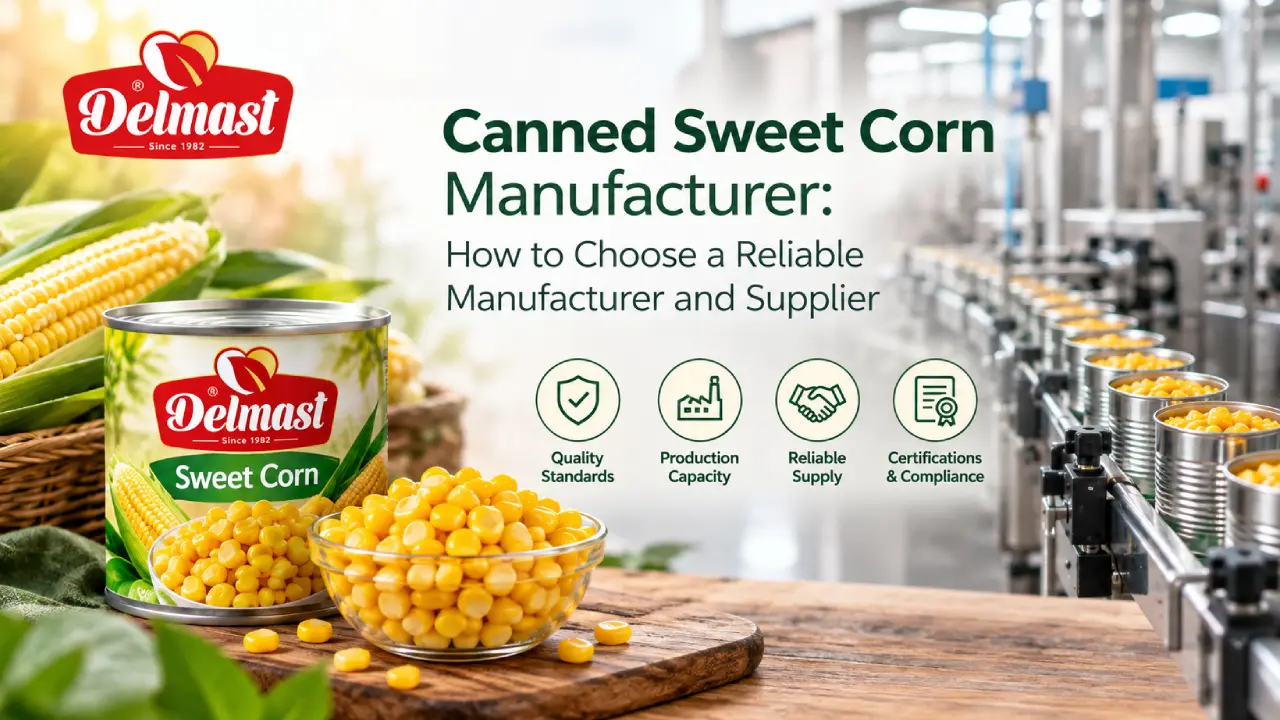
Buying canned sweet corn in bulk is not simply a matter of finding a product at a competitive price. For importers, distributors, food manufacturers, retailers, and foodservice businesses, the choice of supplier can affect product consistency, shelf life, packaging performance, shipping, and ultimately customer satisfaction.
Working with the right canned sweet corn manufacturer also makes it easier to maintain consistent specifications across different orders. Buyers can check everything from corn quality and processing methods to packaging formats, certifications, minimum order quantities, and export experience before committing to a long-term supply relationship.
This guide explains the main factors B2B buyers should consider when selecting a canned sweet corn manufacturer and supplier.
What Is Canned Sweet Corn?
Canned sweet corn is made from sweet corn kernels that are processed and packed in sealed containers, usually with water or a suitable liquid medium and salt, depending on the product specification. The wholesale canned sweet corn specifications may vary based on kernel quality, packing medium, salt content, can size, and customer requirements. The sealed cans are then processed under controlled conditions to achieve commercial sterility and extend the product’s shelf life.
Unlike fresh or frozen corn, canned sweet corn does not require refrigerated storage before opening. This makes it practical for international distribution, food manufacturing, retail, catering, and foodservice applications.
The quality of the final product depends on several stages of canned corn production, including raw material selection, preparation, filling, sealing, thermal processing, cooling, and storage.
For B2B buyers, some of the most important characteristics include:
- Kernel size and uniformity
- Sweetness and flavor
- Color and appearance
- Texture and firmness
- Drain weight
- Liquid-to-kernel ratio
- Can integrity
- Consistency between batches
A reliable canned corn manufacturer should be able to provide clear specifications for these characteristics rather than offering only a general product description.
What to Look for in a Canned Sweet Corn Manufacturer
Choosing a supplier requires looking beyond the product itself. A manufacturer may offer an attractive price, but that does not necessarily mean it can provide consistent quality or reliable export service.
Here are the main points wholesale buyers should evaluate.
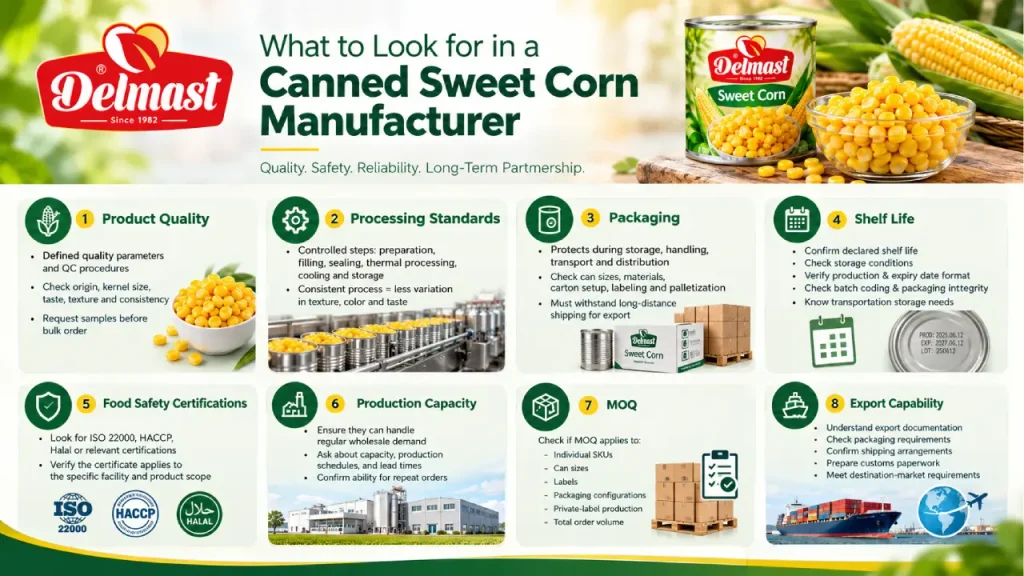
Product Quality
The first step is to examine the quality of the corn itself. A professional manufacturer should have defined quality parameters and quality-control procedures throughout production.
Ask about the origin and selection of the corn, kernel characteristics, taste, texture, and consistency between batches.
If possible, request samples before placing a large order. A sample allows buyers to evaluate the product rather than relying only on specifications or photographs.
Processing Standards
Proper canned sweet corn processing is essential for both quality and food safety. The manufacturer should have controlled procedures for preparation, filling, sealing, thermal processing, cooling, and storage.
A consistent process helps reduce variations in texture, color, and taste from one production batch to another.
Packaging
Packaging should protect the product during storage, handling, transportation, and distribution. Buyers should check the available can sizes, packaging materials, carton configuration, labeling options, and palletization.
For export orders, packaging also needs to withstand long-distance transportation and repeated handling.
Shelf Life
Canned sweet corn shelf life is an important consideration for importers and distributors because products may remain in warehouses or retail channels for extended periods.
Buyers should confirm:
- Declared shelf life
- Recommended storage conditions
- Production and expiry date format
- Batch coding
- Packaging integrity
- Storage requirements during transportation
The exact shelf life should always be confirmed from the manufacturer’s product specification rather than assumed based on the general category.
Food Safety Certifications
Food safety documentation is particularly important when importing processed foods. Depending on the target market and buyer requirements, certifications and systems such as ISO 22000, HACCP, or Halal certification may be relevant.
Instead of simply checking whether a certificate exists, buyers should verify that the certification applies to the relevant production facility and product scope.
Production Capacity
A supplier may be suitable for a small trial order but unable to support regular wholesale demand.
Ask about production capacity, available production schedules, lead times, and the manufacturer’s ability to handle repeat orders.
MOQ
Minimum order quantity can have a major impact on purchasing decisions, especially for new distributors or private-label brands.
Before requesting a quotation, clarify whether the MOQ applies to:
- Individual SKUs
- Can sizes
- Labels
- Packaging configurations
- Private-label production
- Total order volume
Export Capability
An experienced canned sweet corn exporter should understand more than production. Export documentation, packaging requirements, shipping arrangements, customs paperwork, and destination-market requirements can all affect the delivery process.
A supplier with experience in international shipments is generally easier to evaluate because its export procedures are already established.
| Factor | What Buyers Should Check |
|---|---|
| Product quality | Taste, color, texture, kernel size |
| Processing | Controlled production and thermal processing |
| Packaging | Can format, cartons, palletization |
| Shelf life | Declared shelf life and storage conditions |
| Certifications | Applicable food safety certifications |
| Capacity | Production volume and lead time |
| MOQ | Minimum quantity per SKU/order |
| Export | Documentation and international shipping experience |
Canned Sweet Corn Specifications Buyers Should Check
Before comparing quotations, buyers should create a clear specification sheet. This prevents situations where two suppliers quote different products under the same general product name.
Important canned sweet corn specifications may include the following:
- Product type and variety
- Kernel size
- Net weight
- Drained weight
- Ingredients
- Salt content
- Can dimensions
- Packaging format
- Shelf life
- Storage conditions
- Country of origin
- Labeling requirements
- Batch coding
- Certification requirements
For example, a buyer looking for wholesale canned sweet corn should not compare prices based only on net weight. Drain weight can also be important because it indicates how much solid corn remains after the liquid is removed.
A simple specification comparison can look like this:
| Specification | Supplier A | Supplier B | Supplier C |
|---|---|---|---|
| Net weight | Confirm | Confirm | Confirm |
| Drained weight | Confirm | Confirm | Confirm |
| Kernel size | Confirm | Confirm | Confirm |
| Ingredients | Confirm | Confirm | Confirm |
| Shelf life | Confirm | Confirm | Confirm |
| Can size | Confirm | Confirm | Confirm |
| Certifications | Confirm | Confirm | Confirm |
| MOQ | Confirm | Confirm | Confirm |
This makes supplier evaluation much more practical than comparing the unit price alone.
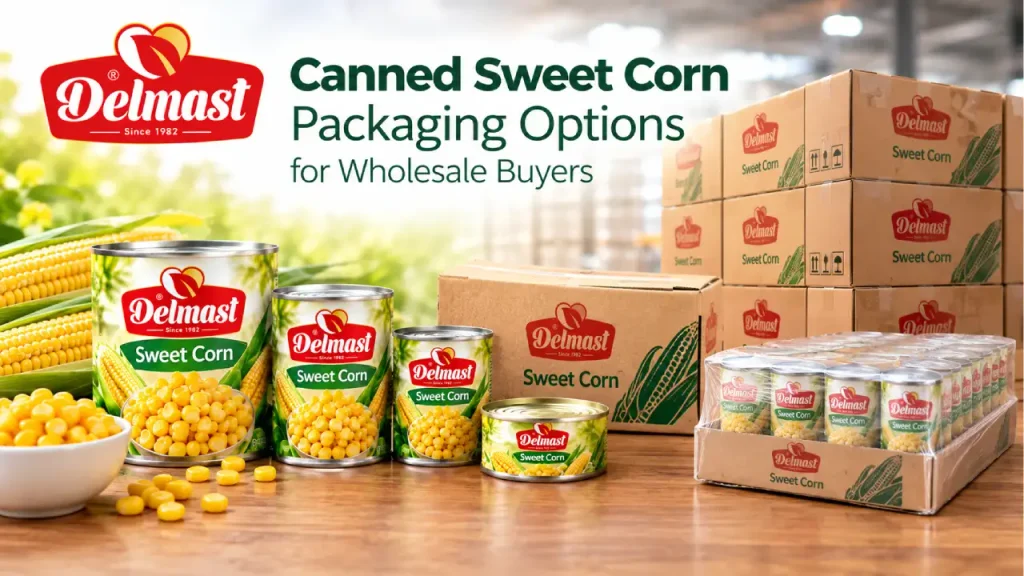
Canned Sweet Corn Packaging Options for Wholesale Buyers
Packaging requirements vary depending on where the product will be sold or used. Retailers may need consumer-ready cans with customized labels, while food manufacturers may prioritize larger formats or efficient case packing.
A professional canned sweet corn supplier should be able to explain the packaging formats it can produce and the limitations of each option.
Common considerations include:
- Standard retail cans
- Foodservice-oriented formats
- Bulk-oriented case configurations
- Private-label cans
- Customized labels
- Export cartons
- Palletized shipments
Packaging is also closely connected to logistics. The number of cans per carton, carton strength, pallet dimensions, and container utilization can affect the final landed cost.
For private-label buyers, it is useful to discuss artwork requirements, label materials, printing specifications, and production lead times at an early stage.
How to Evaluate a Canned Sweet Corn Supplier for Export
When choosing a canned sweet corn supplier for wholesale, buyers should evaluate the complete supply chain rather than focusing only on the product.
A practical evaluation process can include these steps:
- Define your product specifications.
Decide on can size, net and drained weight, ingredients, packaging, labeling, and target market. - Request product documentation.
Ask for technical specifications, certificates, product images, and relevant food safety documents. - Request samples.
Evaluate taste, color, texture, appearance, and packaging quality. - Check production capabilities.
Confirm whether the manufacturer can handle your expected order volume and future demand. - Discuss MOQ and lead time.
Make sure the supplier’s commercial conditions fit your purchasing plan. - Review export experience.
Ask whether the supplier regularly ships to your region and understands the required documentation. - Compare the complete quotation.
Consider product price, packaging, freight, payment terms, and other costs instead of looking at the unit price alone.
This process is particularly useful when comparing several suppliers from different countries.
A supplier that can provide clear answers and documentation at the beginning of the relationship can make future purchasing much easier.
Canned Sweet Corn for Food Manufacturers and Foodservice
Canned sweet corn for food manufacturers is commonly used as an ingredient in products such as salads, ready meals, sauces, pizzas, soups, mixed vegetables, and prepared foods.
Food manufacturers often have different requirements from retail buyers. They may need specific drained weights, consistent kernel characteristics, larger order volumes, or packaging designed for production kitchens.
The same applies to canned sweet corn for foodservice. Restaurants, catering companies, hotels, and institutional kitchens generally value consistent quality, easy storage, convenient preparation, and predictable supply.
For these customers, a supplier should be able to maintain consistent specifications across repeat shipments.
Businesses buying several processed vegetables may also prefer working with a broader canned vegetable supplier rather than sourcing each product from a different company. This can simplify purchasing, logistics, documentation, and communication.
For buyers interested in a wider product range, exploring a supplier’s Canned Vegetables portfolio can therefore be useful.
Pickled Baby Corn Exporter for Wholesale and Bulk Supply
For importers, distributors, foodservice companies, and retailers sourcing pickled baby corn, consistent quality and export-ready packaging are essential. Delmast supplies premium baby corn pickle from Iran in retail jars and bulk packaging options ranging from 5 kg buckets to 200 kg drums, supporting different commercial and industrial requirements. Businesses comparing pickled babycorn exporters from india can also consider Delmast as an alternative supplier for wholesale orders, private label production, and international distribution. As a reliable pickled baby corn exporter, Delmast helps buyers source pickled baby corn with consistent texture, balanced flavor, and packaging options tailored to their target markets.

Why Choose an Experienced Canned Food Manufacturer?
Experience matters when purchasing processed food at commercial scale. An established manufacturer is more likely to have defined production procedures, quality-control systems, established packaging processes, and experience with international buyers.
An experienced canned sweet corn manufacturer for export can also help buyers identify practical issues that may not be obvious during the initial quotation stage.
For example, export-focused production involves more than filling cans. The supplier needs to consider:
- Product consistency
- Packaging durability
- Label compliance
- Batch traceability
- Export documentation
- Container loading
- Pallet configuration
- Production planning
- Shipment coordination
For buyers looking for multiple processed food categories, working with an established food producer can also make portfolio expansion easier. A manufacturer that produces several canned vegetables may be able to coordinate different SKUs within the same purchasing relationship.
This can be especially valuable for importers and distributors that sell several products rather than focusing on a single SKU.
Businesses interested in private-label products can also consider a Private Label Food Manufacturer that can handle product preparation, packaging, labeling, and export requirements under the buyer’s brand.
For companies comparing different manufacturing partners, the key is to look at the complete supply relationship: product quality, production capabilities, documentation, packaging, MOQ, lead times, and export experience.
If frozen vegetables are also part of your product portfolio, comparing canned products with IQF Vegetables can help determine which format better suits your customers and distribution model.
Frequently Asked Questions
What should I look for in a canned sweet corn manufacturer?
Look at product quality, processing standards, packaging, shelf life, food safety certifications, production capacity, MOQ, and export experience. Samples and technical specifications can also help you compare suppliers more accurately.
What is the difference between a canned corn manufacturer and a supplier?
A manufacturer produces the product, while a supplier may manufacture the product itself or source it from another producer. Buyers should clarify the supplier’s role, production facility, quality-control process, and documentation before placing a large order.
How can I choose a canned sweet corn supplier for export?
Start by defining your specifications, then request samples, technical documents, certifications, MOQ information, lead times, and export documentation. It is also useful to confirm whether the supplier has experience shipping to your target market.
What packaging is available for wholesale canned sweet corn?
Packaging options depend on the manufacturer and target market. They may include different can sizes, carton configurations, retail labels, foodservice formats, and private-label packaging.
How long does canned sweet corn last?
Shelf life depends on the product, packaging, processing, and manufacturer’s specifications. Buyers should always confirm the declared shelf life and storage conditions directly with the manufacturer.
Can canned sweet corn be supplied under a private label?
Yes, some manufacturers offer private-label production, allowing buyers to sell canned sweet corn under their own brand. The available options for labels, packaging, MOQ, and customization should be discussed before production.
Why is production capacity important when choosing a supplier?
A supplier needs sufficient capacity to meet both the initial order and future demand. Consistent production capacity can help reduce supply interruptions and maintain product availability for distributors and retailers.
What documents should I request from a canned sweet corn supplier?
Depending on the market, buyers may request technical specifications, ingredient information, certificates, product documentation, packaging details, batch information, and export-related documents.
Is canned sweet corn suitable for food manufacturers?
Yes. Its convenient storage and ready-to-use format make it suitable for a range of food manufacturing applications, including salads, ready meals, soups, sauces, pizzas, and mixed vegetable products.
What is the difference between canned and IQF sweet corn?
Canned sweet corn is commercially sterilized and stored in sealed cans, while IQF sweet corn is individually quick frozen and requires frozen storage. The better option depends on the application, storage facilities, distribution model, and customer requirements.