

 Jam
 Pickles
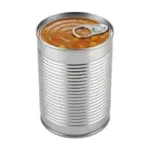 Canned Vegetable
 Syrups
 Vinegar
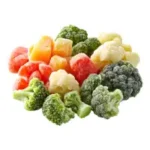 IQF Vegetables
 IQF Fruits
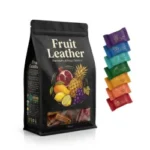 Fruit Strip
 Iranian Foods
Food Packaging for Export: Glass vs Plastic Packaging

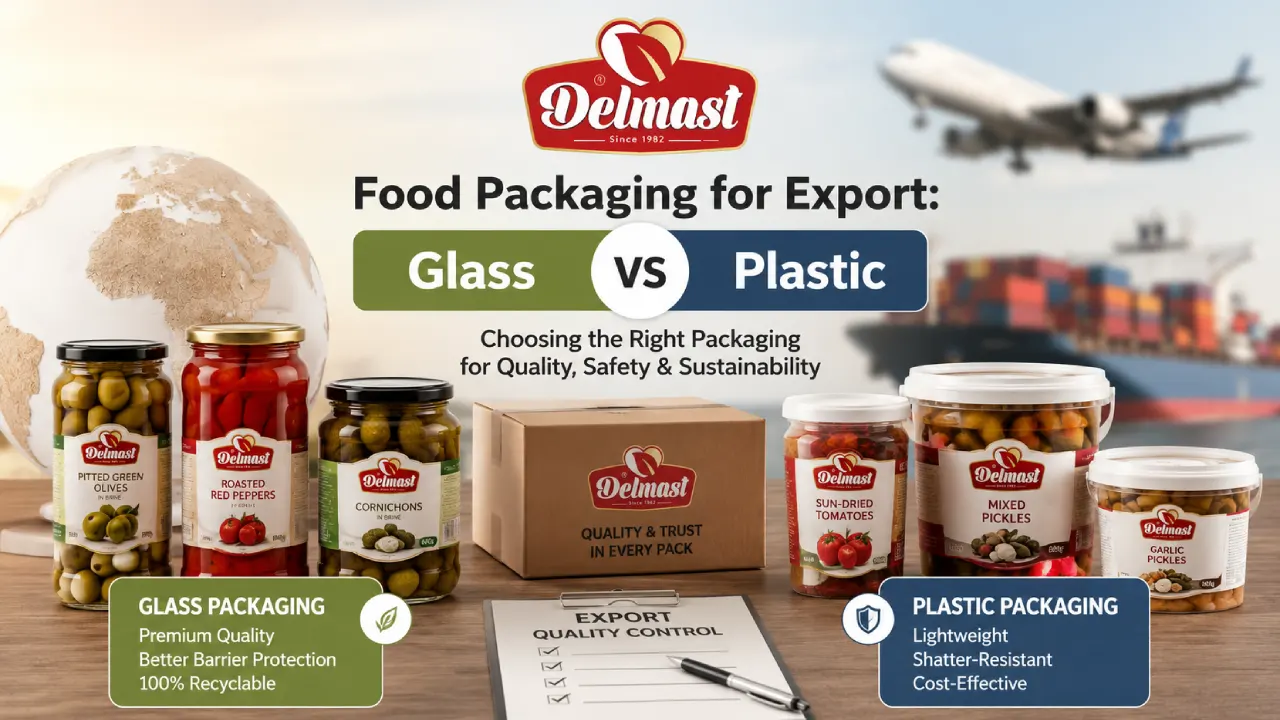
Choosing the right packaging is one of the decisions that can make or break an international food shipment. A product may be excellent, but if its packaging is too fragile, too heavy, difficult to store, or poorly suited to the destination market, problems can quickly appear after the goods leave the factory.
This is why Food Packaging for Export needs to be considered from more than one angle. The package has to protect the food, survive transportation, fit the buyer’s requirements, and make sense for storage and retail. For many food products, the choice eventually comes down to two familiar options: glass and plastic.
Neither material is automatically better. The right choice depends on the product, destination, shipping conditions, shelf requirements, customer expectations, and the way the food will be sold.
Why Packaging Matters in International Food Trade
Export packaging has a different job from packaging designed only for local distribution. Products may travel hundreds or thousands of kilometers, pass through several warehouses, experience changes in temperature, and be handled multiple times before reaching the final customer.
Good Export Food Packaging should therefore provide protection throughout the supply chain. It should also allow efficient palletization, reasonable transportation costs, secure storage, and easy handling.
For exporters, packaging is also part of the commercial presentation. A retailer may judge a product by its appearance before the customer ever tastes it. At the same time, an importer may be more concerned with carton strength, container utilization, labeling requirements, and product protection.
The best Food Export Packaging balances these practical and commercial considerations rather than focusing on appearance alone.
Glass Packaging: Strengths and Limitations
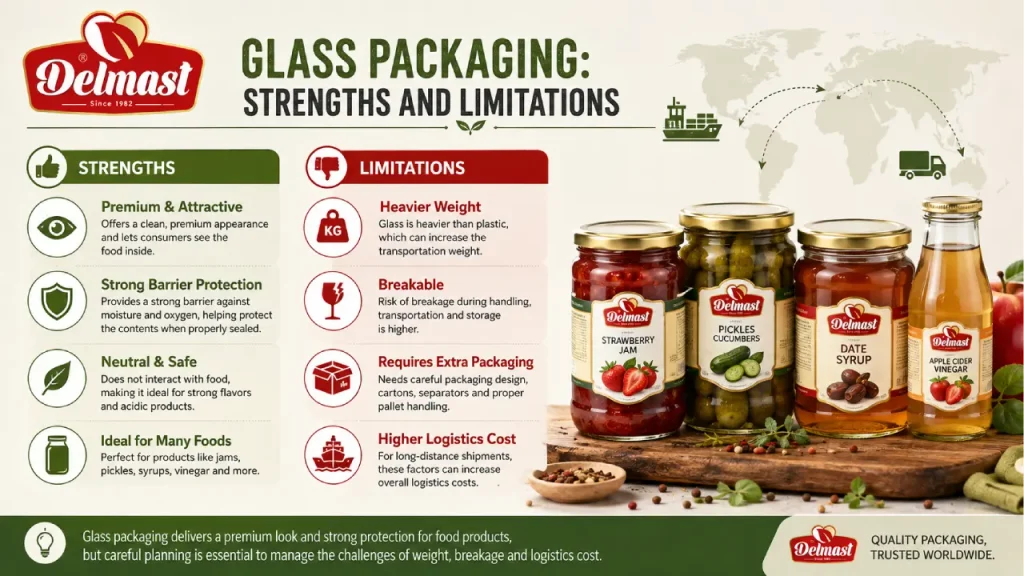
Glass has been used for food packaging for generations, and there is a good reason for its continued popularity. It offers a clean, premium appearance and works particularly well for products where consumers want to see the food inside the package.
For products such as jams, pickles, syrups and vinegar, glass can be an attractive option. It also provides a strong barrier against moisture and oxygen, helping protect the contents when properly sealed.
Another advantage is its neutral character. Glass generally does not interact with the food, making it suitable for products with strong flavors or acidic ingredients.
However, glass also creates challenges for export operations. It is heavier than plastic, which can increase transportation weight. It is also breakable, meaning packaging design, cartons, separators and pallet handling need careful attention.
For long-distance shipments, these factors can influence the overall logistics cost.
Plastic Packaging: Flexibility and Practicality
Plastic offers a different set of advantages. It is lightweight, versatile and available in many shapes and sizes. For exporters shipping large volumes, reducing packaging weight can be particularly valuable.
Plastic containers can also be easier to handle in busy commercial environments. They are less likely to shatter during transportation, which can be useful for wholesalers, food-service businesses and industrial buyers.
From a design perspective, plastic provides considerable flexibility. Different container shapes, closures and sizes can be developed according to the requirements of a particular product or market.
The main consideration is that not every plastic is appropriate for every food application. Material selection, temperature resistance, barrier properties and food-contact requirements all need to be considered before choosing a packaging format.
For this reason, a reliable Food Packaging Manufacturer should evaluate the product and destination market rather than recommending one material for every application.
Glass vs Plastic: Which One Is Better for Export?
There is no universal winner. The better option depends on what the product needs and what the buyer expects.
| Factor | Glass Packaging | Plastic Packaging |
|---|---|---|
| Appearance | Premium and traditional | Modern and highly flexible |
| Weight | Heavier | Lightweight |
| Breakage risk | Higher | Lower |
| Product visibility | Excellent | Usually excellent |
| Transportation | Higher packaging weight | Generally easier to transport |
| Design flexibility | Good | Very high |
| Handling | Requires more care | Generally easier |
| Suitable applications | Jams, pickles, vinegar, premium products | Syrups, foodservice products, bulk and lightweight formats |
For premium retail products, glass can offer a presentation that supports a higher-end brand image. For large-volume distribution, plastic may provide practical advantages through lower weight and easier handling.
The decision should therefore be based on the complete supply chain rather than the container alone.
How Product Type Influences Packaging Choice?
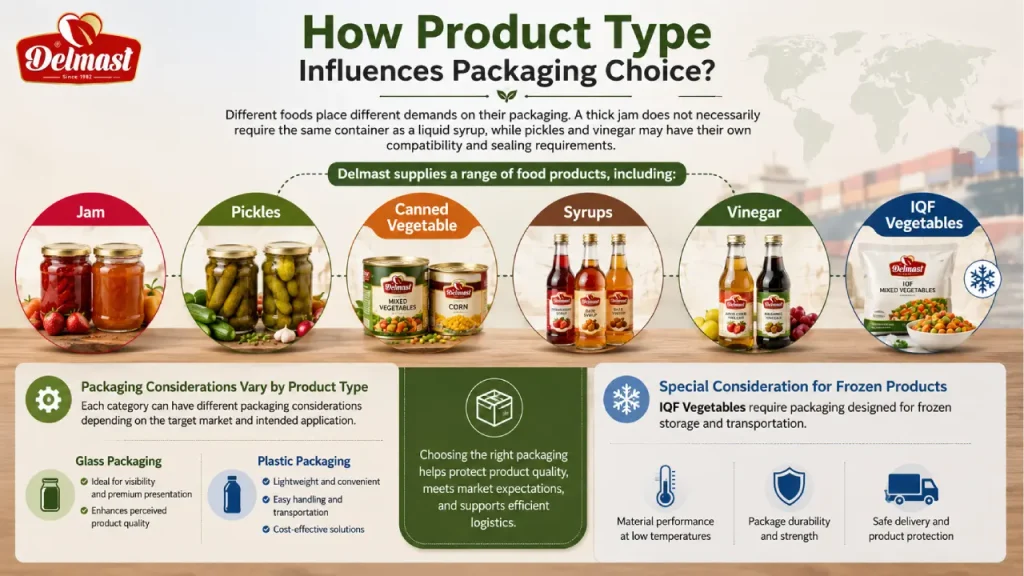
Different foods place different demands on their packaging. A thick jam does not necessarily require the same container as a liquid syrup, while pickles and vinegar may have their own compatibility and sealing requirements.
Delmast supplies a range of food products, including Jam, Pickles, Canned Vegetable, Syrups and Vinegar. Each category can have different packaging considerations depending on the target market and intended application.
For example, glass can be particularly suitable when product visibility and premium presentation are important. Plastic may be more convenient when low weight and easy handling are priorities.
The same principle applies to frozen products. IQF Vegetables require packaging designed for frozen storage and transportation, so factors such as material performance at low temperatures and package durability become particularly important.
Custom Packaging for Different Export Markets
International buyers do not always want the same packaging. A supermarket chain may need retail-ready containers, while a food manufacturer may prefer larger packs designed for production use.
This is where Custom Food Packaging becomes valuable. Instead of forcing every customer into one standard format, manufacturers can work with buyers to determine the most appropriate size, labeling, carton configuration and presentation.
A good International Food Packaging strategy also considers the destination market. Labeling, language, product information, packaging dimensions and other requirements can differ between countries.
Delmast works with international buyers and offers packaging options according to product and market requirements. This flexibility can be especially useful for importers and distributors developing products under their own brands.
The Role of Private Label in Food Packaging
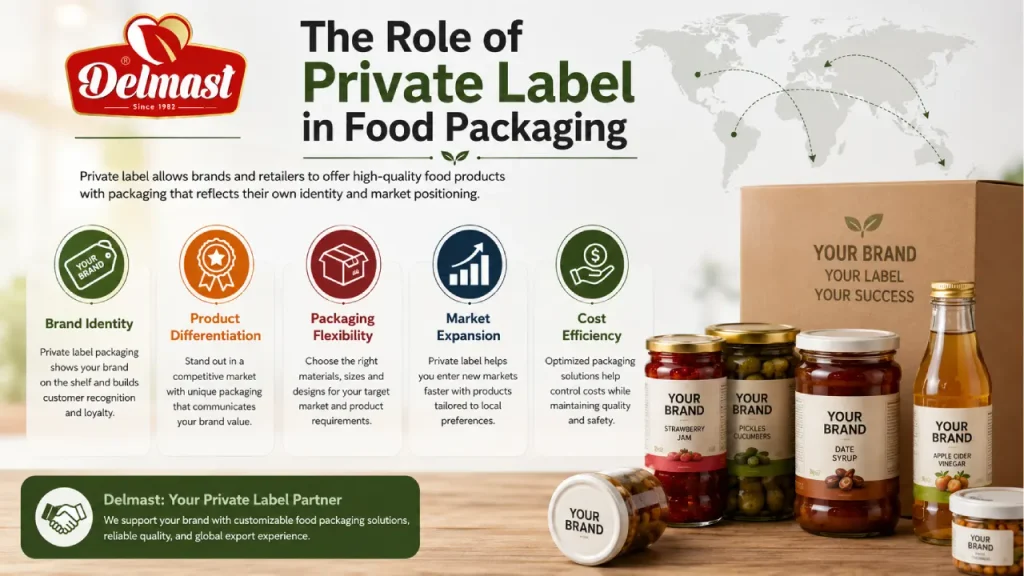
Packaging becomes even more important when a product is sold under a customer’s own brand. In a private-label arrangement, the package is not simply a container; it becomes part of the customer’s brand identity.
Retailers and distributors may have specific requirements for colors, labels, sizes, closures and carton presentation. They may also need packaging that fits an existing product range.
Delmast provides private label services for businesses looking to develop food products under their own brands. Depending on the project, packaging specifications can be discussed alongside product and order requirements.
For a company entering a new market, this approach can make it easier to build a consistent product range without establishing its own manufacturing operation.
What to Consider Before Choosing Export Packaging
Choosing between glass and plastic should start with the actual requirements of the shipment. Before finalizing a packaging format, exporters and buyers should consider:
1. Product characteristics
Acidity, viscosity, moisture content, temperature and shelf-life requirements can all influence packaging selection.
2. Transportation distance
Long-distance shipments require packaging that can withstand handling, stacking and transportation conditions.
3. Shipping cost
Packaging weight can affect logistics expenses, especially for high-volume international shipments.
4. Destination market
Different countries and retailers may have specific packaging and labeling expectations.
5. Storage conditions
The container needs to perform properly under the temperatures and storage conditions expected throughout the supply chain.
6. Retail positioning
Premium products may benefit from the appearance of glass, while value-focused or high-volume products may benefit from lightweight plastic.
7. Order volume
Bulk buyers may prioritize efficiency and handling, while retail customers may place greater emphasis on presentation.
Export Quality Plastic Packaging, Drums & Industrial Containers
For bulk food exports, packaging must protect products throughout storage, handling, and international transportation. Delmast provides export-quality packaging formats designed around product characteristics, order volumes, and destination-market requirements.
220-Liter Aseptic & Food-Grade Drums
For bulk liquids and semi-liquid food products, 220-liter Aseptic and Food-grade drums provide a practical solution for international transportation and storage. These drums are designed for hygienic food contact, secure sealing, durability, and efficient handling. For businesses sourcing bulk syrup products, Delmast also works as a reliable date syrup supplier for export and private label requirements.
Food-Grade Polyethylene Containers
Polyethylene containers offer a durable and practical packaging option for food products that require reliable protection during transportation and storage. Their strength, secure closure, and suitability for food-contact applications make them useful for different B2B export formats, depending on the product and buyer’s specifications.
Retail & Foodservice Packaging Solutions for Private Label Export
Retail and foodservice products require packaging that combines product protection with convenient handling and market-ready presentation. Delmast supports private label export projects with a range of retail and foodservice packaging formats.
Easy-Open Metal Cans
Easy-Open metal cans are suitable for shelf-stable vegetables and other preserved food products, offering durable protection and convenient opening for both retail and foodservice applications. Businesses looking for wholesale canned vegetables can select suitable can formats according to product specifications, order volume, and destination-market requirements.
Vacuum-Sealed Glass & PET Containers
Vacuum-sealed glass jars provide product visibility while supporting reliable sealing and shelf stability for products such as pickles and preserved foods. PET containers can also provide a lightweight alternative for suitable products and distribution formats. Buyers searching for wholesale pickles suppliers can choose packaging solutions based on their product type, market, and private label requirements.
Choosing the Right Food Packaging Supplier
A packaging decision should not be made in isolation. An experienced Food Packaging Supplier can help buyers consider the relationship between the food product, container, closure, labeling and transportation requirements.
This becomes particularly important for international orders. Packaging that works perfectly for domestic distribution may not be the best choice for a long-distance export shipment.
A capable supplier should be able to discuss practical questions such as carton configuration, product protection, packaging sizes, storage conditions and shipping requirements.
For B2B buyers, this broader approach is often more useful than simply choosing between glass and plastic based on appearance or price.
B2B Food Packaging and Long-Term Supply
For B2B Food Packaging, consistency matters. Importers and distributors need to know that packaging specifications will remain stable from one order to the next and that products can be supplied according to agreed requirements.
Packaging also needs to work with the buyer’s own distribution system. A container that looks good but cannot be stacked efficiently may create unnecessary warehouse problems. Similarly, a lightweight package that does not provide enough protection can lead to damage during transportation.
The best Food Packaging Solutions are therefore built around the entire journey of the product, from manufacturing and packing to shipping, warehousing and final sale.
Packaging and Export Markets
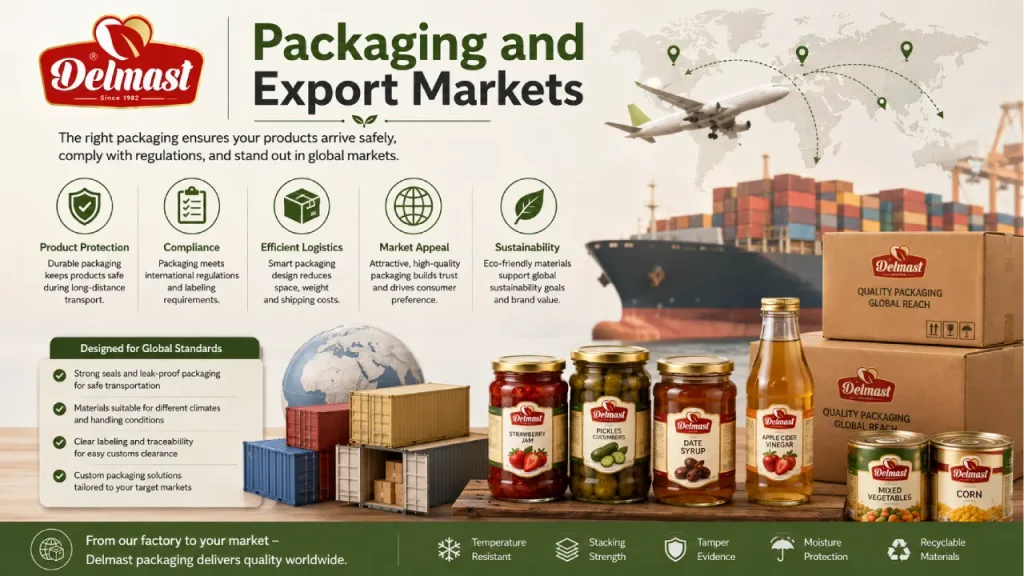
Packaging decisions should always be connected to the intended export markets. A product destined for a European retail chain may have different packaging requirements from one supplied to a food-service distributor in the Middle East.
Delmast supplies food products to international markets and works with buyers across different distribution channels. Understanding the destination, expected order volume and end use helps determine whether a glass, plastic or another packaging format makes the most sense.
The goal is not simply to select the cheapest container. It is to create a package that protects the product, supports efficient logistics and meets the commercial expectations of the target market.
Choosing the Right Food Packaging for Export
Glass and plastic each have a legitimate place in international food trade. Glass offers a premium appearance, strong barrier properties and excellent product visibility, while plastic provides lower weight, flexibility and practical handling advantages.
The right choice depends on the product, market, transportation conditions and buyer requirements. This is why Export Packaging should be treated as part of the overall food supply strategy rather than as an afterthought.
For food manufacturers, importers, distributors and retailers, working with an experienced partner can make the process much easier. By combining product knowledge with suitable packaging options and international supply experience, Delmast can help businesses develop practical packaging approaches for a wide range of food products and export markets.