

 Jam
 Pickles
 Canned Vegetable
 Syrups
 Vinegar
 IQF Vegetables
 IQF Fruits
 Fruit Strip
 Iranian Foods
Fermented vs Vinegar Pickles: A B2B Buying Guide for Importers, Distributors, and Food Brands

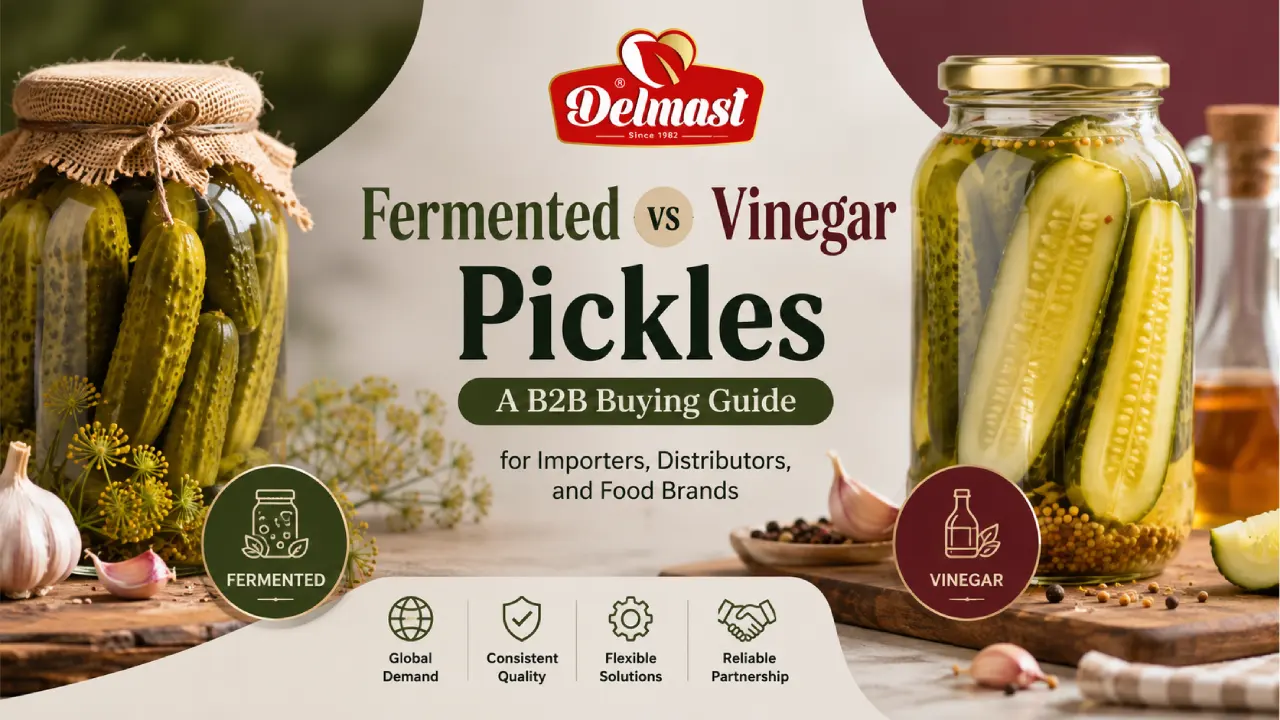
Fermented vs Vinegar Pickles comes down to how acidity is created: fermented pickles develop lactic acid naturally through controlled microbial fermentation, while vinegar pickles are acidified directly with vinegar.
For B2B buyers, the choice affects flavor, texture, processing time, shelf life, storage, food safety controls, and the type of production process required.
| Factor | Fermented Pickles | Vinegar Pickles |
|---|---|---|
| Main preservation method | Natural lactic acid fermentation | Direct acidification with vinegar |
| Acid source | Lactic acid produced by beneficial bacteria | Acetic acid from vinegar |
| Processing time | Usually longer | Usually faster |
| Flavor | Complex, tangy, naturally sour | Sharper, cleaner, more predictable |
| Texture | Can develop a softer or naturally fermented texture | Often easier to standardize for crunch |
| Salt concentration | Important for fermentation control | Usually used mainly for flavor and preservation |
| pH control | Develops progressively during fermentation | Adjusted directly through the pickling process |
| Production complexity | Requires fermentation control and monitoring | More straightforward commercial processing |
| Shelf life | Depends on process, packaging, pH, and storage | Often easier to design for consistent shelf stability |
| B2B suitability | Premium, traditional, specialty, refrigerated or fermented products | High-volume retail, foodservice, export, and private-label applications |
What Is the Difference Between Fermented and Vinegar Pickles?
The difference between fermented and vinegar pickles is primarily the way acidity is generated.
With fermented pickles, vegetables are placed in a salt-based brine, creating an environment in which desirable lactic acid bacteria can grow. These microorganisms convert naturally occurring sugars into organic acids, gradually lowering the pH level and creating the characteristic sour flavor.
Vinegar pickles, on the other hand, do not depend on microbial fermentation to create their primary acidity. Vinegar is added directly to the pickling solution, allowing manufacturers to control acidity more directly.
The USDA describes fermentation as the conversion of vegetable sugars into organic acids, while conventional pickling generally refers to acidification, primarily with vinegar.
For consumers, this may simply be a matter of taste. For importers, distributors, retailers, and food manufacturers, however, Fermented vs Vinegar Pickles represents a much broader purchasing decision.
How Are Fermented Pickles Made?
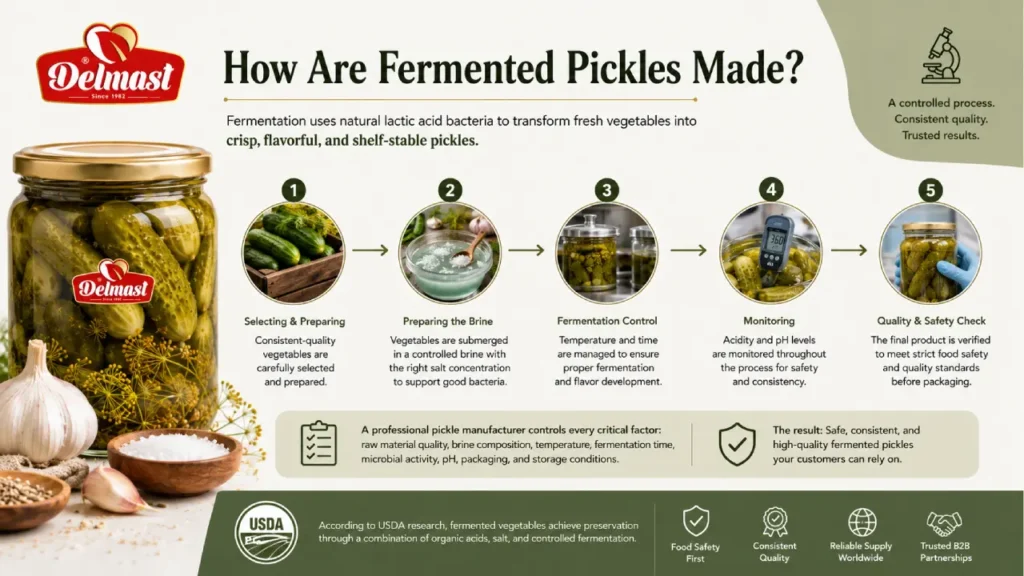
The fermentation process for pickles relies on naturally occurring or selected lactic acid bacteria.
Fresh vegetables are prepared and submerged in a controlled brine containing water and salt. The salt concentration helps suppress undesirable microorganisms while creating favorable conditions for lactic acid bacteria.
As fermentation progresses, bacteria consume available carbohydrates and produce lactic acid. This gradually increases acidity and lowers the pH.
Commercial production requires significantly more control than traditional household fermentation. A professional pickle manufacturer must consider raw material quality, brine composition, temperature, fermentation time, microbial activity, final pH, packaging, and storage conditions.
The process typically involves:
- Selecting and preparing consistent-quality vegetables.
- Preparing a controlled brine with the required salt concentration.
- Managing fermentation temperature and duration.
- Monitoring acidity and pH level throughout production.
- Confirming the finished product meets established food safety and quality specifications.
The final characteristics can vary according to vegetable variety, salt concentration, fermentation conditions, temperature, and processing time. USDA research notes that fermented vegetables can achieve preservation through a combination of organic acids, salt, and controlled fermentation.
What Do Fermented Pickles Taste Like?
Fermented pickles are generally associated with a more complex and developed flavor profile. Instead of receiving acidity primarily from added vinegar, the sourness develops through fermentation.
This can create:
- A naturally tangy flavor
- More complex aromatic characteristics
- A less sharp acid profile
- A traditional fermented-food identity
For B2B buyers targeting premium, traditional, natural, or specialty-food segments, these characteristics can make fermented products commercially attractive.
How Does the Vinegar Pickling Process Work?
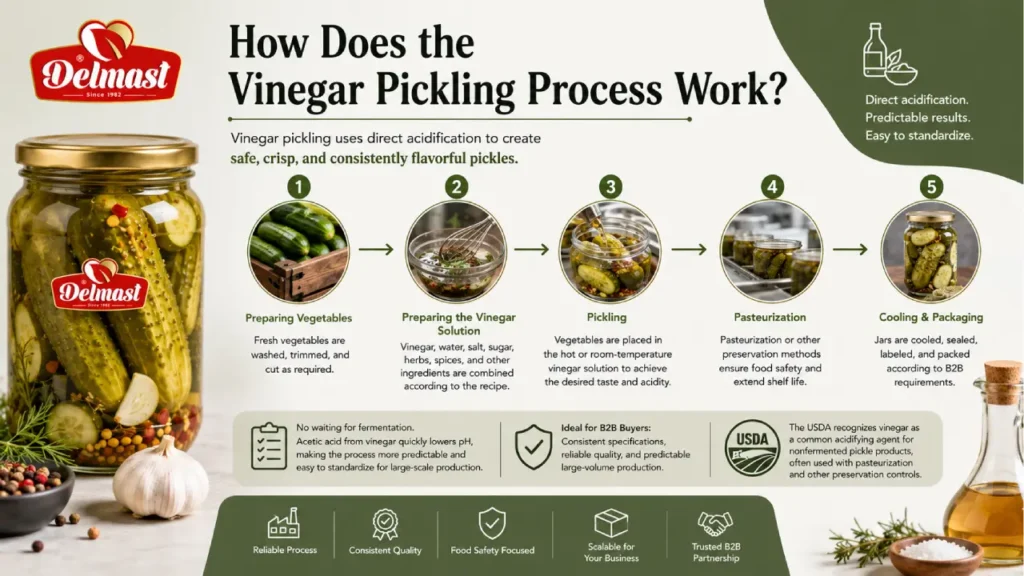
The vinegar pickling process is based on direct acidification.
Vegetables are prepared and placed in a solution containing vinegar, water, salt, sugar, herbs, spices, or other ingredients depending on the desired recipe. The vinegar supplies acetic acid, which lowers the product’s pH and contributes to preservation.
Unlike fermentation, the manufacturer does not need to wait for bacteria to produce the required acidity. This makes the process more predictable and easier to standardize for large-scale commercial pickle production.
The USDA identifies vinegar as a common acidifying agent for nonfermented pickle products, often combined with pasteurization and other preservation controls.
For B2B production, this can be especially useful when buyers require consistent specifications across large volumes.
Fermented vs Vinegar Pickles: Which Has Better Flavor?
There is no universal winner.
Flavor preference depends heavily on the target market, product positioning, recipe, and intended application.
Fermented pickles generally offer a deeper, naturally developed sourness. Vinegar pickles tend to deliver a more immediate and recognizable acidity.
For example, a specialty food retailer may prefer fermented pickles because their flavor profile supports a premium positioning. A foodservice distributor, meanwhile, may prioritize vinegar pickles because their flavor and acidity can be reproduced consistently from batch to batch.
The right choice therefore depends less on which product is “better” and more on what the buyer needs the product to achieve.
Texture: A Critical Factor for B2B Buyers
Texture is one of the most important commercial considerations when purchasing pickles in bulk.
Buyers may specify requirements such as:
- Crispness after processing
- Firmness after opening
- Uniform vegetable size
- Consistent bite
- Minimal softening during storage
Fermentation can affect vegetable texture over time, while vinegar-based processing can provide a more predictable manufacturing framework for products designed around a specific texture.
However, the final texture depends on much more than whether a product is fermented or vinegar-pickled. Raw material quality, processing temperature, formulation, calcium salts where applicable, storage conditions, and processing time can all influence the finished product.
For retailers and foodservice operators, consistency may be just as important as the initial texture.
pH Level, Acidity, and Food Safety
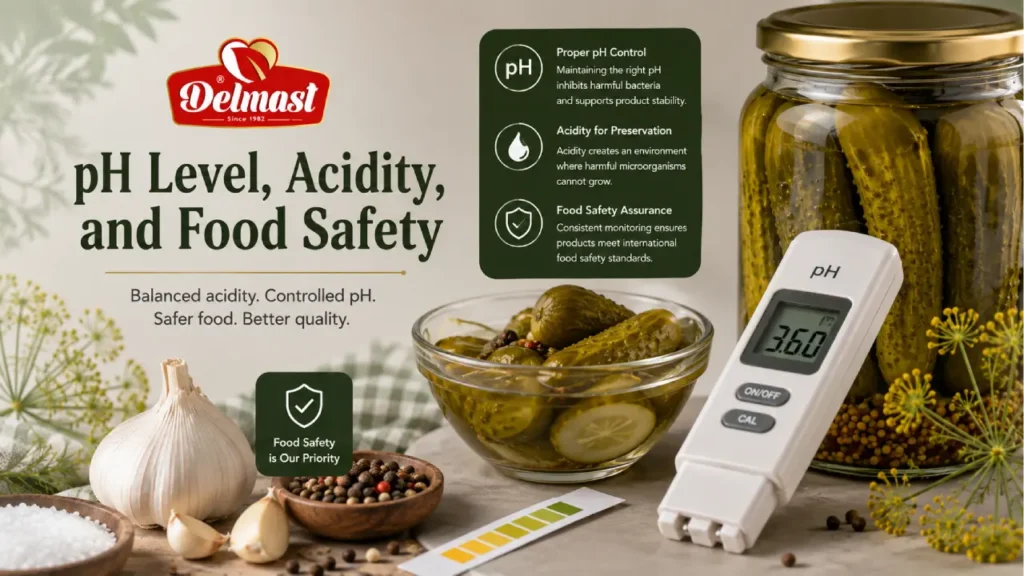
When evaluating Fermented vs Vinegar Pickles, B2B buyers should not focus only on taste and appearance. Food safety and process control are fundamental.
Acidity and pH are particularly important because they influence the ability of microorganisms to grow. In U.S. regulatory guidance, acidified foods are generally defined as low-acid foods with a finished equilibrium pH of 4.6 or below, alongside other conditions specified by the regulation.
For naturally fermented products, the pH reduction occurs through microbial activity. FDA guidance also distinguishes naturally fermented products from acidified foods when the required acidity is achieved through fermentation rather than added acid.
A B2B buyer should therefore ask the supplier about:
- Final equilibrium pH
- Acidity specifications
- Salt concentration
- Microbiological controls
- Processing parameters
- Pasteurization or other applicable treatments
- Packaging specifications
- Storage conditions
- Shelf-life validation
These details are particularly important for international trade because food safety requirements can vary between destination markets.
Shelf Life and Storage Considerations
Shelf life is another major difference to consider when comparing Fermented vs Vinegar Pickles.
A product’s shelf life cannot be determined simply by whether it is fermented or contains vinegar. It depends on the complete formulation and validated manufacturing process, including pH, water activity, packaging, thermal processing where applicable, preservatives, and storage conditions.
Vinegar-based products can be particularly attractive for buyers seeking a standardized product with predictable acidity and scalable production.
Fermented products can also achieve long shelf lives when properly controlled and packaged, but their production may require closer management of fermentation and storage parameters.
For buyers handling wholesale pickles, it is important to request documented shelf-life specifications rather than relying on a generic statement such as “long shelf life.”
What B2B Buyers Should Check Before Ordering Pickles
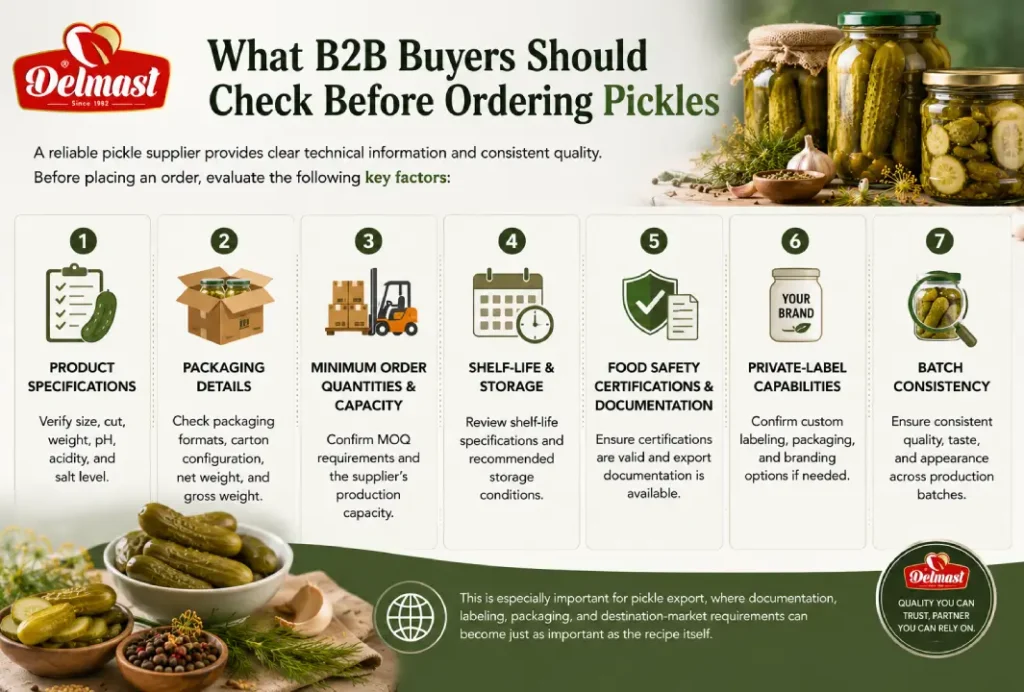
Whether you are sourcing bulk pickles for foodservice, retail distribution, or export, the production method is only one part of the purchasing decision.
A reliable pickle supplier should be able to provide clear technical information about the product and its manufacturing process.
Before placing an order, evaluate:
- Product specifications, including size, cut, weight, pH, acidity, and salt level.
- Packaging formats, carton configuration, net weight, and gross weight.
- Minimum order quantities and production capacity.
- Shelf-life specifications and recommended storage conditions.
- Food safety certifications and applicable export documentation.
- Private-label capabilities if the product will be sold under your own brand.
- Consistency between production batches.
This is especially important for pickle export, where documentation, labeling, packaging, and destination-market requirements can become just as important as the recipe itself.
Fermented vs Vinegar Pickles for Private Label Brands
For brands developing private label pickles, choosing between fermented and vinegar-based products should start with the target customer.
A premium brand focused on traditional foods may benefit from fermented pickles and their distinctive flavor story. A mass-market brand may prefer vinegar pickles because of their predictable production characteristics and broad consumer familiarity.
However, private-label development can go beyond simply choosing one of the two categories. A manufacturer can often work with buyers to adjust:
- Vegetable variety
- Cut and size
- Salt level
- Acidity
- Vinegar type
- Spice profile
- Packaging
- Labeling
- Net and drained weights
For brands looking for customized manufacturing support, Delmast provides Private Label Services for food products.
Which Pickle Type Is Better for Different B2B Applications?
The answer depends on the commercial objective.
Fermented pickles may be a strong option for:
- Premium and specialty food brands
- Traditional-food positioning
- Natural fermentation concepts
- Retailers targeting fermented-food consumers
- Products where complex flavor is a selling point
Vinegar pickles may be better suited to:
- Large-scale retail distribution
- Foodservice
- Consistent high-volume production
- Private-label products requiring standardized specifications
- Export programs requiring predictable processing and shelf-life characteristics
Neither category automatically offers superior quality. A well-made fermented pickle can outperform a poorly formulated vinegar pickle, and the reverse is equally true.
How Much Does Production Method Matter for Importers?
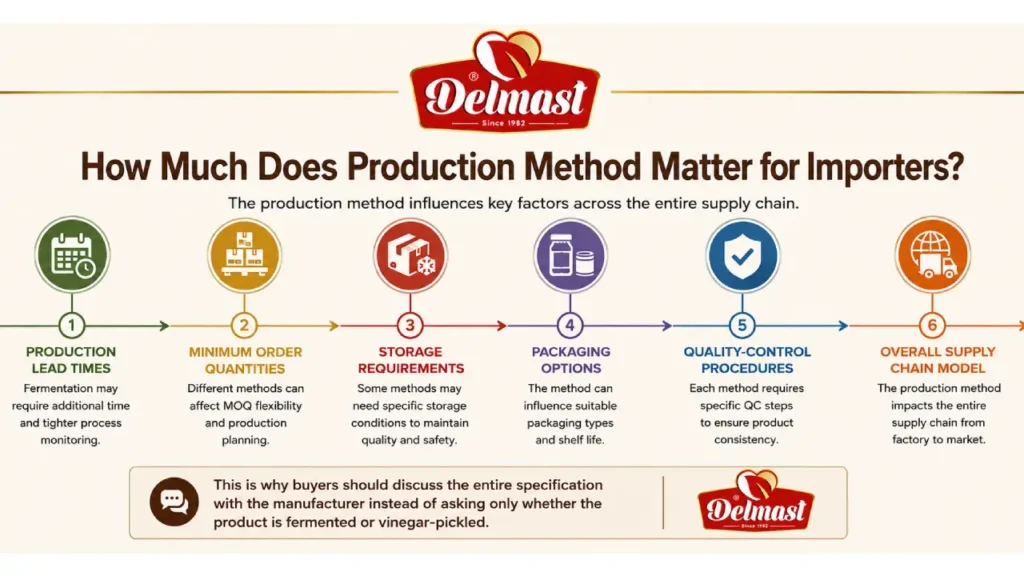
For an importer, the production method affects more than the taste of the final product.
It can influence production lead times, minimum order quantities, storage requirements, packaging options, quality-control procedures, and the overall supply-chain model.
Fermentation may require additional production time and tighter process monitoring. Vinegar pickling can provide greater flexibility when a buyer needs consistent production at commercial scale.
This is why buyers should discuss the entire specification with the manufacturer instead of asking only whether the product is fermented or vinegar-pickled.
For buyers comparing sourcing options, Delmast’s guide to Different Types of Pickles Around the World can also help put different pickle styles and processing traditions into context.
Choosing a Pickle Manufacturer: Questions B2B Buyers Should Ask
A strong supplier relationship begins with the right questions.
Ask your prospective manufacturer:
- What type of pickling process is used?
- Is the product naturally fermented or directly acidified?
- What is the final pH level?
- How is acidity controlled?
- What salt concentration is used?
- How is texture maintained during processing and storage?
- What is the validated shelf life?
- What storage conditions are required?
- What packaging formats are available?
- Can the product be manufactured under a private label?
- What food safety systems and certifications are in place?
- Can the manufacturer support international export requirements?
These questions help distinguish a manufacturer that simply produces pickles from a supplier capable of supporting a long-term B2B program.
For larger-volume buyers, working directly with a Wholesale Pickle Manufacturer can also simplify communication around specifications, packaging, production planning, and export orders.
Fermented vs Vinegar Pickles: A Practical Buying Decision
There is no single answer to the question of which type B2B buyers should choose.
If your priority is traditional flavor, fermentation identity, and a more complex taste profile, fermented pickles may be the better fit.
If your priority is consistent acidity, predictable production, scalability, and straightforward commercial specifications, vinegar pickles may be more appropriate.
The most important point is to evaluate the finished product rather than the production method in isolation. A professional manufacturer should be able to demonstrate how the selected process delivers the required flavor, texture, pH, shelf life, packaging performance, and food safety characteristics.
Buyers interested in the nutritional side of preserved vegetables can also explore Pickles Health Benefits as part of their product-development research.
Choose the Process That Fits Your Market
Fermented vs Vinegar Pickles is ultimately a B2B product-development decision, not simply a question of personal taste.
Fermented pickles rely on controlled biological fermentation to create acidity and develop their characteristic flavor. Vinegar pickles use direct acidification to achieve a more immediate and controllable acidity profile. Both methods can produce high-quality commercial products when the formulation, processing, food safety controls, packaging, and storage conditions are properly managed.
For importers, distributors, retailers, and food brands, the best approach is to define the required flavor, texture, pH, shelf life, packaging, price point, and market positioning first, then select the manufacturing process that meets those requirements.
A capable pickle manufacturer should be able to help you translate those commercial requirements into a consistent product specification—whether you are looking for fermented pickles, vinegar pickles, bulk pickles, wholesale pickles, or a customized private-label product.