 Jam
 Pickles
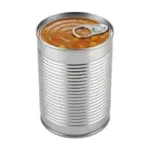 Canned Vegetable
 Syrups
 Vinegar
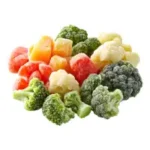 IQF Vegetables
 IQF Fruits
 Fruit Strip
 Iranian Foods
The Global Canned Mushroom Market: Trends & Sourcing Guide

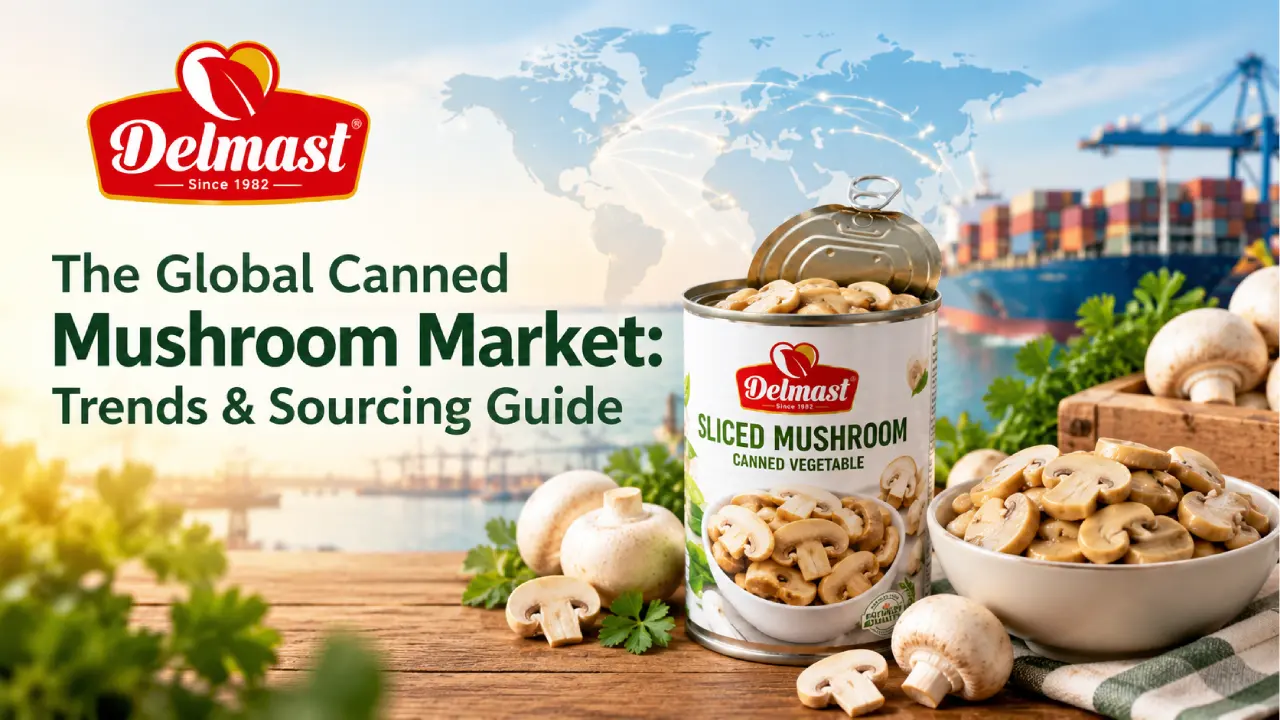
The canned mushroom market is becoming an increasingly important segment of the global processed food industry as retailers, foodservice businesses, distributors, and food manufacturers look for convenient ingredients with reliable shelf life and consistent quality. In 2026, market research estimates place the global canned sliced mushrooms market at approximately USD 10.5–10.8 billion, depending on the methodology and market definition used. Grand View Research estimates the market at USD 10.5 billion in 2026, while Fortune Business Insights estimates USD 10.83 billion.
For importers and distributors, however, market size is only one part of the sourcing decision. Product specifications, drained weight, packaging, food safety, production consistency, minimum order quantities, private label capabilities, and export experience can all affect the long-term value of a supplier.
This guide examines the latest market trends and explains what B2B buyers should consider when sourcing canned mushrooms internationally.
Global Canned Mushroom Market Overview
The global market continues to benefit from demand for shelf-stable and convenient food ingredients. Canned mushrooms are used by households, restaurants, hotels, catering companies, food manufacturers, and ready-meal producers because they can be stored for extended periods without the same cold-chain requirements associated with fresh mushrooms.
According to global food industry reports, commercial demand in the canned mushroom market is driven by the growing preference for convenient, long-lasting food products, expanding foodservice operations, and the versatility of canned mushrooms in various recipes.
Current market estimates differ because research firms use different definitions, product categories, geographic coverage, and forecasting methodologies. Grand View Research estimates a market value of USD 10.5 billion in 2026 and projects it to reach USD 13.3 billion by 2033, while Fortune Business Insights forecasts USD 17.11 billion by 2034.
| Market indicator | 2026 data |
|---|---|
| Grand View Research estimate | USD 10.5 billion |
| Fortune Business Insights estimate | USD 10.83 billion |
| Grand View Research forecast period | 2026–2033 |
| Fortune Business Insights forecast period | 2026–2034 |
| Leading region in recent estimates | Asia Pacific |
Asia Pacific represents a major consumption and production region. Fortune Business Insights estimates that the region accounted for 34% of global market revenue in 2026, while Grand View Research places its 2026 share at approximately 37%. These differences again demonstrate why market figures should be interpreted according to the methodology behind each report.
Leading Canned Mushroom Market Suppliers & Brands in 2026
The united states mushroom market and global foodservice sector rely on established canned mushroom market suppliers such as Giorgio Fresh, Monterey Mushrooms, and Bonduelle. As a B2B alternative, Delmast operates as a direct canned sliced mushrooms factory, supplying competitive OEM private-label canned mushrooms in 400g tins and 3kg A10 cans to importers and food distributors worldwide.
Global Canned Mushroom Market: Specifications, Packaging & B2B Supply
The global mushroom material market serves food manufacturers, catering businesses and retail brands seeking consistent product quality, reliable sourcing and suitable packaging formats. For businesses looking to supply canned mushroom, selecting the right product specifications and packaging options helps meet the requirements of wholesale buyers and international foodservice markets.
Global Canned Mushroom Market & Industrial Material Specifications
| Specification | Details |
|---|---|
| Commercial Cut Styles | Whole Button Mushrooms, Sliced Mushrooms (3mm–5mm for Pizza/HORECA), Pieces & Stems (P&S) |
| Raw Material Variety | Fresh Cultivated White Agaricus bisporus, Processed Within Hours of Harvest |
| Retail & Catering Can Sizes | 184g, 400g and 800g Easy-Open Retail Tins; 2840g / 3kg A10 Foodservice Cans |
| Target Export Markets | United States Mushroom Market, GCC Foodservice, European Pizza Chains & CIS |
| B2B Supply & Private Label | Direct Factory Supply, Custom Brine/Citric Acid Ratio & Full OEM Lithographed Cans |
What Is Driving Global Canned Mushroom Demand?
Several factors are supporting global canned mushroom demand. Convenience remains important because canned mushrooms are ready to use and can be incorporated into recipes without the preparation required for fresh or dried mushrooms.
Canned formats are also attractive to commercial kitchens and manufacturers because they offer predictable availability, standardized specifications, and long shelf life. For distributors, shelf-stable products can simplify inventory management and reduce dependence on refrigerated storage.
The product is also used across a broad range of applications, including pizza, pasta, sauces, soups, salads, ready meals, side dishes, and foodservice products.
Key Trends in the Canned Mushroom Market
The current canned mushroom market is not simply growing through higher volumes. Buyers are also becoming more specific about product characteristics and supply-chain requirements.
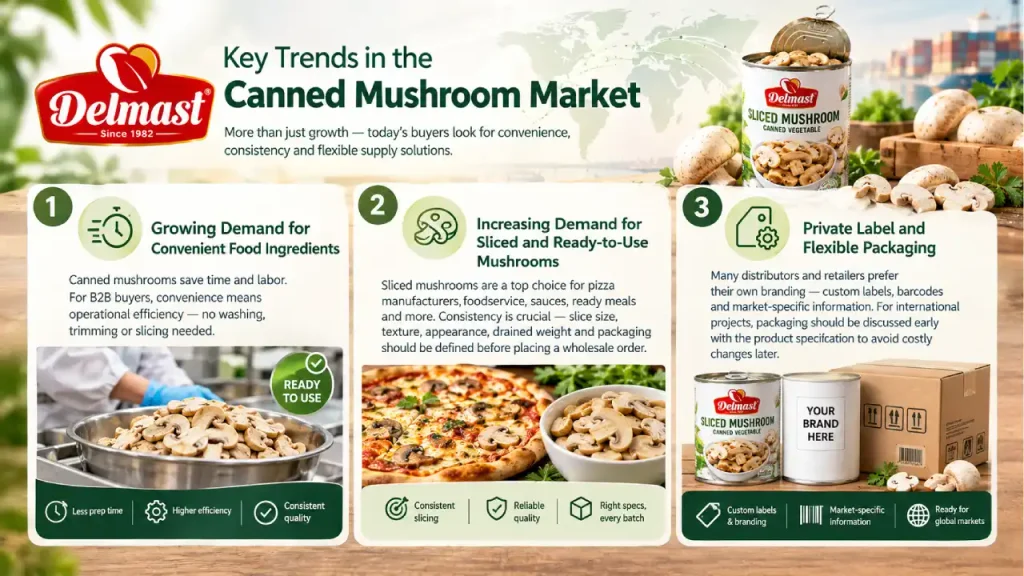
Growing Demand for Convenient Food Ingredients
Convenience continues to influence food purchasing decisions. For B2B buyers, the value of a canned ingredient is not only its convenience for the final consumer but also its operational efficiency.
Restaurants and food manufacturers can use a ready-to-process ingredient without washing, trimming, and slicing fresh mushrooms for every production cycle.
Increasing Demand for Sliced and Ready-to-Use Mushrooms
One of the most commercially useful formats is canned sliced mushrooms. Consistent slicing can be particularly important for pizza manufacturers, foodservice companies, sauces, ready meals, and prepared foods.
For industrial buyers, consistency matters because the mushroom needs to perform predictably from one production batch to another. Slice size, texture, appearance, drained weight, and packaging format should therefore be included in the product specification before placing a wholesale order.
Private Label and Flexible Packaging
Private label is another important consideration for distributors and retailers. Instead of purchasing products solely under a manufacturer’s brand, buyers may want their own packaging, labels, barcodes, and market-specific information.
For an international sourcing project, packaging should be discussed together with the product specification. This helps ensure that the final product is suitable for the destination market rather than requiring major changes after production.
What B2B Buyers Look for in Wholesale Canned Mushrooms
When purchasing wholesale canned mushrooms, price per can is rarely the only factor that determines the commercial value of a supplier.
A buyer should evaluate the complete supply proposition:
- Product consistency, mushroom size, slicing, texture, color, and drained weight
- Packaging options, shelf life, MOQ, production capacity, certifications, documentation, lead time, and export experience
A reliable supplier should be able to provide clear technical specifications before the order is finalized. For larger distributors, consistency between shipments is particularly important because changes in product appearance or specifications can create problems across established retail and foodservice accounts.
| B2B sourcing factor | Why it matters |
|---|---|
| Product specification | Defines exactly what the buyer receives |
| Drained weight | Important for commercial yield and value |
| Packaging | Must suit retail, foodservice, or industrial use |
| Shelf life | Influences inventory planning |
| MOQ | Determines whether the supplier fits the buyer’s purchasing model |
| Certifications | Supports food safety and market compliance |
| Production capacity | Important for repeat and larger orders |
| Private label | Useful for retailers and brands |
| Export documentation | Reduces international shipping and customs complications |
How to Choose a Canned Mushroom Supplier
Selecting a canned mushroom supplier requires more than comparing quotations from several companies. Importers should assess the manufacturer’s ability to maintain specifications over repeated production cycles.
Check Food Safety and Quality Standards
Food safety should be evaluated before price negotiations become the primary focus. Buyers should ask about the manufacturer’s food safety management system, traceability procedures, quality controls, production hygiene, and destination-market requirements.
Codex classifies canned or bottled vegetables, including mushrooms and fungi, within the category of fully preserved products that are cleaned, blanched, packed in a suitable liquid medium, and heat-sterilized or pasteurized.
Destination markets can also have specific requirements. For example, U.S. regulations define canned mushrooms and establish requirements concerning styles, labeling, and container fill. The U.S. standard also specifies a minimum drained weight of 56% of the container’s water capacity for products covered by the regulation.
Evaluate Production and Export Capacity
A good supplier should be able to handle both the manufacturing and commercial requirements of an export order.
This includes the ability to provide consistent products, appropriate packaging, export documentation, and shipment planning. For distributors, the ability to repeat an order using the same specifications can be more valuable than a low price on a single shipment.
Compare Packaging and Product Specifications
Packaging should be selected according to the intended sales channel. Retail buyers may require smaller consumer-ready cans, while foodservice and industrial customers can benefit from larger formats.
For example, Delmast currently lists canned sliced mushrooms in 380g, 500g, and 4kg formats, with applications ranging from salads and pizza to foodservice and industrial food manufacturing.
Canned Mushroom Sourcing: Factory vs. Trading Company
For many importers, the choice between buying directly from a factory and working through a trading company can affect communication, customization, and repeat-order management.
| Factor | Direct Factory Sourcing | Trading Company |
|---|---|---|
| Production control | Direct | Depends on manufacturer |
| Product customization | Usually easier to discuss directly | Depends on supplier network |
| Private label | Often available | Depends on manufacturing partner |
| Product specifications | Discussed with manufacturer | May involve an additional intermediary |
| Repeat orders | Direct production planning | Depends on supplier relationship |
| Technical communication | Direct factory contact | Usually intermediary-based |
A canned sliced mushrooms factory can be particularly relevant for buyers that need customized specifications, private label packaging, recurring volumes, or direct communication about production requirements.
However, the right sourcing model depends on the buyer’s volume, market, product requirements, and procurement structure.
Quality Standards for Export Quality Canned Mushrooms
The definition of quality can vary between markets and applications, but commercial buyers generally need consistent physical and technical characteristics.
For export quality canned mushrooms, important specifications can include:
- Mushroom variety and style
- Slice size and appearance
- Texture and color
- Net weight and drained weight
- Packing medium
- Ingredient declaration
- Shelf life
- Storage conditions
- Packaging specifications
- Applicable food safety requirements
These specifications should be agreed upon before production rather than evaluated only after the shipment arrives.
For international buyers, compliance also extends beyond the food itself. Labeling, packaging, documentation, palletization, and shipping requirements can all influence whether a shipment moves efficiently through the supply chain.
Global Sourcing Trends in the Mushroom Canning Industry
The mushroom canning industry is increasingly connected to broader trends in international food sourcing.
Buyers are looking for suppliers that can provide reliable products while also supporting private label projects, different packaging formats, and repeat commercial orders. This is particularly relevant as distributors expand their product portfolios and retailers develop their own brands.
Current B2B mushroom sourcing trends also point toward greater attention to food safety, traceability, supply continuity, and specification control rather than focusing exclusively on purchase price.
International trade data provides additional context. Under HS code 200310, covering mushrooms preserved otherwise than by vinegar, China was the largest exporter in 2024 by reported trade value, followed by the Netherlands and the European Union. On the import side, the United States, France, Germany, and Japan were among the leading markets by reported import value.
| 2024 trade market | Reported trade value |
|---|---|
| China – exports | USD 600.8 million |
| Netherlands – exports | USD 237.8 million |
| United States – imports | USD 139.0 million |
| France – imports | USD 108.4 million |
| Germany – imports | USD 94.2 million |
| Japan – imports | USD 59.7 million |
These figures refer to the broader HS 200310 category and should not be interpreted as a precise measurement of every canned mushroom product in the market. Nevertheless, they demonstrate the international nature of the preserved mushroom trade.
Exporting to the United States Mushroom Market & GCC Foodservice Sector
Delmast supplies canned sliced mushrooms to meet the needs of the united states mushroom market and the gcc mushroom market, supporting foodservice distributors, wholesalers, and industrial food manufacturers. Our products also serve the mushroom material market, providing sliced mushrooms as a convenient ingredient for pizza factories, sauce producers, and ready-meal manufacturers. As an experienced canned sliced mushrooms factory, Delmast focuses on consistent slice quality, reliable packaging, and dependable export supply for international customers.
Why Work With an Experienced Canned Vegetable Exporter?
For importers searching for canned vegetable suppliers, working directly with an experienced manufacturer can simplify product development and recurring procurement.
Delmast manufactures and exports canned vegetables for importers, distributors, retailers, foodservice companies, and food brands. Its canned vegetable range includes sweet corn, green peas, mixed vegetables, chickpeas, and sliced mushrooms. The company also supports private label and customized packaging projects.
For international buyers, Delmast’s export-oriented model covers production, packaging, quality control, and export preparation. Its export packaging information states that the company works with ISO 22000, HACCP, Halal, and IFS Food standards and provides private label packaging solutions for international customers.
For buyers specifically looking for sliced mushrooms, Delmast Canned Sliced Mushrooms offers retail and bulk formats, private label options, and applications for retail, foodservice, and industrial food manufacturing.
Canned Mushroom Sourcing Checklist for Importers
Before selecting a supplier, importers can use the following checklist to compare offers on the same basis:
- Confirm product type, mushroom style, slice specifications, net weight, drained weight, ingredients, packaging, shelf life, certifications, MOQ, lead time, private label options, export documents, and shipping terms.
A detailed specification sheet is especially useful when comparing suppliers from different countries. It prevents a low quoted price from appearing attractive when the actual product specification, drained weight, packaging, or commercial terms are different.
Frequently Asked Questions About the Canned Mushroom Market
What is driving the global canned mushroom market?
Convenience, shelf stability, broad foodservice applications, and demand for ready-to-use ingredients are among the factors supporting the market. Current 2026 market estimates place the global market around USD 10.5–10.8 billion, although estimates vary by research methodology.
What should buyers look for in a canned mushroom supplier?
Buyers should compare product specifications, quality controls, food safety standards, packaging, shelf life, MOQ, production capacity, export experience, documentation, and private label capabilities rather than focusing only on price.
Are canned mushrooms suitable for wholesale and foodservice?
Yes. Canned mushrooms are used in restaurants, hotels, catering, pizza, sauces, pasta, soups, salads, ready meals, and industrial food manufacturing. Their ready-to-use format and shelf stability make them suitable for many commercial applications.
What certifications should a canned mushroom exporter have?
The appropriate certifications depend on the destination market and buyer requirements. International buyers commonly evaluate food safety systems and certifications such as ISO 22000, HACCP, Halal, or IFS Food, alongside destination-specific regulatory requirements. Delmast states that its export packaging and food safety operations cover these standards.
What packaging formats are available for canned sliced mushrooms?
Packaging depends on the manufacturer and target market. Delmast currently lists 380g and 500g retail formats and a 4kg bulk format for its canned sliced mushroom product, supporting retail, foodservice, and industrial applications.